

📒 Quick Take: Indonesia’s Year of Living Dangerously
Indonesia is entering a riskier chapter as President Prabowo Subianto seems to be turning more insular.

The Indonesian president relies on his inner circle of advisers to make policy decisions.
Indonesia is facing a set of interconnected problems including youth unemployment.

Indonesia is entering a riskier chapter as President Prabowo Subianto seems to be turning more insular.
I wrote on 11 February 2026 that Indonesian officials were not budging despite the growing warnings from international institutions and intensifying fund outflows on concerns over the policy direction.
More than half a dozen people described Prabowo as a leader prone to lashing out, who is surrounded by advisers with conflicting agenda and who lack the attention to detail to follow through on his bold plans, Bloomberg reported on 16 February.
“It depends on who gets to his ears first,” a friend who’s involved in Indonesian politics recently told me.
The former general has multiple advisers, but the innermost circle is occupied by his younger brother, Hashim Djojohadikusumo, and his military schoolmate, Defence Minister Sjafrie Sjamsoeddin, according to several people familiar with the matter.
Another prominent figure is Sufmi Dasco Ahmad (known as Dasco), a senior official in Prabowo’s Gerindra Party who serves as a deputy speaker of the House of Representatives, the first friend said.
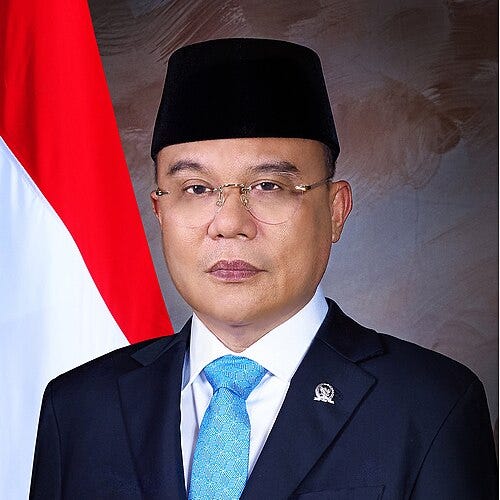
In a podcast released by investigative news agency Tempo to discuss Danantara in February 2025, a group of reporters likened Dasco to the operator of a “highway” within the Indonesian parliament who played a crucial role in fast-tracking the legislative approval to set up the new sovereign fund.
In Indonesia’s political and media circuit, some members of the parliamentary commission overseeing state-owned enterprises were nicknamed “Adidas” (Anak Didik Dasco), which loosely translated to Dasco’s disciples, according to the Tempo reporters.
Interconnected Problems
There are two major problems for Indonesia right now.
First, the linear thought pattern displayed by the policymakers so far may not fit the interconnected landscape. Right after he assumed his role in September 2025, Finance Minister Purbaya Yudhi Sadewa injected IDR 200 trillion (USD 11.8 billion) into the state-owned banks in the hopes of jumpstarting the economy.
He reportedly pumped another IDR 76 trillion in November 2025 after sluggish loan disbursements by the banks. Less than two months later, he took back IDR 75 trillion as the usage of the state funds was deemed “sub-optimal”.
The minister was perhaps disappointed that the liquidity boost did not translate into more meaningful loan growth.
However, there was simply not enough loan demand from cautious businesses, while the state-owned banks likely hesitated to lend to the weaker borrowers for fear of adding to their non-performing loans. I also wrote in July 2025 that these banks were under more pressure to upstream dividends and support their troubled peers.
The second major problem is the diminishing rule of law in the eyes of investors.
I wrote that the nationalist currents in Indonesia have been picking up pace since the president took office in October 2024, so the reported state seizure of the lucrative Martabe gold mine from the local unit of Hong Kong-based conglomerate Jardine Matheson Holdings in late January 2026 was a continuation of this trend.
However, the lack of legal basis for the move had unnerved investors and risked opening Indonesia up to a potential lawsuit. These factors likely compelled the government to reportedly review its decision to take over Martabe.
Apart from the disputed gold mine, a USD 1.67 billion China-backed dam in the North Sumatra province was also thrown into limbo following Indonesia’s move to revoke permits, South China Morning Post reported.

Jobless Youths
In February last year, I flagged that the wave of layoffs in Indonesia’s labour-intensive manufacturing sector risked dampening consumption. I also connected the indicators on the ground to infer that the economy was likely weaker than what the official data suggested.
Earlier this month, several economists questioned Indonesia’s 2025 GDP figures that showed the fastest growth rate in three years. The simple question is if the economy is doing so well, why are there so many jobless youths?
The Straits Times reported this week that Indonesia faces a “severe youth unemployment crisis”, as 21.6% of youth aged 15-24 years old are not in employment, education or training – compared with just 6.1% in Singapore.
Seemingly recognizing the risks from rising unemployment, the president reportedly met five of the nation’s leading businessmen – Prajogo Pangestu, Anthoni Salim, Franky Widjaja, Garibaldi Thohir and Sugianto Kusuma – on 10 February and asked them to help the government to create jobs.
A group of tycoons had also bought the low-yield “patriot bonds” issued by Danantara and will likely be asked to participate in more rounds.
The president appears to be leaning hard on these conglomerates to rejuvenate Indonesia’s economy, but this could be a tougher ask if the overall cake is not growing.