

📒 Quick Take: Indonesia’s Spinning Plates
Indonesia risks losing its hard-won credibility in the international markets if policymakers don’t change course soon.

Moody’s cut Indonesia’s rating outlook on concerns over policy stability under President Prabowo Subianto.
Restoring the confidence of international investors will likely require engaging them on policy substance rather than optics.

Indonesia risks losing its hard-won credibility in the international markets if policymakers don’t change course soon.
After Finance Minister Purbaya Yudhi Sadewa berated Citigroup economist Helmi Arman for not having a PhD during an interview with Bloomberg TV, I wrote on 4 February 2026 that “bombast is not a recognized currency in the global arena and investors can simply vote with their feet.”
The next day, Moody’s cut its outlook on Indonesia’s credit rating to negative from stable, citing concerns over policy stability under President Prabowo Subianto.
“The outlook change is driven by reduced predictability in policymaking, which risks undermining policy effectiveness and points to weakening governance,” the rating agency said.
“If sustained, the trend could erode Indonesia’s long established policy credibility, which has supported solid economic growth and macroeconomic, fiscal and financial stability.”
Rating agencies typically don’t immediately downgrade a sovereign because of the potential ramifications of such a move. So lowering the outlook serves as a warning that a full downgrade could be in store if nothing changes.
Yet when asked for his response, Coordinating Minister for Economic Affairs Airlangga Hartarto alleged that rating agencies lack an understanding of Indonesia’s policies.
The president’s free school lunch program and national cooperatives scheme are set to stimulate the economy, while the creation of sovereign fund Danantara last year would accelerate investments without tapping the state budget, according to Hartarto.
The minister’s comment is a head-scratcher because the agency that runs the free school lunch program reportedly struggles to cover the ballooning costs, while dividends from state-owned enterprises (SOEs) are being diverted from the state budget to Danantara.
Underscoring the erosion of Indonesia’s credibility, several economists openly questioned the veracity of the latest GDP data that showed the fastest growth rate in three years.
“One may wonder whether the (household spending) growth rate is still too high, given the sluggish labour market and reports of lower-than-usual tourism activities on top of the low tax collection,” Rizki Siregar, an economist at the University of Indonesia, told Reuters.

Juggling Operation
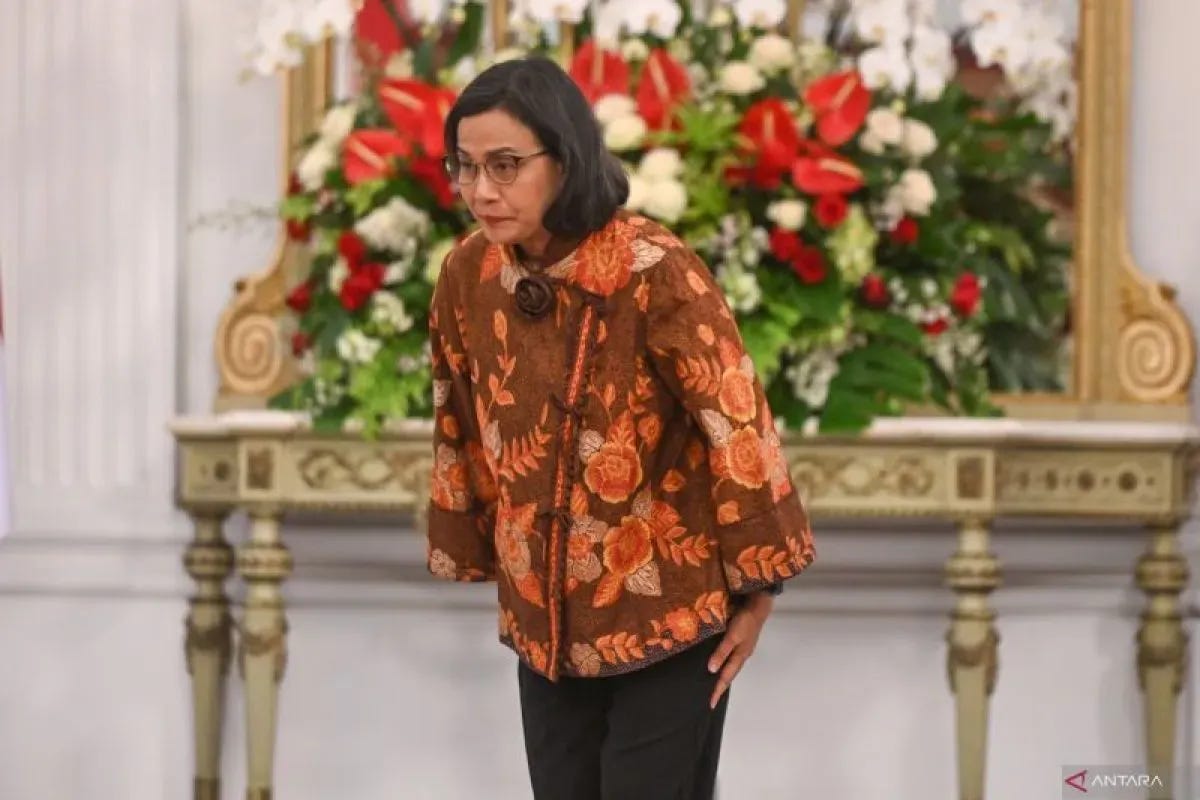
Former Finance Minister Sri Mulyani Indrawati wasn’t perfect, but she likely had the ‘systems thinking’ that would have allowed her to foresee how changing individual components risked triggering a cascade effect on other interconnected parts.
It’s like keeping multiple plates spinning in the air and trying not to drop any of them – yet the president’s decision to roll out the free school lunch program was akin to adding a heavy-duty pot to an already intricate juggling operation.
The former World Bank managing director would have calculated that raising the value-added tax rate from January 2025 was a necessary evil if her boss wanted to retain his signature program. However, the president reversed the hike at the 11th hour and announced that it would only apply to luxury goods.
The Finance Ministry also lost another source of income as Danantara had taken over the management of SOE dividends, so the option left was to step up enforcement on the tax collection.
Rolling back the free school lunch program could have eased Indonesia’s fiscal burden, but the president has shown a pattern of not being able to tolerate perceived weakness.
After her home was ransacked during the mass protests in late August 2025, Sri Mulyani travelled to the president’s country estate in Hambalang to submit her resignation, according to investigative news agency Tempo. However, the president reportedly refused to accept her resignation and told her that he would only do so under his own terms.
On 8 September 2025, Sri Mulyani exited as Finance Minister in a cabinet reshuffle. At the time, I wrote that the president’s camp had likely sought to seize the narrative as it became clear that she was serious about leaving. Yet an international news agency cited anonymous sources on her sacking and presented the fragment as if it was the entire picture.
Since then, Indonesia – which has long been vulnerable to fund outflows – is facing even more pressure as Moody’s latest statement is likely to compound investor concerns over the growing centralization, widening fiscal deficit and a potential MSCI downgrade.
Restoring the confidence of international investors will likely require engaging them on policy substance rather than optics.