

🤝🏻 Guest Take: Navigating Indonesia’s Blurred Lines by Richard Borsuk
The co-author of a highly-acclaimed biography of Salim Group’s founder shares his thoughts on Indonesia.

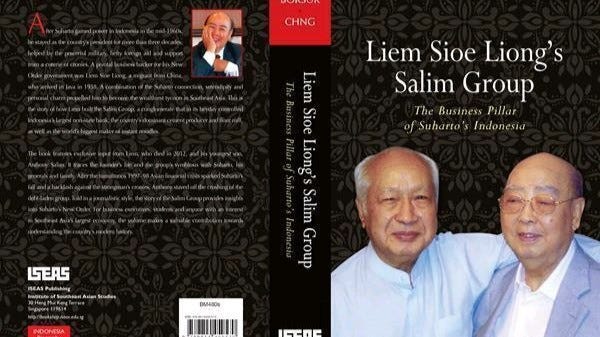
Acrostics Asia is delighted to share a Q&A with Richard Borsuk, co-author of Liem Sioe Liong’s Salim Group: The Business Pillar of Suharto’s Indonesia. This Q&A was first published on 5 July 2024.
The highly-acclaimed biography of Liem, the conglomerate’s late founder, is regarded as one of the best books on Indonesia’s modern history.
It took you eight years to finish the book. Can you describe the process and how you kept going? At which point did you decide that it was time to stop researching and finish the writing?
I’m responsible for the length of time. I naively thought it wouldn’t take too long to do my parts of the text, as I had reported on Indonesia for the Wall Street Journal for years, but I was way wrong.
During the research, co-author Nancy Chng and I learned many intriguing things, often through stimulating interviews. I enjoyed the research so much it was hard to stop that and get on with the drafting. Nancy finished her chapters long before I did.
We made 2011 a cut-off date for submitting the draft. But in June 2012, when the text was being edited, Liem died, so we took it back from the publisher to work in that and material on his legacy.
What kept me going? I had talked Nancy into doing a book together, and I rightly would have been in real hot soup if I didn’t deliver as promised. Our book was completely a joint venture – we brought knowledge about different topics. It can be stressful to write a book with your spouse because each has to edit the other. Fortunately, we got to the finish line – and we’re still married. Nancy has made very clear there will be not be a second joint project.
Did it surprise you that Anthoni Salim (Liem’s youngest son and current group boss) agreed to a series of on-the-record interviews and to your requirement that editorial control stay 100% with you and Nancy? In other words, he couldn’t read any of the text until it was published.
That’s correct. And that was essential for our book to be credible. Anthoni had long read my articles and knew I had no agenda, just wanted a factual story. This isn’t a coffee-table puff-piece of a book that says so-and-so is the greatest thing since nasi goreng. From what I see, no other conglomerate boss would agree with our condition that he couldn’t vet the draft.
In the book, Pak Anthoni likened doing business in Indonesia to the patterns of Batik, which has designs that are intricate and complex – not clear-cut like Burberry patterns. Do you have any advice on how to navigate Indonesia’s blurred lines?
There are often blurs, as Indonesia is complicated. For a reporter, don’t expect to get to the real bottom of why something happened, or who doesn’t like so-and-so because of friction 30 years ago.
Journalist or executive, you sometimes have to settle for quite a bit less than the full story.
It can be hard for potential investors to carry out deep due diligence on stakeholders or proxies in a project. Anthoni has the resources and patience to do it. He reads a lot and spends time talking to experts to get knowledge on a subject that initially might have been a blur.
In your opinion, has business changed significantly or basically stayed the same in Indonesia over the years?
Wah, that’s a big subject, and I haven’t spent enough time in Indonesia in recent years to have formed a clear opinion. My impression is that both statements could be valid. There seems to still be quite a bit of New Order Indonesia (pre-Suharto fall) in post-1998 Indonesia.
There’s still corruption, of course, and still governance and conflict-of-interest issues, plus too little transparency. These impede the building of cleaner, stronger institutions that would help Indonesia grow in a healthier way.
Lastly, do you have any tips for young professionals who are trying to make their mark?
I would never try to be a coach, except perhaps for writing. I would recommend that young people read non-fiction and quality media to deepen their knowledge and understanding of the increasingly complex and fast-changing world.