

📚 Acrostics Anatomy: Danantara’s Genesis
Indonesia created a new sovereign fund to pool state-owned enterprises and leverage up.

📒 Quick Take: Deciphering Danantara (11 November 2024)
📒 Quick Take: Is Danantara Indonesia’s New Debt Machine? (2 December 2024)
📒 Quick Take: Danantara’s Legal Umbrella (25 January 2025)
📒 Quick Take: Danantara’s Fast Track (16 February 2025)
📒 Quick Take: Indonesia’s Sovereign Halo Part 1 (9 February 2025)
📒 Quick Take: Indonesia’s Sovereign Halo Part 2 (11 February 2025)
💼 Brief Take: Danantara’s Launch (25 February 2025)
📒 Quick Take: Deciphering Danantara
11 November 2024
Indonesia is trying to set up its version of Singapore state investor Temasek Holdings.
Why the brains behind Danantara are going for a multiplier effect.
Indonesia has grabbed headlines by floating the establishment of Danantara, its version of Singapore state investor Temasek Holdings.
Friends in the market had a bunch of questions about this Indonesian-style Temasek: What’s the ultimate goal of Danantara? What will be the role of the State-Owned Enterprises (SOE) Ministry? What will happen to the existing sovereign wealth fund, Indonesia Investment Authority (INA)?
While details have been sporadic, the key points so far are the following:
At least seven of the biggest SOEs will be consolidated into Danantara: Bank Mandiri, Bank Rakyat Indonesia (BRI), Bank Negara Indonesia (BNI), Perusahaan Listrik Negara (PLN), Pertamina, Telkom Indonesia, and Mineral Industri Indonesia (MIND ID).
Muliaman Hadad, the former chairman of Indonesia’s financial regulator, was already appointed to head Danantara, while Minister of Investment and Downstreaming Rosan Roeslani and business tycoon Pandu Sjahrir are also reportedly set to be key officials.
SOE Minister Erick Thohir said that he supports Danantara and his ministry will focus on restructuring seven out of 47 SOEs that are still “sick”.
Many pieces of the puzzle were still missing until I stumbled upon this podcast by a team of reporters from Tempo, a respected Indonesian publication with a long history of breaking political news. If you understand Bahasa, I suggest listening to the 43-minute podcast yourself (I listened to it while clocking my steps yesterday).
Here’s my summary of the Tempo podcast:
Danantara’s grand design is to combine the assets owned by Indonesian SOEs to raise more funds for President Prabowo Subianto’s projects.
Hadad’s team has studied three potential structures for Danantara:
Devolved Funds – The SOEs will operate independently and make their own investment decisions, while Danantara only directs policies as a shareholder
Fund Clusters – There will be three investment clusters run by an SOE holding company, sovereign wealth fund and development banks, and their boards will come under Danantara
Merger – Everything will be merged into one fund with a consolidated balance sheet and asset base.
Options 2a) and b) offer greater transparency and professionalism for investors, but the leverage potential is more limited and the operations are less centralized. While 2c) allows Danantara to “orchestrate” the decision-making, its independence may come under question due to the higher risk for conflicts of interest.
Depending on which option is picked by the president, existing regulations – particularly those governing SOEs and state finances – may need to be revised to set up the “legal umbrella” for Danantara. Under the current law, state-owned shares in SOEs (Saham Dwiwarna) and the associated rights, such as appointing commissioners and directors, are held by the SOE Ministry. Transferring these shares to Danantara will therefore require a change to the law.
Revising the law will take time, so one of the suggestions floated by Hadad’s team is to use INA as a “shell” for Danantara. This is seen as a practical choice because the sovereign wealth fund already has a “solid” legal foundation and it currently holds some shares in state-owned lenders Bank Mandiri and BRI.
During the transition period, the SOE Ministry will still be needed for the next two to three years to handle the troubled SOEs. While Thohir has publicly backed Danantara, his ministry is reviewing its position given that it’s supposed to hand over its best assets to the new entity.
If Danantara is pitched as a professional organization, the state auditor’s role might be limited to investigating its projects that are deemed to be for public service. This could create room for “moral hazard”, according to the Tempo reporters.
Now these are my initial thoughts:
The brains behind Danantara seem to be going for a multiplier effect by leveraging up the combined SOE assets. With more favourable financial metrics, such as debt-to-asset or debt-to-equity ratios, Danantara can theoretically borrow more to support the president’s spending plan. Incurring debt at the corporate level may also be a way to get around Indonesia’s budget deficit ceiling of 3% of GDP.
If the SOE Ministry were left as a temporary restructuring house for troubled SOEs, its job could be even harder. The SOE ecosystem is not a bipolar one, where SOEs can be cleanly separated into “healthy” or “sick” companies. In reality, they are interconnected through a web of transactions, be it lending to each other or giving discounts for using certain state-owned goods and services. Some SOEs also could not pull off their debt restructurings without the support of the state-owned banks.
As a state-owned asset manager, can Danantara bifurcate commercial targets and public service obligations? As I wrote before, some PLN bondholders already had concerns that the state-owned utility is heavily reliant on “compensation income” or reimbursement from the government for setting electricity tariffs below its costs.
The formation of Danantara is one of the most important topics in Indonesia right now due to its potentially far-reaching consequences. There will certainly be more chapters in this saga.
📒 Quick Take: Is Danantara Indonesia’s New Debt Machine?
2 December 2024
Danantara is envisaged as a 3-in-1 entity comprising an SOE holding company, sovereign wealth fund and infrastructure development bank.
It was likely created to borrow more at the corporate level without busting the fiscal deficit ceiling.
Indonesia’s new president needs funding for his mega projects, but a planned value-added tax increase got a backlash.

Reading the news on the conception of Indonesia’s new investment body Danantara reminds me of the parable about the elephant and three blind men.
Each of them described the elephant’s leg, tail and trunk, respectively, and they were all partly right. How will these elephant parts come together to form a real elephant, though?
Indonesian investigative news agency Tempo reported last month that the team involved in the formation of Danantara was studying three potential structures, including the option of having three investment clusters run by a holding company for state-owned enterprises (SOEs), a sovereign wealth fund, and development banks.
I also wrote on 11 November 2024 that “the brains behind Danantara seem to be going for a multiplier effect by leveraging up the combined SOE assets.”
Last week, Danantara’s chief Muliaman Hadad told local media that it will have three pillars:
Asset management, which will consolidate the assets of SOEs.
Investment management under sovereign wealth fund Indonesia Investment Authority (INA), which will be “widened and optimized”.
Investment banking under state-owned banks and the Finance Ministry’s special mission vehicles, which will channel funds to infrastructure and other long-term projects.
Danantara plans to consolidate state assets to achieve a bigger economic scale, so leveraging them will be cheaper and more efficient, Hadad said, adding that leverage comes in various forms such as issuing bonds. In short, Hadad’s team seems to have picked the investment clusters option, at least for now, and Danantara’s game is to raise mega debt.
This is because President Prabowo Subianto needs funding for his mega projects, including free school meals, food and energy self-sufficiency, salary hikes for teachers, judges and farmers, as well as the construction of Indonesia’s new capital city Nusantara that was initiated by his predecessor Joko Widodo.
The government was initially set to hike the value-added tax (VAT) from 11% to 12% in January 2025, but may delay the implementation after a backlash from consumers. A plan to increase minimum wages by 6.5% next year also drew the ire of businesses, which complained that they were already struggling with rising costs.
The number of Indonesians classified as middle class fell from 57.33 million in 2019 to 47.85 million in 2024, according to data from the Central Statistics Agency (BPS). In short, Indonesia’s middle class is shrinking while labour-intensive manufacturing industries, such as textile and footwear, are facing a structural challenge that might lead to the disappearance of many lower-end jobs.
To bring some money into the state coffers, Indonesia is reportedly considering reviving the tax amnesty program (two rounds were rolled out by the previous government in 2016 and 2022, with each of them billed as the last chance for Indonesians to declare their hidden wealth to escape penalties).
There’s only so much balloon you can squeeze, so Danantara was likely conceived to borrow more at the corporate level without busting the fiscal deficit ceiling. It was scheduled to be officially launched by President Prabowo on 8 November 2024, but this was delayed so the Danantara team could set up its “legal umbrella”.
Last Friday (29 November 2024), Danantara’s officials submitted the draft presidential regulation (Peraturan Presiden) and government regulation (Peraturan Pemerintah) for its formation to the State Secretariat, its spokesman said. The leadership is also finalizing its organizational and operational structure, he added.
However, these regulations are weaker than the existing Indonesian laws (Undang Undang) governing SOEs and state finances, meaning that Danantara’s legal umbrella might not be able to withstand potential court challenges unless its officials work towards revising the laws.
Minority shareholders are also protected by the capital markets law, but publicly listed SOEs that will be consolidated into Danantara may only have to buy them out at fair market prices if there’s a change of control from the state or government of Indonesia.
If Danantara is really established and issues jumbo debt, the fresh supply could be good news for portfolio managers who are eager for more bond options coming out of Indonesia. But there’s still a big question mark hanging over Danantara, which is why credit analysts and rating agencies tracking the SOEs might be at a loss on what to update their clients beyond the fact that they are monitoring the situation.
They will also have to figure out how to rate an entity that’s supposed to be an SOE holding company, sovereign wealth fund and infrastructure development bank all at once.
A typical option will be to peg Danantara a couple of notches below the sovereign rating, but this could be contentious given that the investment body was likely created to get around Indonesia’s fiscal limits and increase borrowings off the government’s balance sheet.
One thing’s for sure: The market is waiting for Danantara’s shape and form to become clearer in the new year.

📒 Quick Take: Danantara’s Legal Umbrella
25 January 2025
Indonesia’s Deputy Finance Minister Thomas Djiwandono said Danantara’s launch was delayed because the president wants a “clearer regulatory framework”.
SOE Minister Erick Thohir said the parliament is proposing a revision to the SOE law to pave the way for the establishment of Danantara.

Danantara – Indonesia’s touted version of Singapore state investor Temasek – was announced to the world with fanfare last year, but the headlines gradually fizzled out as its official launch kept being pushed back.
When asked about the reason for the delay, Deputy Finance Minister Thomas Djiwandono told a conference in Jakarta last week that President Prabowo Subianto wants a “clearer regulatory framework” for Danantara and its formation is “more complicated” than expected.
Djiwandono – who’s the nephew of the president – did not specify the legal aspect, but said that the issue is not the transfer of assets because from the Finance Ministry’s perspective, it has all along given the authority to manage assets to state-owned enterprises (SOEs) and it just has to transfer that authority to Danantara.
At the same event, Djiwandono said that Danantara’s aim is to pool SOE assets and seek investors, such as from Abu Dhabi and Qatar, for a project or an existing business. “The point is we have such diverse (assets), why don’t we combine these commercial things to create a huge strength so it can be leveraged,” he said.
Danantara’s raison d’etre is pretty clear by now. As I wrote in November 2024, the architects of Danantara were likely gunning for a multiplier effect so they can fund the president’s spending plans.
If there are limits to how much the state can borrow and each SOE has incurred its own debt, Danantara’s blueprint is probably to put the most attractive SOEs together and leverage up that collective basket. On paper, a bigger economic scale should translate to a cheaper cost of funds.
So what’s exactly holding up Danantara’s formal establishment?
I warned in December 2024 that to create a solid legal umbrella, Danantara’s architects may have to revise the existing Indonesian laws (Undang Undang), particularly one that governs SOEs. These are fundamental laws that are higher than government regulations (Peraturan Pemerintah) or presidential regulations (Peraturan Presiden) in Indonesia’s legal hierarchy.
In a nutshell, if Danantara’s legal foundation is weaker than Undang Undang, then the people who are responsible for it might become vulnerable to potential attacks in future. It boils down to who would actually be willing to put their necks on the line.
The latest news indicates that Danantara’s architects would rather be safe than sorry. SOE Minister Erick Thohir told reporters this week that the parliament is proposing a revision to the SOE law (Undang Undang Badan Usaha Milik Negara) to pave the way for the establishment of Danantara.
The draft law will lay out the organizational structure and management of Danantara, Thohir said, adding that it was the initiative of the parliament, not his ministry. It’s unclear how long it will take, but the parliamentary commission overseeing SOEs (Komisi VI) said that it will accelerate the discussion of the bill.
What’s the likelihood that Danantara will clear the hurdles and come into being?
Two friends briefed on the matter said that the president’s camp recognized that the money for his ambitious projects has to come from somewhere – and as I pointed out, Danantara was designed precisely to be Indonesia’s new debt engine.
When there’s a will there’s a way, though I’d still caution that anything can happen in Indonesia.
📒 Quick Take: Danantara’s Fast Track
16 February 2025
A revision of Indonesia’s SOE law to set up Danantara was accelerated through the Parliament.
The SOE Ministry managed to keep some powers, but the Finance Ministry lost the most authority, according to local investigative publication Tempo.

The establishment of Danantara – a new Indonesian superfund supposedly modelled after Singapore’s Temasek – was fast-tracked through the Parliament at an astounding speed. A lengthy process that could take years in normal times was cut short to a mere three days thanks to a “highway” within the House of Representatives (DPR).
Local investigative publication Tempo dropped an insightful podcast yesterday that discussed the accelerated revision of a law governing state-owned enterprises (SOEs), which set the legal foundation for Danantara.
The behind-the-scenes maneuvering that was reported by the Tempo team is reminiscent of the Javanese Game of Thrones (Game of Keratons?), but I’ll just summarize the key points:
In the initial proposal, the SOE Ministry would have been reduced to a “toothless regulator” as the powers over the SOEs were set to be concentrated in the hands of Danantara.
SOE Minister Erick Thohir sent his deputies – Kartika Wirjoatmodjo and Dony Oskaria – to initiate discussions with a parliamentary commission overseeing SOEs (Komisi VI) and push for the SOE Ministry to retain some authority. These talks also involved DPR Deputy Speaker Sufmi Dasco Ahmad.
The parliamentary commission agreed with the SOE Ministry that there should be some checks and balances on Danantara, otherwise the new body risks becoming an untouchable “superpower”.
The compromise is for Danantara to manage SOEs and the SOE Ministry to act as the regulator, while the appointment and termination of commissioners and directors will be submitted to the President for his approval.
The SOE Ministry managed to keep some powers, but the Finance Ministry lost the most authority with the revision to the SOE law, save for having a representative on Danantara’s supervisory board and being in a “rescue committee” for troubled SOEs.
SOE dividends – which are estimated to reach IDR 90 trillion (USD 5.5 billion) this year – will no longer automatically flow to the state budget as they will be managed by Danantara. In return, these SOEs cannot ask for a capital injection from the Finance Ministry anymore, unless they are assigned a specific task such as building toll roads in Sumatra.
According to Tempo, the key players being lined up to run Danantara are Investment Minister Rosan Roeslani (slated to replace current Danantara head Muliaman Hadad), coal and tech tycoon Pandu Sjahrir (who may lead the investment arm), and Deputy SOE Minister Dony Oskaria (potentially in charge of the operations).
These are my thoughts based on Tempo’s latest reporting:
How will the Finance Ministry deal with the loss of SOE dividends, which have thus far contributed a significant portion to the non-tax state revenue? A recent value-added tax hike already stoked public backlash, while the tax office has reportedly allowed taxpayers to return to an old system after the new “Coretax” crashed.
A traditional Javanese kingdom is built on a delicate act of balancing different and competing interest groups. Now that the stage and the players have been assembled, will they move by design?
📒 Quick Take: Indonesia’s Sovereign Halo Part One
9 February 2025
The decoupling of SOE and state losses would be positive if state-owned banks can deploy capital to better borrowers or more productive sectors.
But it also raises questions among investors and lenders on who will be responsible for SOE losses.

Indonesia has overhauled a law governing state-owned enterprises (SOEs), giving birth to Danantara – a new investment fund inspired by Singapore’s Temasek – along with questions on how SOEs will operate from now on.
I’ve written since November 2024 about the reason for Danantara’s existence, the gameplan for the fund, and why its architects had to amend the existing SOE law to lay its legal foundation. I also flagged last month that the establishment of Danantara was picking up pace after a delay.
So when the Indonesian parliament passed the law on Tuesday (4 February 2025), I wasn’t surprised and I went on doing my own thing. But over the weekend, one of my friends sent me an article that reported a key point: Clause 4B in the latest SOE law states that “profits or losses incurred by SOEs are the profits or losses of the SOEs.”
“The capital and wealth (modal dan kekayaan) of SOEs belong to the SOEs and all the profits or losses incurred by the SOEs are not the profits or losses of the state,” the clause said.
An editor at local newspaper Kontan wrote, citing a legal practitioner, that the revision to the SOE law seems to encourage officials to be “bolder in making decisions and not be intimidated by the prospect of state losses.”
Why is this significant?
All along, SOE officials have been operating in fear of being accused by the state auditor of realizing state losses, which may even lead to criminal prosecution. As I wrote last year, state-owned bankers preferred rolling over defaulted loans rather than taking principal haircuts, especially if they inherited legacy credit from their predecessors.
So the decoupling of SOE and state losses would be positive if these state-owned banks can now write off the zombie loans in their books and deploy the capital to better borrowers or more productive sectors. However, the flip side is it raises questions among investors and lenders on who will be responsible for SOE losses.
First of all, there seems to be a misperception that the government provides a blanket backstop to all SOEs.
The reality is all SOEs are equal, but some are more equal than others. The first offshore bond with a direct guarantee from the government was issued in 2020 by Hutama Karya, which is building the Trans-Sumatra toll road – a key project in former President Joko Widodo’s infrastructure drive.
Many investors believe that energy company Pertamina and power distributor Perusahaan Listrik Negara (PLN) are strategic SOEs and the government will never let them default. Even though some of their debt may not carry any government guarantee in black and white, these SOEs have been able to raise billions of dollars from the market because of what a second friend calls the “sovereign halo”.
With the creation of Danantara, rating agencies will also have to decide how to assess this entity if it issues debt at the holding company level. As I pointed out in December 2024, the typical option of pegging certain SOEs below the sovereign rating may not work if Danantara’s debt is classified outside the government’s balance sheet.
Now that the SOE law has been passed, lawyers and analysts will likely get calls on the potential implications.
📒 Quick Take: Indonesia’s Sovereign Halo Part Two
11 February 2025
Indonesia’s latest SOE law may help state-owned banks to unclog their bad loans, but independent asset pricing is key to attract private investors.
Some investors question how Indonesia’s regulatory changes will affect SOE leverage and governance.

Indonesia’s revised law for state-owned enterprises (SOEs) has generated a lot of discussion, with some calling it a potential game-changer.
Apart from laying the foundation for Danantara, the so-called Indonesian Temasek, the amended law also decoupled SOE and state losses. While this could remove the Sword of Damocles that’s been hanging over state-owned banks, there might also be unintended consequences for key SOEs like power distributor Perusahaan Listrik Negara (PLN) and energy company Pertamina.
I’ve collected the feedback from friends and commenters so far into two buckets.
🏦 State-Owned Banks
If state-owned banks can recognize losses without the threat of a criminal prosecution for the officials involved, this could hopefully encourage them to fix the problem instead of sweeping it under the rug.
To use the analogy of a banker who stuffed bad loans into a suitcase that grew bigger and bigger, the hard work going forward is to open that suitcase and sort through the baggage.
I wrote last year that based on South Korea’s post-Asian Financial Crisis experience, transparency around asset quality and pricing is key to creating a secondary market where bad loans can be traded on a commercial basis. One of the commenters also pointed out that Thailand is an example of how a market for non-performing loans can develop.
In Indonesia, the first step to clean up the system is to catalogue the SOE losses and then transfer the distressed assets or loans to state-owned asset manager Perusahaan Pengelola Aset (PPA), a second commenter said, noting that independent appraisal and valuation would be needed to attract bids from private financiers and investors.
Even if PPA was designed to be the cleaning house for distressed SOE assets, it would likely be overloaded by the sheer volume, so the private market should also be allowed to function.
However, a veteran banker friend cautioned that the market mechanism would simply be an “illusion” if there’s only a shallow pool of bidders and the auction ends up being engineered among a group of friends. In short, there must be enough real bids for the SOE assets.
⚡ PLN & Pertamina
Indonesia has a parallel with China, where investors have been trying to read the tea leaves on which SOEs or local government financing vehicles (LGFVs) are supposedly closest to the sun. The true test of whether the firefighters will come or not is for an actual fire to break out, but nobody wants that to happen.
While the Indonesian government is required to cover the operational shortfall incurred by PLN and Pertamina to fulfill their public service obligations, this is not the same as guaranteeing their financial debt.
I wrote last week that many bankers and bondholders have lent to PLN and Pertamina on the belief that they are strategic SOEs whose debt is implicitly backed by the state. In short, these creditors are betting that both SOEs are too big to fail and the Indonesian government will step in to prevent any default.
Without government subsidies and compensations, PLN would have made a loss of IDR 120 trillion (USD 7.3 billion) for its 2023 fiscal year, according to an analysis by the Institute for Energy Economics and Financial Analysis (IEEFA). There’s always been a push-and-pull between commercial and public service goals, but this tension could be even more pronounced if PLN ends up being consolidated into Danantara.
A buyside friend said there are concerns about how Indonesia’s regulatory changes will affect SOE leverage and governance, but there is “not much clarity at the moment.” PLN will likely have to field questions from bondholders on the strength of its state backing, as it is reportedly preparing to sell as much as USD 1.5 billion of notes.
While the latest SOE law may help state-owned banks to unclog their bad loans, PLN and Pertamina may also face more scrutiny from investors. It remains to be seen what the net effect will be.
💼 Brief Take: Danantara’s Launch
25 February 2025
Acrostics Asia’s Founder Eveline Danubrata was interviewed by BBC Chief Presenter Steve Lai about the launch of Indonesia’s new sovereign fund Danantara.
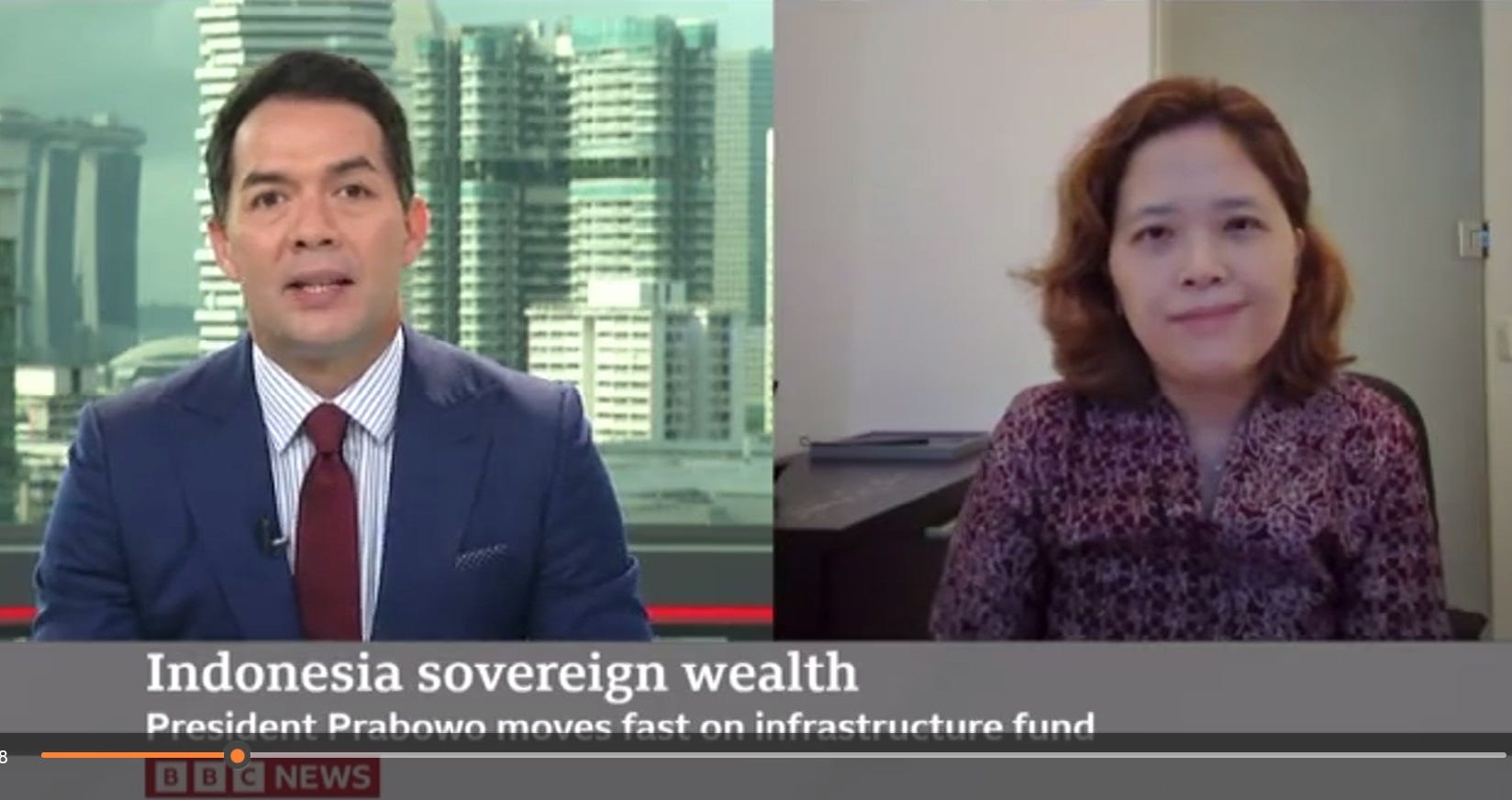
Eveline’s Take:
🔸 Danantara – which was pitched as Indonesia’s version of Singapore state investor Temasek – aims to consolidate state-owned assets and leverage them to fund President Prabowo Subianto’s projects.
🔸 The scale of Prabowo’s ambitions and the speed at which he’s trying to achieve them are the hallmarks of his presidency, but he needs to balance his vision with the commercial reality. Prabowo said Danantara will manage assets worth USD 900 billion – that’s comparable to the amount managed by Singapore sovereign wealth fund GIC, which is a lot more established and has a longer track record.
🔸 On paper, it makes sense to consolidate the fragmented state assets and attract investments to grow the domestic economy. However, governance and independence from political intervention are crucial to build investor confidence in Danantara. Investors wouldn’t want Danantara to become a cash cow for political purposes.
🔸 The president’s drastic budget cuts have drawn criticism and sparked protests on the streets. To understand the source of this discontent, imagine an Indonesian civil servant coming to work to find out that the toilet rolls have been rationed and the office lights are dimmer than usual – and that part of those cuts will fund Danantara.