

📚 Acrostics Anatomy: Danantara’s Bridge to Bonds
The Indonesian sovereign fund is building its capital structure to include loans and bonds.

💼 Brief Take: Danantara’s Jumbo Loan (27 June 2025)
📒 Quick Take: Danantara’s Topsy Turvy Loan Debut (9 July 2025)
📒 Quick Take: Danantara’s Middle Ground (15 July 2025)
💼 Brief Take: Danantara’s Patriotic Pitch (27 August 2025)
📒 Quick Take: Indonesia’s SOE Supremo (30 September 2025)
📸 Snapshot: Indonesian SOE Ratings (4 October 2025)
🔮 Indonesian SOEs 2026 Outlook: Danantara (20 November 2025)
💼 Brief Take: Danantara’s Sovereignty (4 December 2025)
💼 Brief Take: Danantara’s Jumbo Loan
27 June 2025
A USD 10 billion unsecured loan might seem like a bold ask, but it’s in keeping with the mentality of Indonesian SOEs.
If requesting security or a government guarantee is a tall order, potential lenders may consider narrowing the use of proceeds or backing a specific project.

Indonesia’s new sovereign fund Danantara Indonesia is looking to make its loan debut with a jumbo borrowing of up to USD 10 billion, IFR reported on 27 June 2025. The loan will be unsecured and will not carry any guarantee nor come with letters of comfort or support from the government.
Eveline’s Take:
🔸 A USD 10 billion unsecured loan might seem like a bold ask, but it’s in keeping with the mentality of Indonesian state-owned enterprises (SOEs). A friend who often deals with Indonesian SOEs said that if potential lenders ask for security, some officials may get offended because they believe that their sovereign association should count for something.
🔸 I wrote last year that Danantara was likely designed to leverage up but prospective lenders may push back if the debt is classified outside the government’s balance sheet. I also pointed out in February 2025 that the revision of Indonesia’s SOE law had the effect of decoupling SOE and state losses, meaning that it’s unclear who will be responsible for those losses.
🔸 Danantara has asked banks to provide underwritten commitments as well as proposals on an uncommitted basis, IFR reported. This sounds like Danantara believes it should be a prime asset but is not entirely sure if the market can see that too, so it’s outsourced the price exploration to the banks.
🔸 The banks might be put in an uncomfortable position where they don’t know how low is too low and how high is too high, while trying to avoid offending a sovereign fund. It’s common for bankers to use a loan piece as an entry point, so they can build the relationship with the borrower and sell other services in future. It’s a free market, but potential lenders should also walk into this with their eyes open.
🔸 In 2021, a group of banks had to accept Indonesian state-owned plantation company Perkebunan Nusantara (PTPN)’s USD 390.6 million syndicated loan extension by up to eight years as they were unsecured. These banks were restricted from taking PTPN’s assets as collateral during the loan syndication due to a negative pledge in the SOE’s earlier financing from the World Bank. A restructuring deal was also a prerequisite for PTPN to receive around IDR 4 trillion (USD 247.2 million) of state capital.
🔸 Danantara’s officials have sought to assure the international community of their corporate governance. Most bankers are likely to negotiate in good faith, though they may also seek to protect themselves in case anything goes bad. If requesting security or a government guarantee is a tall order, potential lenders may consider narrowing the use of proceeds or backing a specific project.
📒 Quick Take: Danantara’s Topsy Turvy Loan Debut
9 July 2025
Danantara appointed four banks to coordinate its USD 10 billion borrowing after sending a request for proposals, but the usual process is for the leads to soft-sound other banks first.
The Indonesian sovereign fund will likely get something from the banks, but the negotiations may revolve around the safeguards for the lenders.
Danantara Indonesia’s loan debut seems a bit topsy turvy.
The Indonesian sovereign fund has appointed DBS, HSBC, Natixis and Standard Chartered to coordinate a multicurrency borrowing of as much as USD 10 billion, Bloomberg reported. This came after Danantara sent a request for proposals (RFP) to regional and international banks for the loan, which will carry tenors of around three to five years.
The usual practice is for the leads to soft-sound other banks on their appetite, preferred structure and pricing expectation before sending a formal RFP. This pulse check is designed precisely to avoid the situation that Danantara is in right now: Given that the unsecured USD 10 billion figure is already out of the bag, any move to significantly downsize the loan or backpedal may affect the borrower’s reputation in the market.
Perhaps some benefit of doubt can be given to the Danantara team as this is their maiden borrowing, but the key concern for some bankers is the lack of security or guarantee from the government for the loan.
I wrote in December 2024 that a typical option would be to peg the debt issued by an SOE to the sovereign with an adjusted pricing (a five-year Indonesian sovereign bond is currently yielding around 6.2%). Even though their debt may not carry any black-and-white guarantee, strategic SOEs like Pertamina and Perusahaan Listrik Negara (PLN) were able to raise billions of dollars thanks to their perceived state backing – or what my friend calls the “sovereign halo”.
In this case, Danantara is seeking to raise a jumbo loan several months after it was launched under Indonesia’s revised SOE law, which states that losses incurred by SOEs no longer count as state losses. The establishment of Danantara was also fast-tracked through the Parliament, with the Finance Ministry losing the most authority in the process, Tempo reported.
The bankers are likely hoping for any sort of comfort letter that can assure their credit committees – which are understandably more cautious given the latest headlines on another country’s wealth fund – that Indonesia will backstop Danantara in case anything goes wrong.
Dividend Squeeze
Apart from the unsecured status, the loan will be for general corporate purposes and mature in three to five years. This means that to repay the loan, Danantara will either have to squeeze the SOEs under it for dividends or borrow more for refinancing – or both.
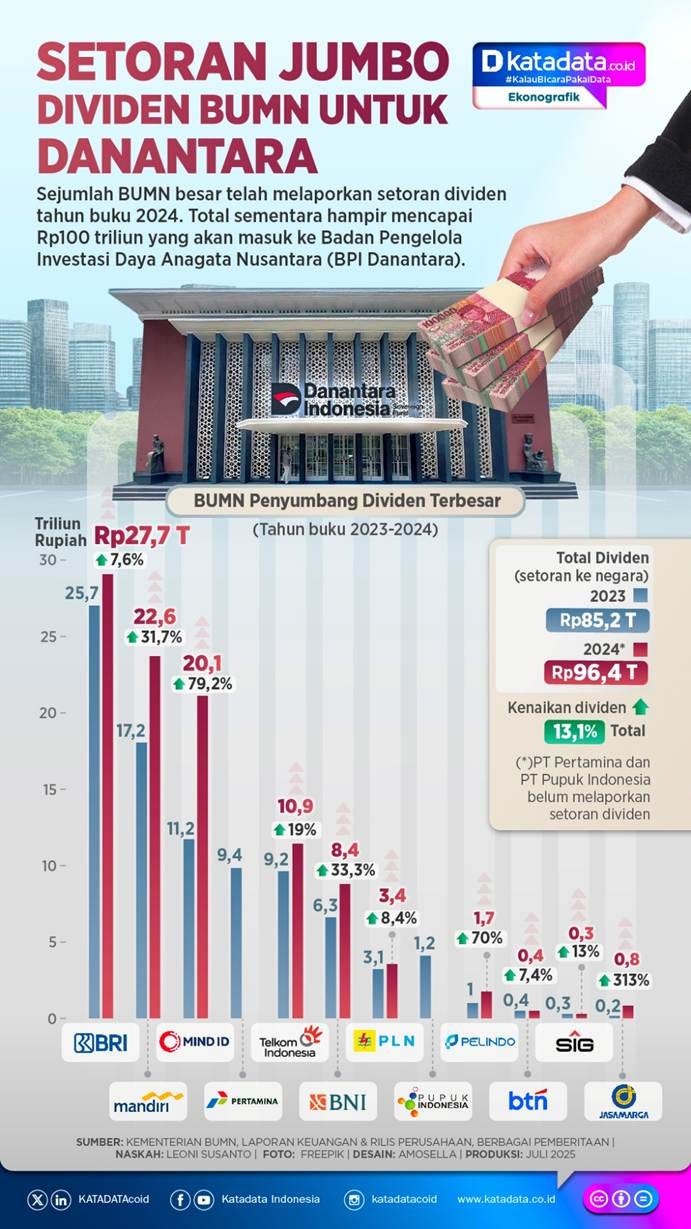
As of June 2025, 10 SOEs had contributed a total of IDR 96.4 trillion (USD 5.9 billion) for the 2024 financial year, up 13% from the dividend collection a year earlier, Katadata reported.
The top contributors were state-owned lenders Bank Rakyat Indonesia (BRI), Bank Mandiri and Bank Negara Indonesia (BNI), mining holding company MIND ID, energy giant Pertamina and electricity distributor PLN.
Risk Calculations
However, the SOEs also have their own funding needs to sustain their operations. Pertamina and its shipping arm, for example, are seeking an offshore loan of around USD 700 million to build vessels, Bloomberg reported. They are likely to face more questions from potential lenders on whether their debt servicing capability will be affected by their duty to upstream dividends to Danantara.
The calculations for banks may not be limited to a particular loan, as they may consider the potential of getting other business streams from the borrower. It’s logical for Danantara to tap the bond market after getting loans in its capital structure, as bondholders are typically more receptive if the banks are already in the picture.
While this presents an opportunity for the banks to earn some fees from marketing Danantara’s future bonds, the perceived credit risk that comes with participating in the jumbo loan right now is not a trivial matter.
Danantara will likely get something from the banks, but if an explicit support from the government is not forthcoming, then the negotiations may revolve around the loan structure, use of proceeds, or other safeguards for the lenders.

📒 Quick Take: Danantara’s Middle Ground
15 July 2025
Indonesian sovereign fund Danantara’s loan arrangement is probably seen by the banks as a pragmatic middle ground for now.
The lead banks likely committed to an initial round of USD 3 billion, while aiming to raise the remainder over the next three years.
Indonesian sovereign fund Danantara’s loan arrangement is probably seen by the banks as a pragmatic middle ground for now.
Danantara would likely draw down an initial amount of USD 3 billion from a USD 10 billion credit line for investments including a chemical plant and co-financings with the wealth funds of Qatar and China, Reuters reported on 11 July 2025, citing two sources with direct knowledge of the matter. The USD 10 billion credit facility will be available for the next three years, according to one of the sources.
Even though it was reported as a USD 10 billion credit line, the reality is no banks would underwrite such a huge unsecured loan right off the bat. The lead banks likely committed to an initial round of USD 3 billion, while aiming to raise the remainder over the next three years, depending on the available projects and the buy-in from more lenders.
I flagged on 27 June that the banks may get around the lack of government guarantee by narrowing the use of proceeds or backing a specific project. I also noted on 9 July that Danantara’s loan debut seemed a bit topsy turvy as it appointed the leads after sending the request for proposals, instead of the other way round.
Nevertheless, I wrote that Danantara was likely to get something from the banks as they would consider the potential of winning other business streams beyond the underlying credit, such as advisory services and marketing future bonds.
Loan Anchors
Danantara will reportedly tap the USD 3 billion loan to finance Indonesian petrochemical manufacturer Chandra Asri Pacific’s chlor-alkali and ethylene dichloride plant, as well as to jointly invest with Qatar Investment Authority (QIA) and China Investment Corporation (CIC).
Indonesian billionaire Prajogo Pangestu’s Chandra Asri is a relatively well-regarded borrower with a tangible project that’s aligned with the national priorities, while QIA and CIC are two of the biggest sovereign wealth funds with deep pockets and international stature. In short, anchoring Danantara’s USD 3 billion round to these names may have made it an easier sell to some credit committees.
To raise the remaining USD 7 billion, the leads would likely have to syndicate the loan to a wider group of banks and build a so-called bridge to bonds.
While Indonesian state-owned enterprises (SOEs) such as energy giant Pertamina and electricity distributor Perusahaan Listrik Negara (PLN) are a known quantity in the debt markets, Danantara was only set up five months ago as a holding entity overseeing the SOEs.
Danantara may have to establish its credit profile and repayment track record overtime, so the subsequent loan tranches for the fund will likely be tied to specific projects or the fulfilment of certain conditions.
Pitching an Indonesian credit to bondholders is also a different ball game now, as they are likely to scrutinize the borrower and ask more questions to avoid holding the bag for the banks if it goes south.
Headline Number
A common question is why not raise USD 3 billion first and gradually add to the borrowings, rather than leaping out of the gate with a USD 10 billion ask and getting stuck with this headline figure?
The likely answer is because Danantara CEO Rosan Roeslani already made headlines by assuring President Prabowo Subianto – who visited the fund’s office building on 30 June alongside Vice President Gibran Rakabuming Raka and various ministers – that it was set to secure USD 10 billion from foreign banks this month.
“That confidence (from foreign banks) is very, very extraordinary and we are also exploring several other partnerships and sources of funding,” Roeslani said in a statement.
Pulling off a USD 3 billion maiden loan is a significant step for Danantara, but the real test would be the fund’s ability to scale its borrowings from the international markets.
💼 Brief Take: Danantara’s Patriotic Pitch
27 August 2025
Indonesian sovereign fund Danantara has moved fast to build its capital structure.
President Prabowo Subianto’s government is seeking to rekindle the patriotic spirit by asking local tycoons to buy Danantara’s low-yield bonds.
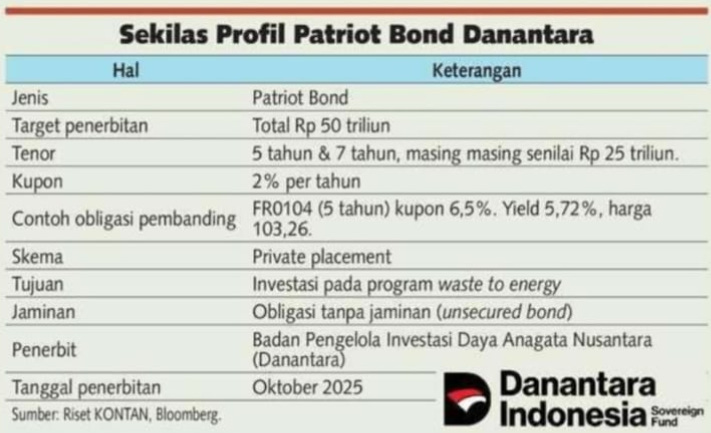
Indonesia’s new sovereign wealth fund Danantara has sounded out investors on a plan to raise IDR 50 trillion (USD 3.1 billion) by selling so-called patriot bonds at below-market yields, Bloomberg reported on 26 August 2025.
Eveline’s Take:
🔸 Half a year since it was officially established, Danantara has moved fast to build its capital structure. “National-scale projects demand diversified financing. Funds come not only from the dividends of state-owned enterprises, but also bank loans, co-investments with other investors, and many other possibilities,” the fund wrote in its “Danantara Diaries”.
🔸 I wrote in November 2024 that Danantara was designed to pool Indonesian state-owned enterprises (SOEs) and leverage up to fund President Prabowo Subianto’s projects. Last month, Danantara appointed DBS, HSBC, Natixis, Standard Chartered and United Overseas Bank to arrange a USD 10 billion unsecured loan, Reuters reported.
🔸 The drawdown of the loan is likely tied to specific projects and the fulfilment of the agreed conditions. While Danantara is set to tap SOE dividends to service the loan, I wrote in July that the fund would have to expand its base of lenders and construct a bridge to bonds for potential refinancing. However, I flagged that some offshore bondholders may ask tougher questions to Indonesian issuers including Danantara.
🔸 Enter the Indonesian tycoons. Danantara wrote in its diaries that even though the coupons of the patriot bonds are below market rates, the structure reflects the bond’s purpose. “It’s like impact-first funds: those willing to sacrifice returns if it pushes their cause forward. But impact investors understand that once the payoff arrives, it will dwarf the sacrifice.”
🔸 The concept of “gotong royong” – described by Danantara as “the tradition of communities working together toward a shared goal” – is not new. Former President Suharto once invited around 30 business leaders, including Salim Group’s late founder Liem Sioe Liong, to his Tapos ranch near Bogor in March 1990, according to a book authored by Richard Borsuk and Nancy Chng.
🔸 At the ranch (which included a cattle breeding station and a go-kart track), Suharto addressed the thorny subject of the widening income disparity in Indonesia and urged the tycoons to take concrete action to help narrow this gap, Borsuk and Chng wrote.
🔸 Three decades later, Indonesia’s current president who was Suharto’s son in law, Prabowo, is seeking to rekindle that patriotic spirit. The Indonesian government met a group of tycoons on 23 August to brief them about the bonds and some of them agreed to invest IDR 2 – 3 trillion (USD 122 – 183.5 million) each, The Straits Times reported.
📒 Quick Take: Indonesia’s SOE Supremo
30 September 2025
Indonesian sovereign fund Danantara controls the restructurings and consolidations of the country’s sprawling SOEs.
However, it may eventually run into a similar challenge faced by state-owned asset manager PPA to resolve the underlying bad debt.

Indonesian sovereign fund Danantara reigns supreme over the operations of the country’s state-owned enterprises (SOEs), with overarching control of their restructurings and consolidations.
On 26 September 2025, Indonesian lawmakers agreed to dissolve the SOE Ministry and replace it with a regulatory agency (BPBUMN). This agency will retain the government’s 1% “golden share” in the SOEs, while Danantara holds the remaining 99% and acts as the operator, the Jakarta Globe reported.
SOE Minister Erick Thohir – who was first appointed to the position by former President Joko Widodo in 2019 – was reassigned to the Youth and Sports Ministry. Danantara’s Chief Operating Officer who was previously Thohir’s deputy, Dony Oskaria, will be the acting head of the SOE Ministry during the transition period.
When the SOE law was revised in February 2025 to create the legal foundation for Danantara, the profits and losses incurred by the SOEs were decoupled from the state. Since then, the SOEs have directly upstreamed dividends to Danantara, which determines how to distribute these funds.
Oskaria said in June that the SOEs will no longer receive a state capital injection (penanaman modal negara) from the Finance Ministry because state-owned assets are now managed by Danantara. If the SOEs need support from the government, this will come from Danantara instead of the state budget.
Danantara is set to accelerate the restructurings of SOEs including flag airline Garuda Indonesia and steel maker Krakatau Steel, on top of consolidating state-owned builders and the subsidiaries of energy giant Pertamina, Oskaria told local media.
I wrote last week that a potential merger between Garuda and Pertamina’s aviation unit, Pelita Air, is likely driven by the need to pool plane components amid an industry-wide shortage. Despite the resistance from some politicians, Oskaria reportedly said on 29 September that the merger will go ahead.
The state-owned airline consolidation has been included in Danantara’s “working plan” this year, according to Oskaria. He sought to assure members of a parliamentary commission overseeing SOEs that the merger with Garuda should not drag down Pelita Air’s service quality.
PPA Precedent
In the previous administration, Indonesian state-owned asset manager Perusahaan Pengelola Aset (PPA) spearheaded the restructurings and the clean-up of distressed debt in the SOE sector. However, PPA became less active under President Prabowo Subianto, as Danantara has firmly taken over the role of turning around the SOEs.
Danantara’s goal to slim down the number of SOEs from as many as 1,050 to around 200 companies should help to reduce business overlaps and pool resources more effectively. But the fund may eventually run into a similar challenge faced by PPA to resolve the underlying bad debt.
PPA was supposed to take the non-performing loans (NPLs) off the state-owned banks while being funded by the same banks. This means that its operating model was effectively circular unless it could attract third-party investors or recover the soured loans.
In 2021, PPA tested the market for a potential offshore bond – out of which around IDR 2.3 trillion (USD 137.8 million) would be allocated for refinancing – but the asset manager had to shelve the issuance because investors questioned how it would actually make money.
Indonesia is not alone, as China is also trying to figure out how to clear its unpaid bills. I wrote on 12 September that getting the state-owned banks to absorb the NPLs in China’s property sector could create another problem down the road if there’s no market mechanism for bad debt to exit the system.
As the boss of Indonesia’s SOEs, one of the most challenging tasks in Danantara’s clean-up operation is deciding who should take the biggest hit, but this would likely take an extraordinary level of commitment.
📸 Snapshot: Indonesian SOE Ratings
4 October 2025
Fitch’s affirmation of Indonesian state-owned telco Telkom shows how the rating agency views the SOE framework under new sovereign fund Danantara.
Telkom doesn’t have the structural protections to ringfence its cash or assets, so it must follow any order to upstream dividends to Danantara.
Fitch’s latest affirmation of Indonesian state-owned telco Telekomunikasi Indonesia (Telkom) might seem like a routine step, but it indicates how the rating agency views the SOE framework under the new sovereign fund.
I previously wrote that Danantara – which was officially established in February 2025 – reigns supreme over the operations of the country’s sprawling SOEs. These companies directly upstream dividends to Danantara, which decides how to allocate the pooled funds.
On 3 October 2025, Fitch affirmed Telkom’s long-term foreign and local-currency issuer default ratings (IDR) at ‘BBB’, with a stable outlook. Let’s unpack Fitch’s take on Telkom.
Rating Cap
Fitch: “Telkom’s ratings continue to be constrained by those of the Indonesian sovereign (BBB/Stable) due to their close linkages and absence of restrictions that limit cash and asset flow from Telkom to the government, as assessed under Fitch’s Government-Related Entities (GRE) Rating Criteria. We “look through” the direct owner, Indonesia’s new sovereign wealth fund, Danantara, in applying the criteria.”
“Telkom’s Standalone Credit Profile (SCP) of ‘a-’ reflects its dominant market position in both fixed broadband and mobile service and conservative financial profile.”
“Telkom’s SCP is stronger than Indonesia’s sovereign rating. The company’s IDRs are capped at the sovereign rating due to the state’s majority ownership and the absence of shareholder agreement terms, ring-fencing debt covenants or similar restrictions that could limit the government’s access to Telkom’s cash or assets. Telkom is one of Indonesia’s major dividend-paying GREs.”
Eveline’s take: Even though Telkom has a stronger standalone credit profile, the telco cannot exceed Indonesia’s sovereign rating because it’s not insulated from the government.
Indonesian SOEs have always been subject to government action, but Fitch’s assessment is noteworthy as the rating agency spelled out that Telkom doesn’t have the structural protections to ringfence its cash or assets. In short, if the government asks Telkom via Danantara to contribute dividends, the company will just have to comply with this order.
Peer Comparison
Fitch: “Telkom has a lower support score than most GRE peers from Indonesia, as the government’s influence over the telco’s operation and decision-making is not as strong relative to peers such as PT Mineral Industri Indonesia (Persero) (MIND ID, BBB-/Positive) and PT Pertamina (Persero) (BBB/Stable).”
“The government has been closely involved in MIND ID’s key acquisitions, such as additional stakes of around 42% in PT Freeport Indonesia (PTFI, BBB/Stable) in 2018 and 14% in PT Vale Indonesia Tbk in 2024, and investments to improve downstream processing capability. The government uses Pertamina to keep prices of several key fuels below the market rate.”
“We assess the government’s incentive to support Telkom at the same level as that of PT Pelabuhan Indonesia (Persero) (Pelindo, BBB/Stable) and PT Hutama Karya (Persero) (HK, BBB-/Stable) but not as strong as Pertamina. Fitch views Pertamina’s role in the preservation of government policy as ‘Very Strong’ as it is highly important to Indonesia’s energy security.”
Eveline’s take: It’s common knowledge that all SOEs are equal but some are more equal than others. Energy giant Pertamina – along with electricity distributor Perusahaan Listrik Negara (which wasn’t mentioned in the Fitch report) – usually sit at the top of the pecking order, as widespread fuel shortages or blackouts could trigger a public backlash. For the rest of the SOEs, gauging whether they are aligned with the Indonesian president’s priorities is a bit like reading the tea leaves.
In Telkom’s case, government support for the telco is seen as weaker than for Pertamina and state-owned mining holding company MIND ID, which oversees Indonesia’s downstream push. However, Fitch has placed Telkom in the same bucket as port operator Pelindo and construction company Hutama Karya.
🔮 Indonesian SOEs 2026 Outlook: Danantara
20 November 2025
Danantara is syndicating a USD 1 billion-equivalent loan, far below the USD 10 billion credit line that it was reported to have clinched four months ago.
The sovereign fund will likely have to construct a refinancing path to the international markets as the facility will mature in three years.

Four months ago, I wrote that even though several media reported that Danantara had clinched a USD 10 billion credit line, “the reality is no banks would underwrite such a huge unsecured loan right off the bat.”
In short, the USD 10 billion wasn’t in the bag yet and the fund will have to broaden its base of lenders to reach that target.
IFR reported on 18 November that Danantara had launched a USD 1 billion-equivalent debut loan into general syndication, with commitments due by 19 December.
DBS, HSBC, Standard Chartered and UOB (Natixis withdrew) are the mandated lead arrangers and bookrunners of the transaction, which can be upsized to a maximum of USD 10 billion.
It’s possible that Danantara needs less from the banks at this point after raising USD 3 billion from a sale of low-yield “patriot bonds” to local tycoons. While Danantara can also tap SOE dividends to service its debt, the USD 1 billion facility will mature in three years and the fund will likely have to construct a refinancing path to the international markets.
The advantage for Danantara is that Asia’s bond tide has returned as institutional investors are hungry for more supply. However, I noted in July that pitching an Indonesian credit to offshore bondholders is a different ball game now and some of them may push harder for a guarantee or other forms of protection.
Negative Pledge
I flagged in June that some SOE lenders were restricted from taking collateral because of a negative pledge in previous financing from the World Bank.
In these cases, banks can put in place quasi-security protections, such as tying the loan drawdown to certain projects or installing an offshore cash account management agreement (CAMA). However, bondholders may not have the latitude for a similar structural workaround.
Another factor to watch is the risk of a crowding out effect, as individual SOEs under Danantara have their own financing needs and potential investors may have to decide how to allocate their capital. As I wrote last month, it’s common knowledge that all SOEs are equal but some are more equal than others.
Energy giant Pertamina and electricity distributor Perusahaan Listrik Negara (PLN) are usually perceived to sit at the top of the pecking order, as fuel shortages or blackouts risk triggering a public backlash. But for the rest of the SOEs, investors will have to gauge whether they are aligned with the Indonesian president’s priorities.
Finally, I noted in September that while Danantara reigns supreme over the restructurings and consolidations of the country’s sprawling SOEs, the fund may eventually run into a similar challenge faced by state-owned asset manager Perusahaan Pengelola Aset (PPA) to resolve the underlying bad debt.
💼 Brief Take: Danantara’s Sovereignty
4 December 2025
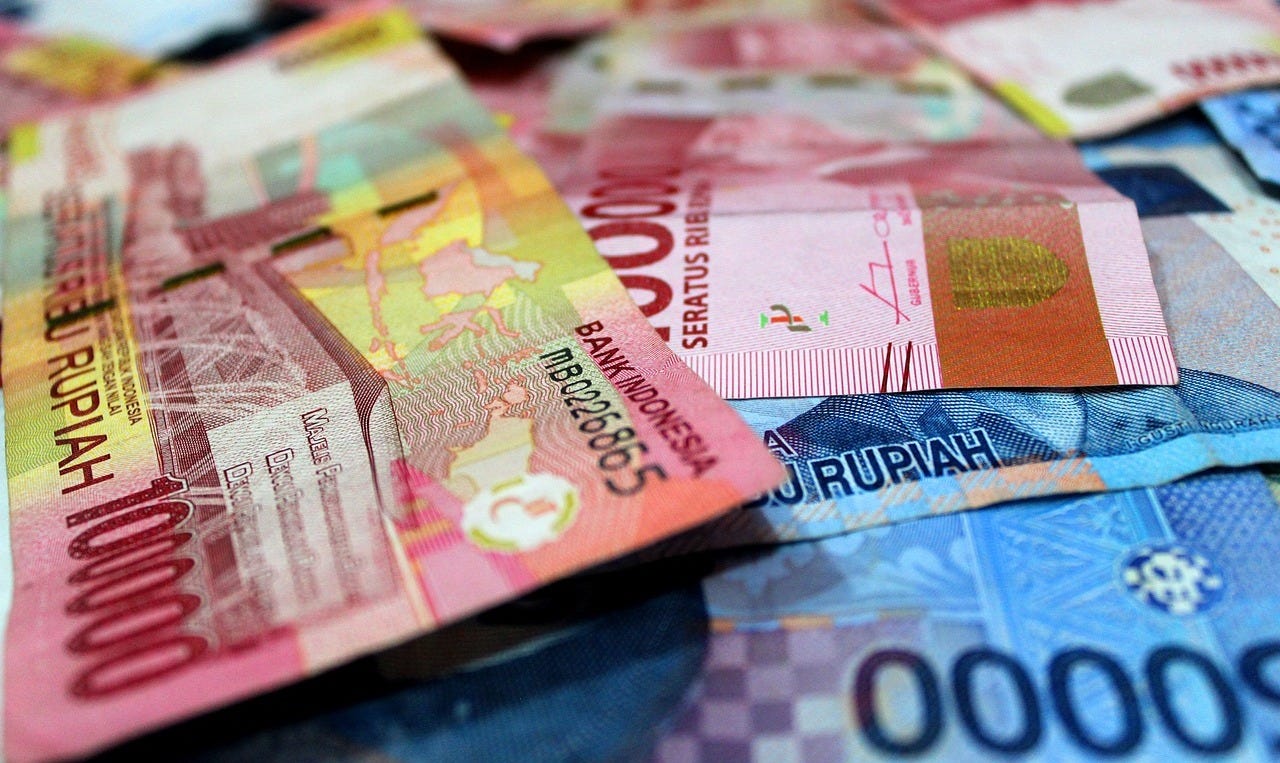
Indonesian sovereign fund Danantara helped to ease fiscal pressures by securing financing at far lower costs than the Indonesian government, Bloomberg reported on 1 December 2025, citing Rain Yin, an S&P sovereign analyst.
The 2% coupon for Danantara’s “patriot bonds” is “really unbelievable for Indonesia, lower than what the government needs to pay,” Yin said.
Eveline’s Take:
🔸 This comment actually highlights the crux of Danantara’s existence. In November 2024, I wrote that Danantara was likely conceived to raise debt for President Prabowo Subianto’s development agenda without busting Indonesia’s fiscal deficit ceiling. Boiled to its essence, Danantara functions as an off-balance-sheet financing vehicle for the Indonesian government.
🔸 Danantara’s ability to borrow internationally hinges on whether it’s seen as a sovereign or not. Proponents may argue that Danantara’s legal standing as a sovereign entity is enshrined in Indonesia’s revised law governing state-owned enterprises (SOEs) that was passed in February.
🔸 Putting aside the legal or philosophical definitions of sovereignty, the key aspect that matters for lenders is the fiscal wherewithal of the borrower. As the holding company and shareholder of the SOEs, Danantara collects dividends that previously flowed to the state budget.
🔸 However, Danantara cannot print money like the US Treasury or collect taxes like Indonesia’s Finance Ministry. In short, Danantara doesn’t have the ability to create new money or extract taxes – but its footing in the offshore arena rests on its perceived state backing.
🔸 Danantara is syndicating a USD 1 billion-equivalent unsecured loan, far below the USD 10 billion credit line that it was reported to have clinched in July. It’s plausible for Danantara to need a smaller loan after raising USD 3 billion from the patriot bonds. In fact, the fund is reportedly preparing to issue a second batch of domestic notes worth an additional IDR 12.6 trillion (USD 759 million).
🔸 A Danantara official also said on 28 November that the fund is considering global bonds for diversification. I wrote in October that Asia’s bond tide is returning as investors are keen for fresh supply beyond China. I also laid out the concept of the musical chairs, whereby banks, bondholders and private credit funds swap seats with each other.
🔸 For the musical chairs to work, however, the players must believe that they can get taken out in time. Danantara should be able to issue some offshore notes, but the question is whether bondholders would be willing to get repaid after the banks. Otherwise, Danantara may have to figure out how to avoid a maturity wall of both the loans and bonds coming due in three years.