

👣 Asia’s Restructuring Milestones
Key developments across Asia’s restructuring landscape

China’s Bankruptcy Law (16 November 2025)
Southeast Asia’s Mixed Platter (18 November 2025)
India’s Reversal (30 November 2025)
🧬 China’s Bankruptcy Law
16 November 2025
China’s bankruptcy law should be revised to tackle zombie companies that are sucking precious resources from more promising businesses.
Officials need an upgraded toolkit to untangle China’s heavily indebted property and LGFV sectors.

Asia’s restructuring landscape has seen several milestones this year, including a proposed overhaul of China’s bankruptcy law that could be its most sweeping reform in nearly two decades.
On 12 September 2025, the Legislative Affairs Commission released a draft revision of the Enterprise Bankruptcy Law for public consultation, following its first reading at the 17th session of the Standing Committee of the 14th National People’s Congress (NPC). The draft will be reviewed by the NPC Standing Committee before potential adoption.
This represents the most ambitious reform of China’s bankruptcy regime since 2006, according to Professor Xiahong Chen, a fellow of the Research Center of Bankruptcy Law and Enterprise Restructuring at the China University of Political Science and Law. It would also mark China’s fifth bankruptcy law in the past 120 years and the third since 1949.
“Its evolution reflects the country’s transformation from an agrarian society to a market-oriented economy, alongside a profound shift in attitudes toward debt,” Chen wrote. “Where debtors were once criminalized and no culture of discharge existed, concepts such as forgiveness, corporate rescue, and alignment with international standards are now broadly accepted.”
When it was implemented under a centrally planned economy in 1986, the bankruptcy law primarily served as a punitive tool against failing state-owned enterprises. Following the growth of the market economy in the 1990s, a new law in 2006 introduced modern procedures – liquidation, settlement, and reorganization – alongside diverse case administration models.
However, the rise in “zombie enterprises” in subsequent years highlighted gaps in clarity and tools, Chen said, noting that the latest draft was designed as a response to these challenges. The purpose of the law was stated as “promoting the survival of the fittest and the optimal allocation of resources among market entities, and preventing and mitigating major risks.”
While retaining the overall structure of the 2006 law, the 2025 draft introduces innovations such as quasi-consumer bankruptcy, group insolvency, and cross-border rules. (Click here for the key points I extracted from Chen’s article).
Zombie Companies
A revision to the bankruptcy law is necessary to tackle zombie companies that are multiplying and sucking precious resources from more promising businesses.
China was laying the groundwork to clear the unpaid bills owed by local governments to private enterprises, but I wrote two months ago that transferring the risk to the banks may create another problem if there’s no market mechanism for bad debt to exit the system.
China seems to be gradually weeding out the weaker local government financing vehicles (LGFVs), as officials seek to avoid a repeat of the property meltdown that was triggered by the “three red lines” policy five years ago. However, I noted that both sectors are entangled, as local governments relied on land sales for income and the developers are a significant source of employment.
LGFVs had an average debt-to-EBITDA of 28x last year, nearly triple the ratio for commercialized SOEs, according to S&P Global Ratings. The government’s 2027 deadline for LGFVs to reach commercial viability will not be a hard stop, as “the LGFVs have a lot more to do to genuinely de-risk,” S&P’s Christopher Yip said. “In the meantime, there will be more kicking the can down the road.”
A prolonged property slump was perceived as the biggest risk to China’s stable growth, according to a poll with 83 votes collected at S&P’s China Credit Spotlight conference. This was followed by local government and LGFV debt risks, as well as “involution” (excessive domestic competition) and overcapacity.
Former Finance Minister Lou Jiwei also warned this week that China’s property market has not bottomed out yet and may continue hindering economic growth for another five years, South China Morning Post reported.
China is facing a twin set of problems – property and LGFVs – that are intertwined with each other like a double helix. Officials need an upgraded toolkit to unwind these strands.

🥘 Southeast Asia’s Mixed Platter
18 November 2025
Malaysia passed a bill that incorporated the UNCITRAL Model Law on Cross-Border Insolvency this year.
The Philippines also had a breakthrough when its flag carrier’s Chapter 11 restructuring was recognized by a local court in 2021.
Singapore made strides by building the ecosystem for crypto restructurings and refining its legal toolkit.
Flag airline Garuda Indonesia’s PKPU deal was recognized internationally, but Indonesia still has barriers for cross-border restructurings.
Vietnam’s bankruptcy law is considered largely untested and ad-hoc negotiations with individual creditors remain a common restructuring tool.

Malaysia stood out in Southeast Asia’s restructuring scene this year as it leapt forward to align its insolvency framework with international practices.
In September 2025, the Dewan Negara (Senate) passed a bill that incorporated the United Nations Commission on International Trade Law (UNCITRAL) Model Law on Cross-Border Insolvency. The move established “a robust legal mechanism for cooperation between Malaysian courts and courts in foreign jurisdictions in insolvency matters,” according to a Rajah & Tann article.
The country’s insolvency history shaped its path toward the Model Law, as the 1997–1998 Asian Financial Crisis exposed the risks of unrestricted moratoriums under schemes of arrangement, Malaysian lawyer Lee Shih wrote on LinkedIn.
“Moratoriums could be stretched almost indefinitely. The result: room for debtor misuse, creditor prejudice, and a scepticism of overly flexible restructuring tools,” he said, noting that these lessons drove Malaysia’s corporate rescue reforms, eventually leading to the Model Law legislation.
The Philippines also had a cross-border breakthrough around four years ago, when its flag carrier Philippine Airlines (PAL)’s Chapter 11 restructuring was recognized by a local court. This was “the first time on record a Philippines court had recognized a Chapter 11 proceeding under the country’s Financial Rehabilitation and Insolvency Act,” Norton Rose Fulbright – which represented PAL – said in a statement.
Meanwhile, Singapore’s restructuring community has made strides on several fronts. Apart from recognizing an Indian company’s Corporate Insolvency Resolution Process (CIRP) as a foreign main proceeding for the first time, the city-state has also been building the ecosystem for crypto restructurings and refining its legal toolkit.
Defi Payments was the first cryptocurrency company to successfully restructure its debt through a Singapore scheme of arrangement in 2023. Singapore also raised the bar for crypto firms operating in the country by ordering those that only serve overseas markets to shut by end-June unless they received a license.
Marking another notable step, Singapore had its first “cross-class cramdown” this year when oil trader GP Global deployed the mechanism to overcome a holdout creditor class. I wrote in April that it may provide a blueprint to cram down a creditor class that’s blocking a restructuring at the expense of the majority.
Ad-Hoc Deals
Garuda Indonesia entered the history books when the Indonesian flag carrier’s local in-court restructuring (PKPU) was recognized in Singapore and New York. The airline also successfully asserted foreign state immunity in Australia, thwarting one of the challenges mounted by its lessor Greylag Goose Leasing.
However, Indonesian law does not recognize foreign court judgments and applicants seeking enforcement typically must “re-litigate”, potentially adding to their legal costs. Indonesian courts are also not bound by past rulings, which means that lawyers may have to build each case as if it’s new, according to a lawyer friend.
Another barrier is the lack of a framework to manage post-PKPU defaults, as a creditor can file a debtor into bankruptcy if it breaches the agreement. As I previously wrote, some borrowers inserted a clause that would enable an out-of-court restructuring, but the bankruptcy of Arpeni Pratama Ocean Line in 2019 showed that a single holdout creditor can torpedo this deal.
Turning to Vietnam, the country’s 2014 Bankruptcy Law is considered largely untested. From 2015 until March 2020, Vietnamese courts accepted fewer than 600 bankruptcy requests, of which the courts only granted over 100 bankruptcy orders, according to a note by Hogan Lovells. Since March 2020, no further data has been published by the government.
“Due to the challenges in the enforcement of the bankruptcy regime, the most common restructuring tool in Vietnam remains for the debtor company to negotiate terms on an ad hoc basis with individual creditors on the restructuring of each debt outside of any formal court proceedings,” the law firm wrote.
The Right Fit
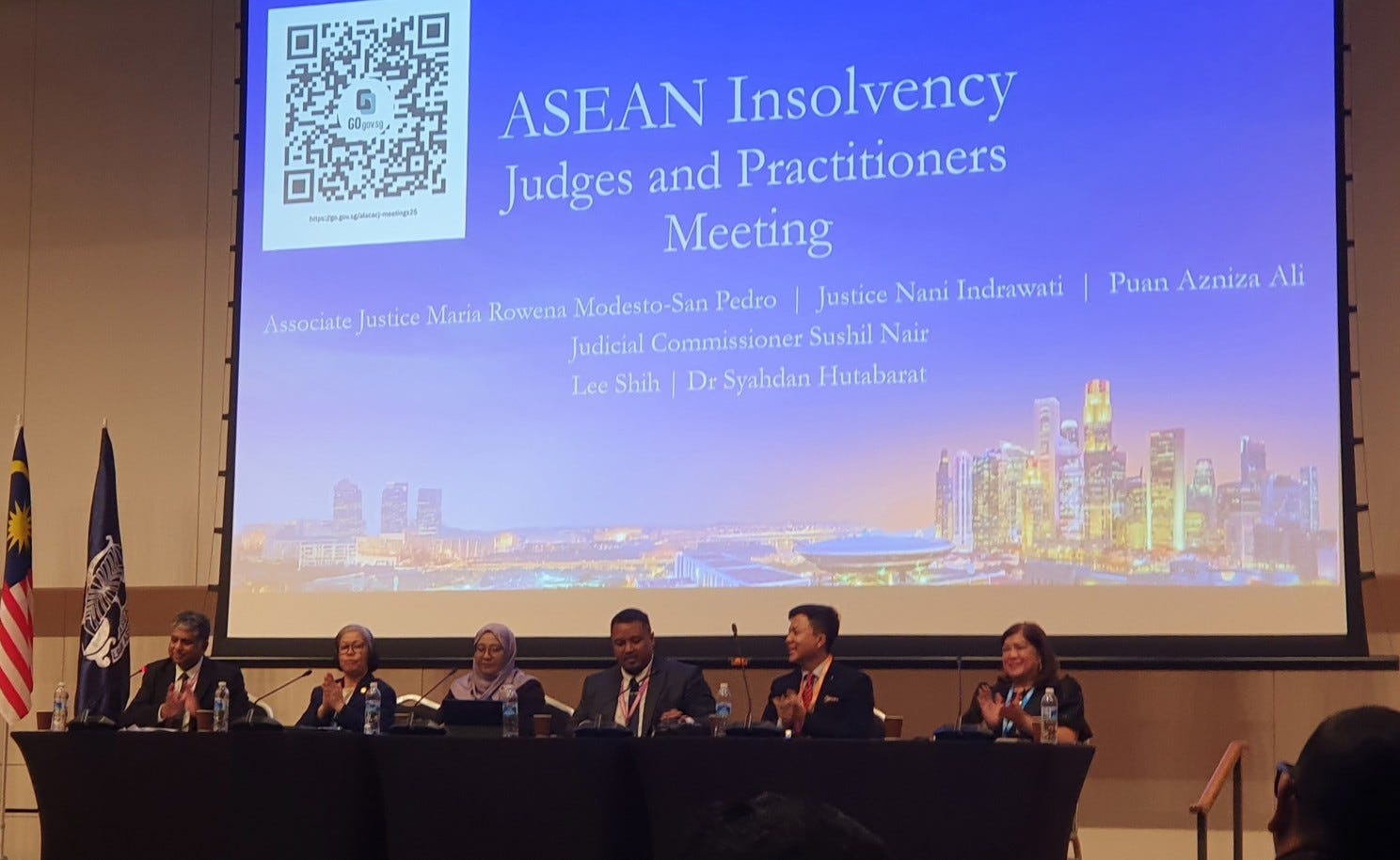
Different countries move at a different pace, but getting stakeholders in the same room to start a dialogue can accelerate progress.
Last week, Singapore hosted the ASEAN Insolvency Judges and Practitioners Meeting, which brought together justices and professionals from the region to exchange their thoughts. “There is no such thing as ‘one size fits all’ when it comes to ASEAN – a region of rich and diverse cultures and people,” according to the organizers.
“However, there is a lowest common denominator amongst all of us – which is the desire to work together and find the right fit for the problems that we are faced with.”
⏪ India’s Reversal
30 November 2025
The Supreme Court restored trust in India’s bankruptcy framework by upholding JSW Steel’s acquisition of Bhushan Power & Steel.
India’s airline sector is also in the spotlight with the implementation of the Cape Town Convention and Go First’s dispute with tyre lessor Bridgestone.

India’s restructuring and insolvency community was jolted by the Supreme Court’s 2 May 2025 decision to scrap JSW Steel’s acquisition of Bhushan Power & Steel around four years after the deal was finalized.
The order to unwind JSW Steel’s court-approved acquisition of Bhushan Power had raised questions over the sanctity of the legal process under India’s Insolvency and Bankruptcy Code (IBC). In 2016, the IBC was created as a consolidated framework to oversee insolvency and bankruptcy proceedings in a “time bound manner”.
I wrote in May that the ruling was a collective head-scratcher because nobody really knew how to reverse an acquisition four years after the fact. Bhushan Power’s lenders already offloaded chunks of their exposure on various parties, meaning that the debt had changed hands multiple times and any attempt to claw it back would have been daunting.
After completing the INR 197 billion (USD 2.2 billion) acquisition of Bhushan Power in 2021, Indian tycoon Sajjan Jindal’s JSW Steel had also boosted the annual crude steel capacity of the subsidiary by nearly 65%. In short, the top court’s 2 May ruling was both impractical and potentially damaging to investors’ confidence in the IBC.
On 26 September, a three-judge bench led by India’s Chief Justice decided to uphold the validity of the acquisition, bringing relief to many of the country’s restructuring and insolvency practitioners. “Permitting any claims to be reopened will amount to committing violence on the provisions of the law,” according to the latest verdict.
The Supreme Court “saves IBC” by restoring the trust of market players, including creditors and prospective applicants, in the resolution framework and ensuring that “a significant economic reform is not inadvertently undone by the judiciary,” Indian law firm AZB & Partners wrote in a note.
Aviation Leasing
In another notable development this year, the Indian Parliament passed a bill to fully implement the Cape Town Convention, which was a long-standing demand of the international aircraft leasing community, according to Chandhiok & Mahajan.
“One of its key features is that it overrides conflicting provisions of existing domestic laws, including the Insolvency and Bankruptcy Code 2016, thereby ensuring better protection of the rights and interests of aircraft lessors and creditors in India,” the Indian law firm said.
India’s airline sector has also been in the spotlight as bankrupt carrier Go First reportedly faced a lawsuit over 1,400 missing tyres leased to it by Japan’s Bridgestone. I wrote in September that the key point of contention would likely be whether the tyres are owned by Go First or remain the property of Bridgestone.
This is because under Section 36 of the IBC, “assets owned by a third party which are in possession of the corporate debtor” shall not be included in the liquidation estate and used for recovery.
The outcome of the case should be closely watched by other suppliers to Indian airlines because it could help to clarify how the National Company Law Tribunal (NCLT) views asset ownership in a lease structure. In short, these suppliers would likely want to know whether they could repossess the assets or must line up with other creditors in a liquidation.