

📚 Acrostics Anatomy: VietJet vs FitzWalter
Vietnamese airline VietJet’s long-running war against UK special situations fund FitzWalter Capital.

📒 Quick Take: VietJet’s English Setback (14 May 2025)
📒🎞️ Quick Take: Flight Turbulence in Asia Pacific (12 June 2025)
🚨 Newsflash: VietJet Loses Appeal to Overturn UK Court Order (24 June 2025)
🔎 Highlights: VietJet vs FitzWalter Dispute (24 June 2025)
📒 Quick Take: VietJet’s Cash Mystery (25 June 2025)
🎞️ Slideshow: The JOLCO Play (27 July 2025)
📒 Quick Take: The NeverEnding Story of VietJet and FitzWalter (23 July 2025)
📸 Snapshot: VietJet 1H25 Results (4 September 2025)
🚨 Newsflash: UK Court of Appeal Finds VietJet Not Guilty of Contempt (15 November 2025)
📒 Quick Take: VietJet’s English Setback
14 May 2025
Vietnamese airline VietJet was ordered to pay around USD 180 million to FW Aviation starting this week.
Liabilities stemming from future lease payments are a common source of friction between airlines and their lessors.
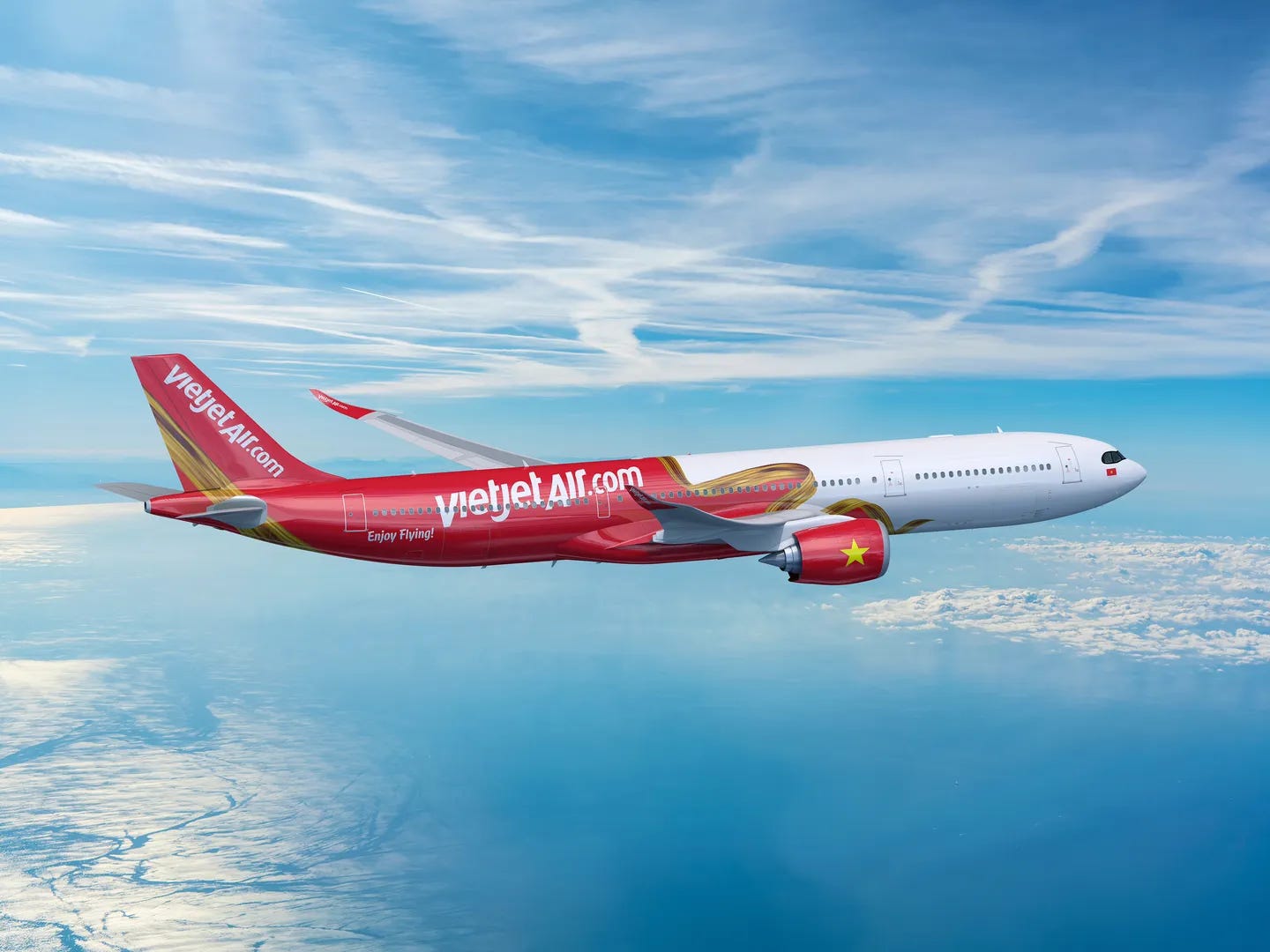
Vietnamese airline VietJet Aviation Joint Stock Company has suffered a setback in its long-running battle against one of its lessors.
The London High Court has refused VietJet’s application for a stay and ruled that the carrier must pay around USD 180 million to FW Aviation, a unit of London-based buyout fund FitzWalter Capital, starting this week, Bloomberg reported. The money must be paid in three equal installments beginning on 15 May and ending in late November.
The dispute revolves around unpaid rents for four Airbus aircraft that were leased by VietJet. In the aftermath of the pandemic, FW Aviation took back its planes from VietJet and filed claims in the UK for the premature termination of the leases as well as damages arising from the default. VietJet countered that FW Aviation already repossessed the planes, so having to pay on top of that would amount to a “double penalty”.
VietJet – which is controlled by Vietnamese billionaire Nguyen Thi Phuong Thao – basically argued that paying up would bring it to ruins, but the English judge didn’t buy this. Last month, VietJet reportedly signed a USD 300 million aircraft financing deal with a partner of KKR. The Vietnamese airline also announced last week that it was acquiring a strategic stake in Kazakhstan’s Qazaq Air as part of their new joint venture.
In response to the latest UK court ruling, VietJet told Bloomberg it “remains optimistic that it will overturn the original judgment in the appeal scheduled to be heard later this month.” In short, VietJet seems intent on exhausting all legal means in its tussle with FW Aviation, which has played out in courts across London, Hanoi and Singapore.
VietJet said on 27 April that it would be “unable to pay the entire judgment debt without having to re-arrange its business and quite possibly dismantle parts of it.” The airline needs around USD 45 million in unrestricted cash for its day-to-day operations and it has no physical assets that could be liquidated to cover the amount it was ordered to pay, according to its statement.
Liabilities stemming from future lease payments are a common source of friction between airlines and their lessors. Airlines typically argue that it’s too punitive for them to be held liable for the entire lease, as some of them had to end the contracts early due to the market conditions. On the other hand, lessors say that contract sanctity must be upheld and they should be compensated for the trouble of having to find another customer as a result of the lease termination.
When airlines clash with their lessors, the fight tends to spill over to multiple jurisdictions because of the laws governing the lease agreements and the locations of the entities that are tied into the contracts.
Greylag Goose Leasing, which is backed by US private equity firm Avenue Capital Group, waged a scorched earth campaign against Garuda Indonesia in Jakarta, Singapore, Australia and France. However, the Indonesian flag airline managed to score critical legal victories by getting its local in-court restructuring (PKPU) deal recognized in Singapore and successfully asserting “foreign state immunity” in Australia.
VietJet may not have the same state backing as Garuda, but the first privately owned airline in Vietnam doesn’t seem ready to throw in the towel yet.
📒🎞️ Quick Take: Flight Turbulence in Asia Pacific
12 June 2025
Jetstar Asia, Rex Airlines and Bonza Aviation ran aground, while SriLankan Airlines and Garuda Indonesia must undergo a restructuring.
VietJet pleaded financial constraints as a legal defence against its lessor, yet it has been announcing plane orders, route expansions and financing deals.

A handful of airlines are flying into a storm in Asia Pacific as they struggle to scale up to compete with larger rivals.
Jetstar Asia, the Singapore budget arm of Australia’s Qantas Airways, shocked travellers and staff when it announced its impending closure, but aviation analysts say the writing was on the wall as it was only profitable for six out of 20 years in operation. Rising costs and tough competition had “fundamentally challenged” the airline’s ability to offer low fares, Jetstar Group CEO Stephanie Tully reportedly said.
While Singapore Airlines’ budget unit Scoot ramped up flights and destinations, Jetstar Asia’s latest fleet only stood at 13 planes, down from 18 before the pandemic, and it had little presence in the major aviation markets of India and China, according to an expert interviewed by the Straits Times.

Down under, Australian carriers Rex Airlines and Bonza Aviation both ran aground last year, leaving passengers stranded and various legal issues to be resolved, according to an article written by law firm DLA Piper.
Rex entered a voluntary administration in July 2024 after its foray into capital cities – where it competed directly with Qantas and Virgin Australia – resulted in heavy losses, the Australian Financial Review (AFR) reported. Binding bids for Rex were due last week and private equity firm Anchorage Capital Partners was among the parties that submitted a proposal to buy it, according to AFR.
In South Asia, Sri Lanka is accelerating the restructuring of its flag airline after being prodded by the International Monetary Fund (IMF), which bailed the nation out of bankruptcy. In a notice dated 29 May 2025, SriLankan Airlines told holders of its USD 175 million bond due 2024 that it had appointed Lazard and Norton Rose Fulbright as its financial and legal advisers, respectively, for a potential restructuring.
SriLankan Airlines took in a new Airbus plane to increase its fleet to 23, with plans to add two more by the end of this year. However, I wrote last week that even with the upsized fleet, it would still be much smaller than the battalion commanded by Singapore Airlines, which operated 163 aircraft as of February 2025.
The Singapore flag airline seems to be an outlier in the region, as it recently awarded staff with 7.45 months of bonus on the back of a record annual profit. This turnaround came after it received a pandemic support package of up to SGD 19 billion (USD 13 billion) from state-linked entities in 2020.
In contrast to Singapore’s bold bazooka, Indonesia has so far given a drip feed of state funds to its perpetually ailing airline Garuda Indonesia. I flagged in April 2025 that Garuda was likely headed towards a fourth restructuring as it grappled with aircraft maintenance costs and a cap on domestic fares.
I also wrote that Garuda may receive some funds from sovereign fund Danantara to reactivate its grounded planes, but it could still be weighed down by expensive legacy leases. Last week, Garuda announced that it will seek shareholder approval on 30 June 2025 for a proposed restructuring and changes in management.

Elsewhere in Southeast Asia, Vietnamese budget carrier VietJet had a legal setback in its long-running battle against one of its lessors. VietJet – which is controlled by Vietnamese billionaire Nguyen Thi Phuong Thao – was ordered by an English court to pay around USD 180 million to a unit of London-based buyout fund FitzWalter Capital.
Despite VietJet’s allegedly “significant financial constraints”, it has been announcing a string of aircraft orders, route expansions and financing deals. In fact, the airline is reported to be in talks to order around 100 more Airbus planes. My takeaway is either VietJet has the money but pleaded poverty to avoid paying its nemesis, or it doesn’t have the money but is putting up a selective show of strength.
The relationship between airlines and their lessors seems to be a complicated one. As a friend said: “Leases are just the operating cost. It’s actually very difficult to get rid of them because lessors can always take the planes away. And once you are a bad lessee it’s harder to get planes. The airline business is hard.”

🚨 Newsflash: VietJet Loses Appeal to Overturn UK Court Order
24 June 2025
Vietnamese budget airline VietJet has lost its appeal to overturn a UK court order to pay an aircraft leasing firm, according to a ruling on 24 June 2025.
The dispute revolved around the rights to terminate the finance leases of four Airbus planes and whether FW Aviation – part of UK distressed credit investor FitzWalter Capital – was entitled to acquire rights under the lease structure as a “financial institution”.
The Court of Appeal held that the entitlement to terminate the leasing did not depend on an Enforcement Event having occurred under the loan agreements, and that the Security Assignments did not qualify the Security Trustee’s rights in this respect, according to a note written by South Square, which represented FW Aviation.
While the appeal was pending, a quantum trial earlier this year awarded FW Aviation USD 181.5 million. There will be a further quantum hearing next year, according to the latest court documents.
🔎 Highlights: VietJet vs FitzWalter Dispute
24 June 2025
🔸 In 2018 and 2019, VietJet leased four Airbus 321 passenger aircraft under a financing structure known as JOLCO (Japanese Operating Lease with Call Option). The financing was a mixture of debt and equity: 75% came from syndicated loans led by BNP Paribas and Natixis, while the remaining 25% was from Japanese equity investors.
🔸 After Vietnam imposed Covid restrictions, VietJet fell behind on its rents and sought to negotiate payment deferrals. However, before those negotiations reached any conclusion, the lenders resolved in October 2021 to sell their positions to FitzWalter, which set up a special purpose English subsidiary (FWC) for the transaction.
🔸 At FWC’s instigation, BNP and Natixis served termination notices in October 2021 over the rent arrears. In addition to the termination notices, they also served mandatory prepayment notices under the loan agreements, which if valid would accelerate the obligation to repay the loan in full.
🔸 FWC took assignments of the loans in October 2021 and was appointed as Security Trustee after BNP and Natixis resigned in November 2021. VietJet disputes that FWC fell within the permitted class of assignees by reference to the definition as a “financial institution”. It also disputes that FWC fell within the permitted class of new Security Trustees under the Security Assignments for all four aircraft.
🔸 In November 2021, FWC transferred the Security Trustees’ rights under the leases to FW Aviation.
📒 Quick Take: VietJet’s Cash Mystery
25 June 2025
Vietnamese airline VietJet has been losing key battles in its long war with London-based buyout group FitzWalter Capital.
Does the budget carrier actually have the money to pay up or not?

Vietnamese airline VietJet has been losing key battles in its long war with London-based FitzWalter Capital.
The budget carrier failed in its appeal to overturn a UK court order to pay FW Aviation, part of former Macquarie investment banker Ben Brazil’s buyout group. The twists and turns of their legal duel are detailed in this 54-page court document, but the dispute was basically centered on whether FW Aviation was entitled to acquire the leasing rights for four planes and file claims against VietJet.
On 24 June 2025, the Court of Appeal affirmed an earlier ruling that held VietJet liable for a sum of USD 181.5 million, though there will be a further hearing next year on the quantum.
The English judges were of the view that VietJet – founded by Vietnamese tycoon Nguyen Thi Phuong Thao – had the means to pay up but chose not to. Indeed, I wrote that despite VietJet’s legal plea of poverty, it has been announcing a string of aircraft orders, route expansions and financing deals.
The company’s presentation also painted the picture of a thriving airline with strong liquidity and banking relationships.
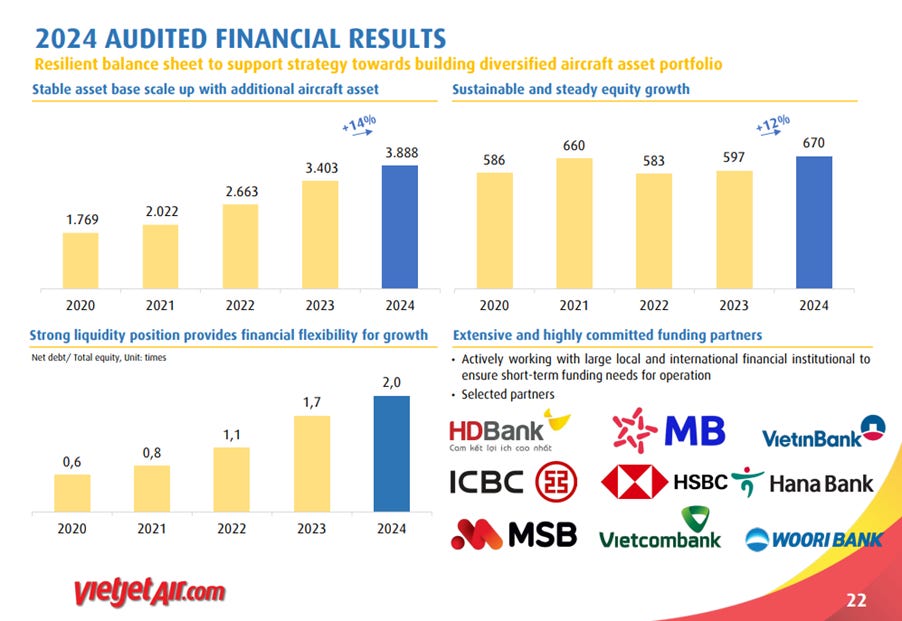
Cash Outflow
I couldn’t reconcile these contrasting images, so I checked out the unvarnished financial statement.
VietJet’s revenue was up 0.9% to VND 17.95 trillion (USD 686.5 million) in the first quarter of 2025 (1Q25) from a year earlier, translating to a pre-tax profit of VND 836.4 billion. However, the airline swung to a net operating cash outflow of VND 848.8 billion, from an inflow of VND 818.3 billion in 1Q24, partly due to an increase in prepaid expenses.
Cash and equivalents dropped to VND 2.2 trillion (USD 84.1 million) as of 31 March 2025, from VND 3 trillion a year earlier. In short, paying the entire judgment sum of USD 181.5 million to FitzWalter would wipe out VietJet’s cash on hand.
If it’s true that VietJet has “extensive and highly committed funding partners”, then the airline or its controlling shareholder should be able to leverage these relationships and get loans. Having said that, I can’t imagine banks rushing to take out a distressed credit fund unless they get sufficiently favorable terms.
Self-Made Billionaire
When there’s a will there’s a way – especially for Nguyen Thi Phuong Thao, who reportedly became a millionaire by distributing fax machines, plastic and rubber while studying in Moscow, and went on to become the second Vietnamese to be recognized by Forbes as a USD billionaire.
Apart from the commercial calculations, I’m no psychologist but perhaps the Madam is fighting tooth and nail against FitzWalter because she feels that she shouldn’t have to pay up. VietJet fell behind on its rents for the four planes after it was hit by the pandemic – like other airlines around the world – and sought to negotiate payment deferrals.
However, before those negotiations reached any conclusion, the original financiers – consisting of a banking group led by BNP Paribas and Natixis alongside Japanese equity investors – resolved in October 2021 to sell their positions to FitzWalter, according to court documents. VietJet also argued that FitzWalter’s unit already repossessed the planes, so having to pay on top of that would amount to a “double penalty”.
So does VietJet actually have the money or not? As with many other things, the truth is probably somewhere in between.
🎞️ Slideshow: The JOLCO Play
27 July 2025
The tussle between VietJet and FitzWalter Capital has shone a spotlight on the JOLCO lease structure, which allows a lessor to terminate an agreement and demand full payment upon a default.
📒 Quick Take: The NeverEnding Story of VietJet and FitzWalter
23 July 2025
Vietnamese airline VietJet is fighting UK buyout group FitzWalter Capital’s attempt to freeze its assets globally.
FitzWalter is in this to get a big payout, while VietJet probably sees itself as standing up to a bully.

UK investment group FitzWalter Capital’s pursuit of Vietnamese budget airline VietJet for more than USD 200 million has become a neverending story.
In a London court hearing on 22 July 2025, FitzWalter Capital’s aircraft leasing unit FW Aviation asked a judge to freeze the global assets of VietJet as the carrier’s arrears swelled to at least USD 217 million, Bloomberg reported. The targeted assets include Airbus planes that were purchased but not yet delivered, engines, as well as cabin equipment including seats and in-flight entertainment systems.
FW Aviation alleged that VietJet started dissipating its assets in the wake of a USD 225 million judgment, but the English court has declined to grant the worldwide freezing order, according to Global Restructuring Review.
VietJet’s lawyers argued that the appropriate venue for any litigation should be Vietnam and as a company that’s publicly accountable to shareholders, “there is no risk of covert divestment of assets for any nefarious purpose.”
I wrote last month that paying the entire sum may wipe out VietJet’s cash on hand, but the airline founded by Vietnamese tycoon Nguyen Thi Phuong Thao is also not in a hurry to take out loans and hand the money to former Macquarie investment banker Ben Brazil’s buyout fund.
“Justice and Fairness”
After losing its appeal on 24 June, VietJet released a statement that the dispute relates to a payment of around USD 7.4 million that fell due during “the most challenging period of the COVID-19 pandemic, when the aviation industry, international payment systems, and global financial markets were all severely affected.”
“The Company is continuing its legal journey in pursuit of justice and fairness and is considering all appropriate actions, including further appeal,” VietJet said, adding that it maintains a stable financial position. “We remain confident in the ability of the legal system to deliver a fair and just outcome.”
It’s telling that justice and fairness were mentioned twice in VietJet’s brief statement. The Vietnamese likely perceive FitzWalter as a predatory fund that’s trying to squeeze more than USD 200 million from USD 7.4 million of overdue rents. In short, VietJet is building a narrative in Vietnam that it’s fighting a brute capitalist that’s out to make a hyper-inflated buck from mere pennies.
Secret Talks
The protracted tussle revolves around four planes that were originally leased by VietJet from a group of banks, led by BNP Paribas and Natixis, alongside Japanese equity investors.
VietJet fell behind on its rents during the pandemic and sought to negotiate payment deferrals, but the financiers resolved in October 2021 to sell their positions to FitzWalter, which then filed claims against the airline. On top of disputing the standing of FitzWalter’s unit FW Aviation to acquire the leasing rights, VietJet also argued that having to pay up and return the planes would amount to a “double penalty”.
While VietJet gave possession of the aircraft to FW Aviation in December 2021, the planes only started being exported out of Vietnam in June 2024, according to court documents. FW Aviation alleged that VietJet “created difficulties in getting the aircraft removed”, which was denied by the carrier.
EU Reporter wrote this analogy of what happened:
Like others in the sector, VietJet was renegotiating its plane leases with its various lenders. But in the case of the four aircraft in dispute, VietJet was negotiating with its lenders (BNP and Natixis) at the same time as its lenders were secretly negotiating with FitzWalter. For comparison’s sake, imagine losing your job because of the pandemic and then renegotiating your mortgage payments in good faith with your bank, only to be told that your home was now owned by strangers who wanted all of your past and future mortgage payments and your house to sell on for profit?
“Exactly As Agreed”
I wrote in May that liabilities stemming from future lease payments are a common source of friction between airlines and their lessors. Airlines typically argue that it’s too punitive for them to be held liable for the entire lease as they are subject to changing market conditions, while lessors say that contract sanctity must be upheld.
The problem for VietJet is that the leases for the disputed planes were structured as a Japanese Operating Lease with Call Option (JOLCO), which allows the lessor to terminate the agreement and demand the full payment of all outstanding amounts upon a default. In short, VietJet cannot willingly sign a contract and then cry foul when it’s enforced.
As Harley Miller Law Firm wrote in its note:
This case emphasizes that in international commercial transactions, especially in high-value asset leases like aircraft, English courts will strictly uphold contractual terms. Clauses such as “Event of Default,” “termination,” or “damages” will be enforced exactly as agreed, if clearly drafted and commercially balanced. Businesses cannot expect courts to intervene and adjust terms due to “changed circumstances” without specific grounds and good faith efforts.
Truce or No Truce
There’s no angel in this situation and the most rational solution is for both parties to reach a settlement.
However, FitzWalter is in this to get a big payout from VietJet right from the start, while the Vietnamese airline probably sees itself as standing up to a bully. It’s unclear if they can put these aside and agree to a truce.
📸 Snapshot: VietJet 1H25 Results
4 September 2025
Vietnamese airline Vietjet Aviation Joint Stock Company (VietJet) has released its results for the six months ended 30 June 2025. These are some of the highlights.
🛩️ 𝗙𝗼𝗿𝗲𝘅 𝗴𝗮𝗶𝗻𝘀 𝗹𝗶𝗳𝘁 𝗼𝗽𝗲𝗿𝗮𝘁𝗶𝗻𝗴 𝗽𝗿𝗼𝗳𝗶𝘁𝘀: VietJet reported a 5.1% rise in revenue to VND 35.6 trillion (USD 1.3 billion) from a year earlier. However, net operating profits jumped 64.2% to VND 1.52 trillion partly due to an increase in financial income. Broken down further, VietJet’s financial income was lifted by realized foreign exchange gains as well as interest income from deposits and lending.
🛩️ 𝗛𝗶𝗴𝗵𝗲𝗿 𝗰𝗮𝘀𝗵 𝗰𝗼𝗹𝗹𝗲𝗰𝘁𝗶𝗼𝗻 𝗳𝗿𝗼𝗺 𝗰𝘂𝘀𝘁𝗼𝗺𝗲𝗿𝘀: Net operating cashflow turned positive to VND 462.8 billion, compared with an outflow of VND 3.7 trillion a year earlier, partly due to a decrease in receivables. However, net cash outflow from investing activities surged 3.6x to VND 11.2 trillion from a year earlier, mainly because of the purchase and construction of fixed and other long-term assets.
🛩️ 𝗦𝗵𝗮𝗿𝗲 𝗽𝗿𝗼𝗰𝗲𝗲𝗱𝘀 𝗯𝗼𝗼𝘀𝘁 𝗳𝗶𝗻𝗮𝗻𝗰𝗶𝗻𝗴 𝗰𝗮𝘀𝗵𝗳𝗹𝗼𝘄: VietJet reported a jump in net cashflow from financing activities to VND 13.3 trillion, from VND 4.3 trillion a year earlier, partly as it booked VND 5 trillion in proceeds from the issuance of shares. The airline also repaid VND 21 trillion of borrowings in 1H25, down by VND 3.9 trillion from a year earlier. Total cash and equivalents stood at VND 7.1 trillion as of 30 June 2025, while current liabilities amounted to VND 38.5 trillion.
🚨Newsflash: UK Court of Appeal Finds VietJet Not Guilty of Contempt
15 November 2025
The UK Court of Appeal has ruled in favour of VietJet, finding the Vietnamese airline not guilty of contempt.
The court decision on 14 November 2025 marked the latest turn in VietJet’s long-running dispute with FW Aviation, part of UK special situations fund FitzWalter Capital, over four planes leased by the carrier.
These are the key points extracted from the court documents.
Lord Justice Males said:
1️⃣ The issue on this appeal is whether an injunction respondent who has not actually done anything prohibited by the injunction can be guilty of contempt of court for acting contrary to the spirit and purpose of the injunction.
2️⃣ In March 2023, FW Aviation (FWA) obtained an interim injunction against VietJet, prohibiting it from ‘taking possession of or operating four identified aircraft either directly or indirectly or otherwise interfering with FWA’s right to possession, custody and/or control of the aircraft’. VietJet subsequently sent a number of letters to public authorities in Vietnam which, at least on one view, were an attempt to interfere with the export of the aircraft from Vietnam.
3️⃣ In August 2024, FWA applied for permission to amend an extant contempt application by adding a new allegation that the sending of these letters constituted a contempt. FWA made clear that it did not contend that VietJet had infringed the injunction by sending the letters. Rather, its case was that the letters were an attempt to circumvent the injunction, contrary to its spirit and purpose, and thus an intentional interference with the administration of justice amounting to a criminal contempt of court.
4️⃣ Mr Justice Picken granted permission to make this amendment, but did not address VietJet’s key argument that it was impossible in law for the respondent to an injunction to commit a contempt in relation to the injunction without actually infringing it. On this appeal VietJet contends that he was wrong to do so.
5️⃣ I have concluded that the appeal must be allowed. The answer to the question identified in para 1 above, at least in the circumstances of the present case, is ‘No’.