

📚 Acrostics Anatomy: Sritex’s Bankruptcy Spiral
The former Indonesian textile giant’s descent into bankrutpcy.

📒 Quick Take: Indonesia’s Textile Tangle (30 August 2024)
📒 Quick Take: Sritex’s Restructuring Deal Risks Fraying (17 September 2024)
📒 Quick Take: Sritex’s Bankruptcy Caps Fall from Grace (25 October 2024)
📒 Quick Take: Can Sritex Be Saved? Part 1 (27 October 2024)
📒 Quick Take: Can Sritex Be Saved? Part 2 (28 October 2024)
📒🎞️ Quick Take: Why Sritex Frayed (1 November 2024)
📒 Quick Take: Sritex’s Financial Knot (4 November 2024)
📒 Quick Take: Indonesia’s Textile Tangle
30 August 2024
Why the Indonesian government’s restrictions on Chinese textile imports are not addressing the crux of the problem.
Pan Brothers entered a local in-court restructuring (PKPU) around two years after its debt deal.
Buried among the news out of Indonesia this week was the government’s plan to move textile import points to the east.
The Industry Ministry is finalizing a proposal to relocate entry points for imports, including textiles, from Java to West Papua, North Sulawesi or East Nusa Tenggara, according to the Jakarta Post.
From 9 August, the Finance Ministry also reimposed additional tariffs on fabric imports to protect the local industry from the influx of cheaper goods, mainly from China, Bloomberg reported.
The Indonesian government probably had to do something after reports of mass layoffs in the domestic textile sector, but a key challenge that has yet to be addressed is the decline in working capital loans.
Pan Brothers entered a local in-court restructuring (PKPU) around two years after its pre-packaged scheme of arrangement was sanctioned in Singapore. Back then, the deal extended its offshore bonds by four years and syndicated loan by two years, but didn’t resolve its underlying weakness.
Pan Brothers struggled with a lengthening cash conversion cycle, meaning that customers took longer to pay up while suppliers wanted to be paid faster. That was fine when Pan Brothers could get credit to help cover the gap, but a bunch of banks retreated from the textile sector after the distress of Duniatex and Sritex.
A restructuring friend opined that Pan Brothers should have rolled over its syndicated loan by up to five years, but the reality is that getting the “1+1” extension was already like pulling teeth (the company had to fend off both a PKPU petition and a bankruptcy application by Maybank Indonesia before the 2022 deal).
At the time, Pan Brothers’ creditors chose to kick the can down the road because 1) The key shareholders agreed to inject USD 50 million into the company, 2) They were hoping that business would improve and/or Pan Brothers would find new lenders, 3) The company emphasized the support of its key customer Adidas, and 4) Pan Brothers’ boss Anne Patricia Sutanto didn’t go into hiding.
However, Pan Brothers couldn’t pay the USD 124 million syndicated loan that fell due in December 2023. The company only had around USD 20.7 million of cash as of 1Q24, which included USD 6.5 million in its bond interest reserve account that was then released to settle an outstanding coupon, according to Fitch.
Pan Brothers and its units entered PKPU on 11 June at the request of a logistics provider and the process was extended until 22 November to verify claims (as an aside, colourful Indonesian lawyer Hotman Paris’ team posted on Instagram that they were hard at work registering the claims of an undisclosed client).
The company has assembled an alliance of restructuring veterans: Geoff Simms’ AJCapital Advisory (which advised Duniatex and Sritex), Nicky Tan’s nTan Corporate Advisory (Tan handled Hyflux and Asia Pulp & Paper), and Aji Wijaya & Co (the long-time counsel of Bakrie Group).
A friend close to Pan Brothers’ creditors said there was “no info flow after months” and they are worried the restructuring will turn into “Sritex 2.0”. Around USD 700 million in off-balance-sheet debt – mainly related party loans – emerged during Sritex’s PKPU in 2021 and the company eventually pushed through a deal.
Whether Pan Brothers will carve its own path or take the road others have travelled will be clear when it presents its new restructuring proposal.
📒 Quick Take: Sritex’s Restructuring Deal Risks Fraying
17 September 2024
Indonesian textile company Sritex faces a court petition to cancel its PKPU deal and declare it bankrupt.
Why Arpeni Pratama Ocean Line’s bankruptcy in 2019 has raised the bar for a post-PKPU restructuring.

More than two years after Indonesian textile company Sri Rejeki Isman (Sritex) stitched an in-court restructuring (PKPU) agreement, the deal risks falling apart now.
On 2 September 2024, Indo Bharat Rayon registered a petition at the Semarang Commercial Court against Sritex and its subsidiaries Sinar Pantja Djaja, Bitratex Industries, and Primayudha Mandirijaya, according to the court website.
Indo Bharat Rayon asked the court to cancel the PKPU deal and declare bankruptcy for Sritex and its three units, alleging that they failed to fulfil their payment obligations based on the PKPU ratification on 25 January 2022.
The petitioner seems to be a legitimate company, at least based on the online trail. In 2015, the opening ceremony for Indo Bharat Rayon’s seventh production line in the West Java regency of Purwakarta was attended by its President Director Mukul Agrawal and several Indonesian government officials, state news agency Antara reported.
Is this the end of the line for Sritex?
The situation seems tricky because Indonesian law allows a creditor to file a borrower into bankruptcy if it defaults on its PKPU agreement. Even if Sritex inserted an amendment clause in its 2022 deal, which is basically designed to enable a post-PKPU restructuring without going back to court, the bankruptcy of Indonesian shipping company Arpeni Pratama Ocean Line has changed the game.
In 2019, Arpeni used this PKPU amendment provision to launch a prepackaged restructuring deal in the US, with creditor consent that far exceeded the approval threshold of two-thirds by value.
However, Bank CIMB Niaga successfully challenged it at Indonesia’s Supreme Court and Arpeni was declared bankrupt. While Indonesian courts are not bound by precedents, Arpeni’s fate has effectively raised the bar to 100% because it shows that a single holdout creditor can torpedo the deal.
After Arpeni, Indonesian coal miner Bumi Resources was the next high-profile company to attempt a PKPU amendment. In 2022, Bumi proposed a five-year debt extension to its creditors, but encountered resistance from a Chinese bank that wanted to be paid faster in the cash waterfall. In short, any post-PKPU deal risked being challenged by this Chinese bank.
In the end, local conglomerates Bakrie Group and Salim Group settled the debt via an equity deal after some creditors also requested Bumi’s minerals unit, Bumi Resources Minerals (BRMS), as collateral. This was a no-go as BRMS has long been an asset of Bakrie Group and it’s also a key plank in Salim Group’s quest for scale in the resources sector.
Two restructuring friends said that a PKPU amendment is not impossible, but it’s open to being challenged, especially because it’s not set in Indonesian law. Does a borrower want to have a Sword of Damocles hanging over its head indefinitely?
Another option that’s been floated in the restructuring community is for a borrower to strike bilateral agreements with all of its lenders, but this is also an onerous task.
Back to Sritex. The textile company has already used up many of its ammunitions to push through the 2022 deal. Does it have a white knight who can buy out its creditors? Can it get the latest bankruptcy petitioner to fall in line without upsetting the balance with other creditors?
This context is worth considering when assessing what’s next for Sritex.
📒 Quick Take: Sritex’s Bankruptcy Caps Fall from Grace
25 October 2024
Sritex was declared bankrupt by a local court but it may file an appeal.
Beyond Sritex, the larger issue of whether post-PKPU restructurings should be allowed has resurfaced.
Indonesian textile company Sri Rejeki Isman (Sritex) was declared bankrupt by a local court, concluding a bleak chapter in its 58-year history.
On Monday (21 October 2024), the Semarang Commercial Court issued the bankruptcy ruling on the basis that Sritex had defaulted on its in-court restructuring (PKPU) agreement that was ratified around two years ago. The successful petitioner was fiber supplier Indo Bharat Rayon (IBR), a unit of India’s Aditya Birla Group.
It seems that Sritex’s legal dispute with IBR had trundled on for a while. In December 2023, Sritex filed an appeal to strike IBR off the list of creditors in its PKPU agreement, but this was rejected by the Semarang court in February 2024, according to the court website. Around six months later, IBR requested that the same court cancel Sritex’s PKPU ratification, which was eventually granted.
Local restructuring practitioners are not surprised by the outcome as the writing was on the wall. As I wrote on 17 September, Sritex had already deployed much of its remaining arsenal to push the 2022 deal through and it was a long shot to get another post-PKPU agreement with creditors. New lenders and investors are also still shunning Indonesia’s textile sector.
Following the bankruptcy ruling, the Semarang court appointed four administrators and a supervisory judge to handle Sritex’s liquidation. These administrators are set to hold a meeting with creditors to verify their claims, though a court spokesman said he expected Sritex to lodge an appeal, local media reported.
Indeed, Indonesia’s Manpower Ministry has reportedly asked Sritex – which is estimated to employ around 50,000 people at the group level – to wait until a final and binding decision from the Supreme Court before terminating its workforce. The ministry, along with labour unions, also demanded that Sritex pay outstanding wages and other entitlements.
It’s uncertain how long the appeal process will take and whether the court might be swayed by political considerations. Regardless, secured creditors are likely to start scrambling for Sritex’s assets in fear of being left with scraps, while some unsecured bondholders may have already written off their investments.
The question is whether there’s any value left in Sritex’s liquidation. Even before the PKPU deal in 2022, Sritex already had a plan for a potential “transformation” of its textile business, which could involve a reorganization of group entities including privately owned rayon producer Rayon Utama Makmur (RUM).
There were past cases where Indonesian borrowers transferred their remaining assets to a “good company”, ringfencing it from the liabilities that were left in the “bad company”. If Sritex were to follow this model, then creditors would have an uphill task ahead to recover any value.
Beyond Sritex, the larger issue of whether Indonesia’s existing law should be amended has resurfaced, as a creditor can file a borrower into bankruptcy if it defaults on its PKPU deal.
Several borrowers inserted a clause in their agreements that would enable another round of restructuring out of court, but the 2019 bankruptcy of Arpeni Pratama Ocean Line showed that a single dissenting creditor can blow up any post-PKPU deal.
This topic has been fiercely debated in the legal community, with one camp saying that the law is too rigid and some borrowers genuinely struggle with challenging market conditions, while the other camp argues that changing the law would invite abuse as errant debtors can continually engineer a bogus agreement at the expense of creditors.
The crux of the matter is that the Indonesian legal system is too dependent on who is involved: Does the borrower have the willingness to pay? Will the judge assess the case on its merits and does he or she have the ability to understand complex commercial matters? Are the lawyers and administrators handling the case professional practitioners who will follow the due process?
For now, Sritex’s bankruptcy is a stark reminder that a PKPU deal is like one last chance for a borrower to honour its obligations.
📒 Quick Take: Can Sritex Be Saved? Part One
27 October 2024
Sritex has filed an appeal at Indonesia’s Supreme Court to overturn a lower court’s bankruptcy ruling.
President Prabowo Subianto has tasked four ministries to save Sritex and prevent mass layoffs, but none of the potential options is particularly feasible.
Since Indonesia’s Sri Rejeki Isman (Sritex) went bankrupt, events have quickly unravelled this week.
On 21 October 2024, the Semarang Commercial Court granted a petition by Indo Bharat Rayon (IBR) to declare Sritex bankrupt as it had defaulted on its ratified in-court restructuring (PKPU) in 2022.
In response to a query from the Indonesia Stock Exchange (IDX), Sritex said that it has appointed Indonesian lawyer Aji Wijaya to appeal against the bankruptcy ruling and that it is carrying out its business normally.
When the IDX asked Sritex to clarify the identity of the petitioner and why it didn’t show up in the textile company’s financial statement, Sritex said IBR is a trade creditor that was clubbed under trade payables to third parties. Sritex owed IDR 101.3 billion (USD 6.4 million) to IBR, which represented 0.38% of its total liabilities as of 30 June 2024.
Based on the PKPU agreement, Sritex was to pay IBR a monthly installment of USD 17,000 and/or fully settle its outstanding debt upon maturity. IBR alleged that it did not receive the stipulated payments since July 2023, but Sritex said the requirement was “not cumulative in nature” and that it had in fact made some payments that exceeded the minimum level set in the PKPU deal.
I don’t even understand how installments are supposed to be not cumulative, but putting that aside, what does it say about Sritex’s cashflow that the company couldn’t continue paying USD 17,000 per month?
Sritex’s workers are getting restless after news of its bankruptcy spread, while labour unions have started mobilizing. In response, President Prabowo Subianto has tasked the Industry Ministry, Finance Ministry, State-Owned Enterprises Ministry, and Manpower Ministry to save Sritex, local media reported.
Let’s look at the potential options.
Overturn the bankruptcy ruling
Sritex filed an appeal at the Supreme Court, which has the authority to reverse the lower court’s ruling. However, Indonesian law clearly states that a creditor can file a borrower into bankruptcy if it fails to honour its PKPU agreement.
Whether or not a borrower has paid its debt isn’t supposed to be rocket science, so what would be the basis to say that the lower court made the wrong decision?
If the Supreme Court were swayed by political influence, this could compromise its independence and continue a troubling trend of disregard for the rule of law. Furthermore, even if Sritex gets out of bankruptcy legally, it will still struggle to keep a horde of trade and financial creditors at bay.
Provide fresh capital
The only sustainable way to prevent mass layoffs is for Sritex’s business to turn viable, but nobody would want to put in new money without being ringfenced from its mountain of debt.
As I wrote two days ago, there was a precedent for a borrower to set up a “clean company” while dumping its liabilities in the old company. There’s obviously a moral hazard attached to this move and it will further antagonize creditors when Sritex continually needs working capital to keep its factories running.
One option is to get state-owned banks to step up with fresh loans, but bankers would be reluctant to sign off due to the risk of being prosecuted in future for causing state losses. Rescuing Sritex will also be a slippery slope as nearly the entire textile industry is in distress and many other companies would plead for a similar bailout.
Consolidation
It’s unlikely that everyone can survive this crisis, so another option is for the stronger companies to acquire the weaker ones or for some of them to merge with each other. But this will be practically difficult to execute given the egos involved.
Imagine a bunch of textile bosses meeting to discuss who should acquire whom. Can they get beyond the chest-thumping – who has bigger assets/sales/workforce, who has a longer history, or even who has better sewing skills – and agree on the most commercially sensible path? The other question is who would want to assume the liabilities sitting in the books.
None of the options I’ve listed above is particularly feasible, so perhaps the only way forward is to choose the least bad option.
📒 Quick Take: Can Sritex Be Saved? Part Two
28 October 2024
Indonesia’s Sritex is fighting to stave off bankruptcy while labour unions are calling for a state bailout.
Sritex’s boss said he will form a “big strategy” to save the business after meeting the Industry Minister.
Indonesian textile employer Sri Rejeki Isman (Sritex) is fighting to stave off bankruptcy, while labour unions are calling for a state bailout to prevent mass layoffs.
To recap, Sritex filed an appeal against its bankruptcy ruling, but even before Indonesia’s Supreme Court makes its decision President Prabowo Subianto has already ordered four ministers to save the textile company. Sritex directly employs 14,112 people, though it claimed to have 50,000 workers at the group level.
On Monday (28 October 2024), Industry Minister Agus Gumiwang Kartasasmita called Sritex President Commissioner Iwan Setiawan Lukminto, the eldest son of the group’s late founder, to a meeting in Jakarta. Lukminto told reporters afterwards that the minister instructed him to keep Sritex’s operations going and that he would form a “big strategy” to make the business more sustainable.
I wrote yesterday that neither of the potential options – overturning the bankruptcy ruling, providing new money to Sritex, or consolidating the textile industry – is particularly feasible. Since then, I’ve received feedback from several financial and legal friends that refined the options or suggested something else entirely.
One of them said that state-owned institutions may only be willing to provide fresh capital to a “clean company” with its unsustainable debt removed from its balance sheet. This company should then carry out a debt-to-equity conversion with different classes of shares for different types of creditors, reducing the Lukminto family to a minority shareholder.
Another friend said that the calculations on how to slice and dice the pie would depend on the size of preferred claims (which could be worker salaries, unpaid taxes or other claims that must be prioritized). He also noted that the government should rescue Sritex’s workers, not its controlling shareholders.
However, two other friends asked if Sritex should be saved in the first place, as it had racked up huge debt over the years and cannot simply blame external factors for its woes. Some creditors also protested the way Sritex conducted its local in-court restructuring (PKPU), which was ratified in January 2022.
An independent auditor that was appointed during Sritex’s PKPU process in 2021 impaired USD 459.8 million or 64.7% of Sritex’s reported inventories totalling USD 710.6 million, according to a friend with knowledge of the audit report. The biggest portion was in the form of “work in process” inventories.
The auditor also made an allowance for USD 122.4 million in impairment losses which represented 55% of receivables totalling USD 222.7 million. These included an allowance for “doubtful receivables” owed by customers that struggled to make payments.
Beyond these financials, Sritex has real workers who will indeed suffer a blow to their livelihood if the company were to go bankrupt. The government – which has said that it will prioritize these workers – must now weigh all the bad options on the table and essentially decide who should bear the biggest loss.
📒🎞️ Quick Take: Why Sritex Frayed
1 November 2024
Indonesian media and Sritex’s boss blame the textile company’s bankruptcy on Chinese imports.
Imports are not the sole reason for Sritex’s quagmire.
Indonesian media have been on a frenzy, pumping out hundreds of headlines blaming the collapse of textile giant Sri Rejeki Isman (Sritex) on an onslaught of imports from China.
One of the headlines screamed: “Sritex and the Global Textile Catastrophe: Everything’s Because of China”.
Local media also quoted Sritex President Commissioner Iwan Setiawan Lukminto as saying that a regulation issued by Indonesia’s Trade Ministry this year is a “classic problem” that opened the floodgate of imports and crippled the domestic textile industry.
Is everything really falling apart because of imports?

Let’s look at the sequence of events dating back to 2020, four years before the Trade Ministry regulation was released. This reconstruction of events is based on my conversations with Sritex’s creditors and other people who are familiar with its restructuring.
In November 2020, Sritex proposed a two-year extension for its USD 350 million syndicated loan due January 2022, but faced resistance from some banks that sought to reduce their exposure to Indonesia’s textile industry after the default of Duniatex.
Sritex then tested the offshore bond market for a potential issuance of up to USD 325 million of notes, but it was forced to drop the plan in early 2021. Some investors questioned why the company earmarked more than half the bond proceeds to refinance short-term working capital loans, while others demanded yields of more than 10% to buy the new notes.
Banks holding USD 205 million of the USD 350 million syndicated loan accepted the two-year extension, but the bookrunners requested more information from Sritex about its working capital lines before signing off.
Sritex released a public statement, saying that the syndicated loan bookrunners decided to postpone the sign-off due to “unprecedented events”. The company also blamed the bookrunners for putting it in “a vulnerable position in regards to the continuation of our syndicated and bilateral facilities.”
Bondholders were alarmed by Sritex’s dispute with the banks—which was made public by its own press release—and rushed for the exit. Sritex’s existing bonds crashed more than 30 points in late March 2021.
Sritex initially tried to contain its restructuring to its loans, but the talks with the banks were not going anywhere. On 6 May 2021, Sritex entered a local in-court restructuring (PKPU) in Semarang at the request of an unknown contractor.
Around USD 700 million in off-balance-sheet debt surfaced when Sritex’s creditors filed their claims. An independent auditor appointed during the PKPU process also impaired a significant portion of Sritex’s inventories and receivables.
Sritex eventually pushed through a PKPU deal and had it ratified by the local court in January 2022. But more than two years later, the same court granted a trade creditor’s petition to cancel that PKPU deal and declare Sritex bankrupt.
As the finger-pointing started on what caused Sritex’s bankruptcy, it’s important to look at the facts beyond the cacophony. Chinese imports may have played a part in disrupting the local textile industry, but they’re not the sole bogeyman for Sritex’s quagmire.
📒 Quick Take: Sritex’s Financial Knot
4 November 2024
Net sales fell 21% in 1H24 mainly due to a plunge in yarn exports.
Sritex swung to a net operating cash outflow of USD 5.1 million on a sharp drop in cash from customers and big payments to suppliers.
Over the weekend, Sri Rejeki Isman (Sritex)’s management and workers held a mass prayer to plead for the Indonesian textile company’s escape from bankruptcy.
While thankful that Indonesian President Prabowo Subianto has instructed four ministers to look at ways to rescue Sritex, President Director Iwan Kurniawan Lukminto – the younger son of the group’s late founder – said what would really help is if the Supreme Court grants its appeal and overturns the lower court’s bankruptcy ruling.
Lukminto’s statement suggests that everything would be fine if the Supreme Court rules in Sritex’s favour. But let’s take a look at Sritex’s financials to gauge the health of its business (bear in mind that I’m only doing an overview of the company’s latest financial statement compared with a year earlier).
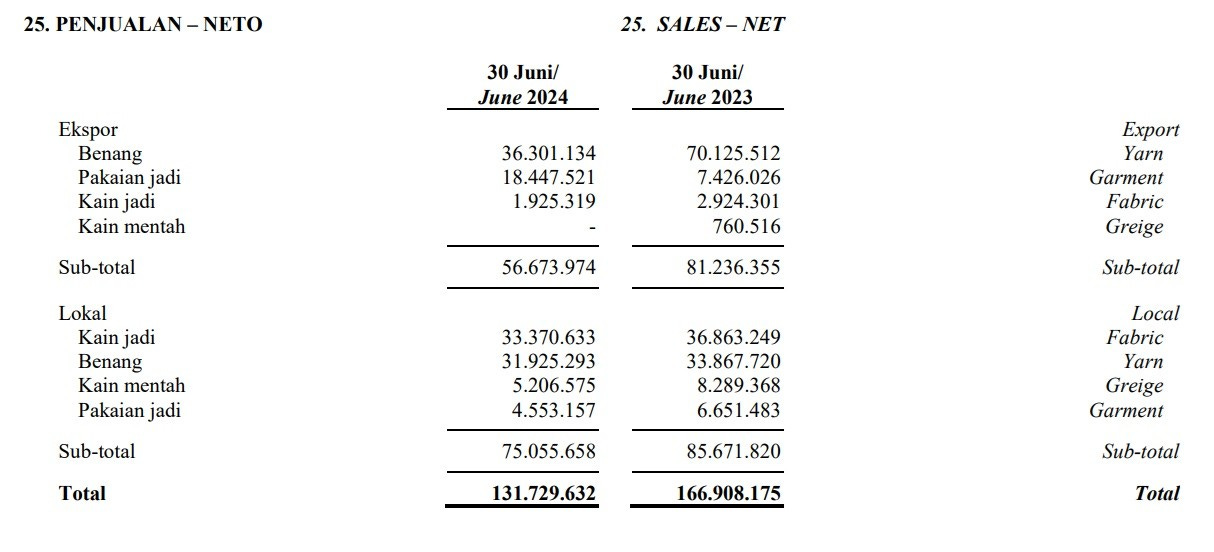
For the six months ended 30 June 2024 (1H24), Sritex’s total net sales fell 21.1% to USD 131.7 million year-on-year. Sritex’s performance was mainly dragged down by a 48.2% plunge in yarn exports to USD 36.3 million, while domestic sales also dropped 12.4% to USD 75 million.
Sritex made a gross loss of USD 18.5 million in 1H24, as its net sales were eroded by the cost of goods sold (COGS). The company reported USD 150.2 million in COGS, though this was lower than USD 198.3 million a year earlier. Let’s look at the breakdown.
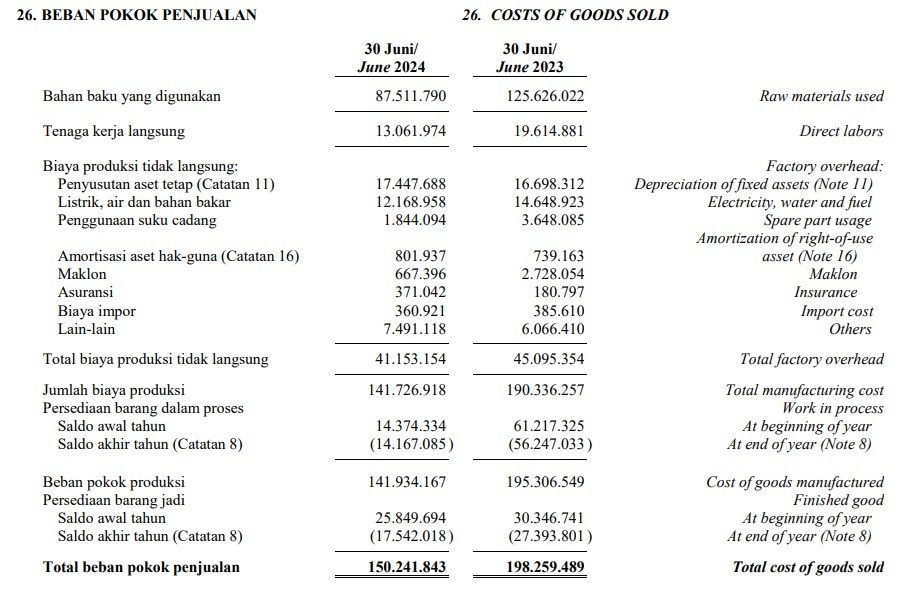
A big component of Sritex’s COGS was its USD 87.5 million raw material cost, which was already reduced from USD 125.6 million a year earlier. The company also cut its direct labour cost to USD 13 million from USD 19.6 million.
Cashflow is king, so this part is crucial.
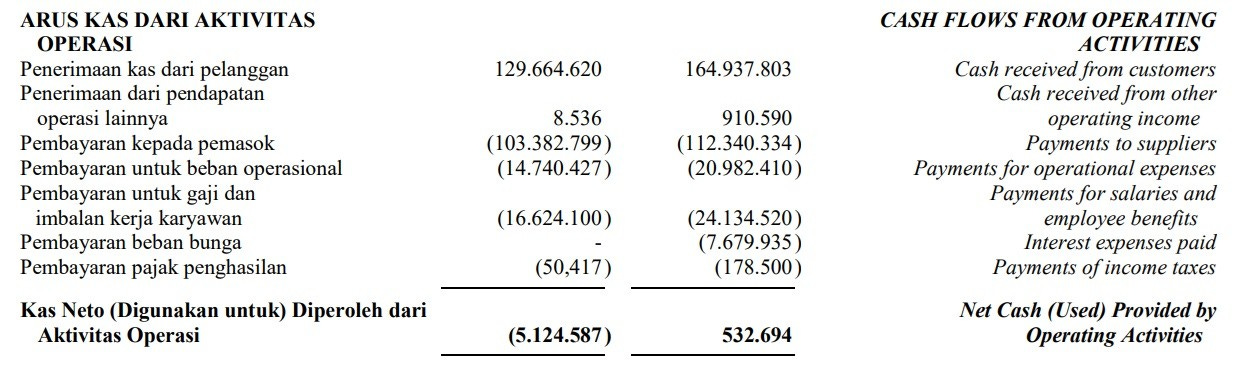
Sritex swung to a net operating cash outflow of USD 5.1 million, from an inflow of USD 532,694 a year earlier.
The company suppressed payments for operational expenses, salaries and employee benefits, as well as interest expenses. But this was not enough to offset the sharp drop in cash received from customers and other operating income, while payments to suppliers only dipped slightly to USD 103.4 million.
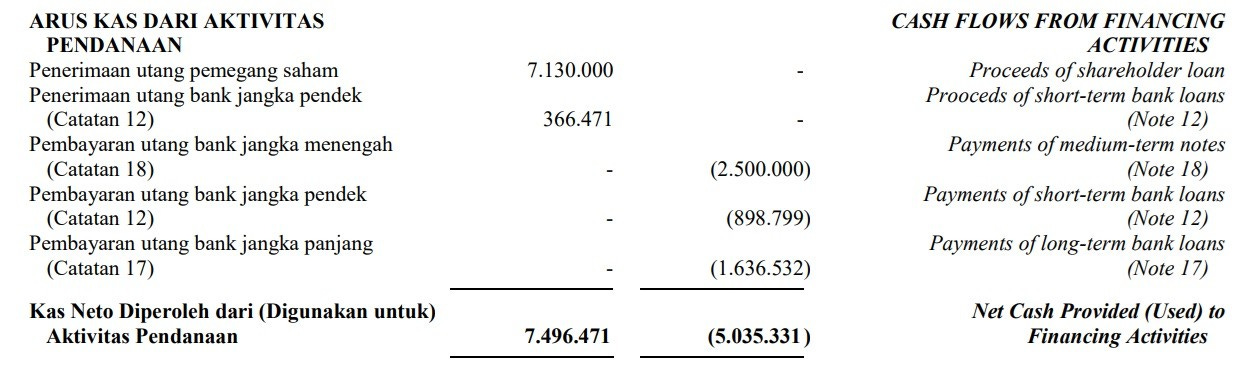
On the financing side, Sritex made no payments for its medium-term notes as well as short-term and long-term bank loans in 1H24. During the same period, the company received a USD 7.13 million shareholder loan, which propped up its cash on hand and in banks to USD 4.6 million at end-June.
Turning to the balance sheet, Sritex’s total liabilities stood at USD 1.6 billion, which included USD 828.1 million in bank loans, USD 375 million in bonds, and USD 18.7 million in medium-term notes.
These numbers indicate that a one-off capital injection would not be enough to turn around Sritex’s operations as its challenges are structural in nature. Saving Sritex’s workers would require a rational assessment of what needs to change – it cannot be business as usual if there’s no business.