

📚 Acrostics Anatomy: Novaland’s Debt Woes 2.0
Barely a year after completing a Singapore restructuring, the Vietnamese developer is back in a cash crunch.

💼 Brief Take: Novaland’s Debt Woes 2.0 (9 June 2025)
📸 Snapshot: Novaland’s Cash Crunch (14 June 2025)
📒 Quick Take: Novaland’s Chinese-Style Playbook (26 August 2025)
💼 Brief Take: Novaland’s Police Overhang (20 October 2025)
💼 Brief Take: Novaland’s Local Blueprint (8 December 2025)
💼 Brief Take: Novaland’s Debt Woes 2.0
9 June 2025
Novaland’s predicament seems to be a cross between the typical troubles in China and Indonesia.
Many Chinese developers are going through Round 2 of restructurings while Indonesia’s property sector is beset with red tapes.

Vietnamese developer No Va Land Investment Group Corporation (Novaland) is seeking consent from the holders of its outstanding USD 320.9 million 5.25% convertible notes due 2027 to waive certain and anticipated missed payments.
The proposal must be approved by holders representing at least 66% of the bonds, according to a statement dated 5 June 2025.
Eveline’s Take:
🔸 Barely a year since Novaland restructured the offshore bonds, it’s already missing payments and likely headed for a second round of restructuring. The Vietnamese developer won’t be able to pay VND 59 trillion (USD 2.3 billion) of debt until end-2026 due to legal hurdles plaguing its projects and is currently negotiating with creditors, local news agency VnExpress reported last month.
🔸 Novaland had to navigate legal obstacles for various projects in Ho Chi Minh City as well as the provinces of Dong Nai, Ba Ria-Vung Tau and Binh Thuan, according to The Investor. These delays reportedly arose from pending land clearance by city officials, compensation for the affected residents, and the finalization of land valuations.
🔸 The Vietnamese company’s latest predicament seems to be a cross between the typical troubles in China and Indonesia: Many Chinese developers are going through Round 2 of restructurings as the first rounds could not resolve their debt woes, while Indonesia’s property sector is also beset with red tapes and thorny negotiations with residents.
🔸 Novaland’s earlier restructuring was regarded as a “significant milestone” because it was the first cross-border prepackaged scheme of arrangement that was approved by the Singapore International Commercial Court (SICC). “This case also highlights the efficient and expeditious process facilitated by the SICC where the total elapsed time from case commencement to the approval of the Pre-pack Scheme was just 15 days,” according to an article written by BlackOak, a Singapore law firm that advised Novaland.
🔸 While a restructuring achievement is often linked to its complexity, novelty and other milestones, there’s a question mark over the effectiveness of the restructuring or the borrower’s compliance with the agreement down the road. The best restructuring should ideally be the last as it would have truly turned a company around, though a friend in the industry said that “restructurings are inevitably a compromise, thus lots of items need to be adjusted in the future.”
📸 Snapshot: Novaland’s Cash Crunch
14 June 2025
Novaland was heading towards a second debt restructuring as its cashflow was tied up by red tape in Vietnam.
This is a snapshot of the Vietnamese developer’s financial and legal challenges.
Barely a year after Novaland restructured its offshore bond in Singapore, the Vietnamese developer will likely have to negotiate another restructuring.
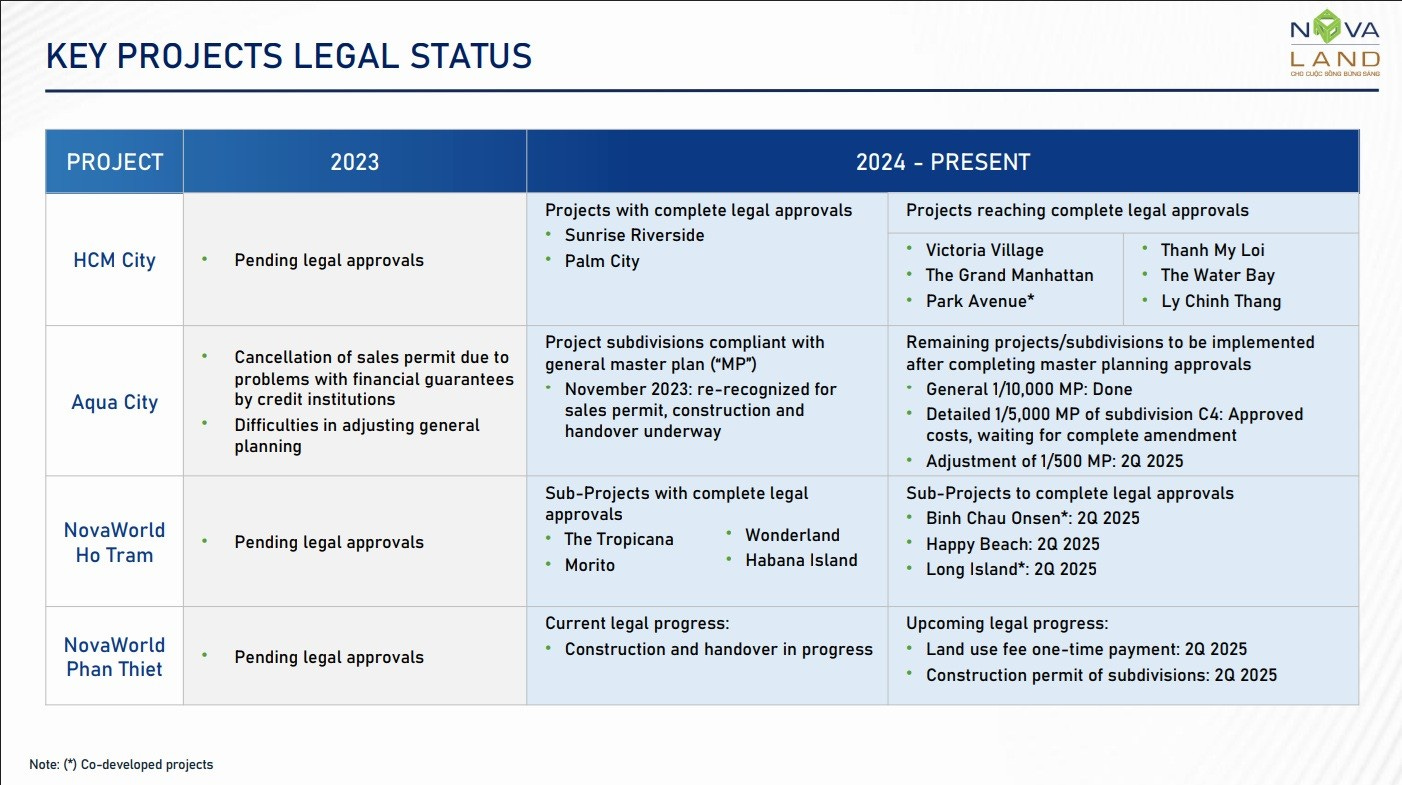
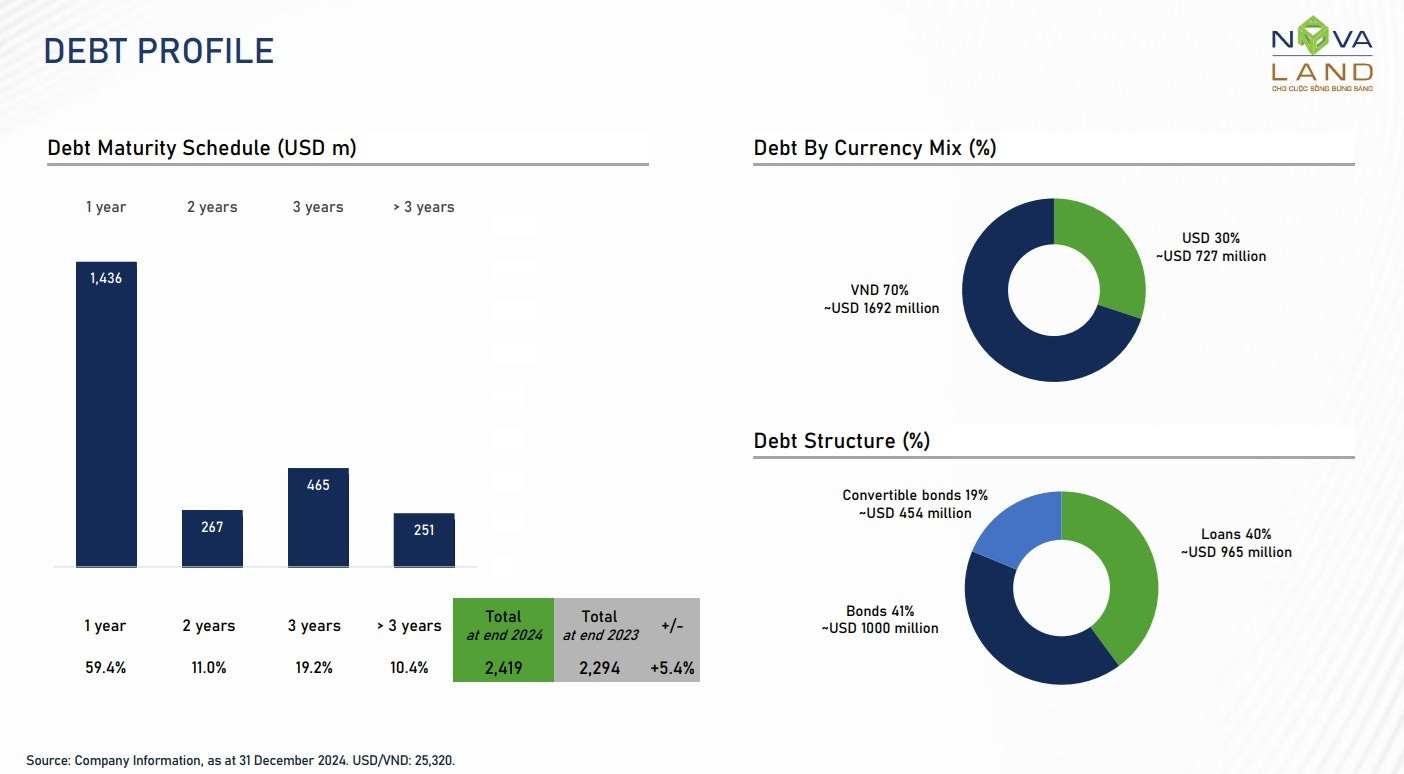
Here’s a snapshot of Novaland’s financial and legal challenges, based on its annual report and earnings presentation.
💵 Missed Payments
Early this year, Novaland informed the holders of its USD 320.9 million convertible notes due 2027 that it couldn’t pay the interest on 16 January 2025 because “the progress in resolving legal obstacles for real estate projects has not proceeded as planned”, substantially affecting its cash collection.
In a statement dated 5 June, Novaland sought consent from the offshore bondholders to waive certain and anticipated missed payments. The company announced on 12 June that it had obtained consent from holders representing 86.07% of the notes, above the minimum 66% threshold.
Novaland also missed payments on its domestic notes since the start of this year, according to local media. On 9 June, the developer announced its plan to seek a second extension for its VND 1.3 trillion (USD 50 million) bond.
📉 Heavy Losses
Revenue rose 90.7% to VND 9.1 trillion (USD 349 million) in 2024 from a year earlier, but almost all of it was consumed by the cost of goods sold and services rendered, leaving only a VND 84 billion gross profit.
Novaland swung to a net loss of VND 4.4 trillion in 2024, from a net profit of VND 486 billion a year earlier, mainly due to provisions. However, management said it has “the potential to reverse thousands of billions of dong in provisions” tied to its Lakeview City project this year as “the issues related to land use fees” have been resolved.
The developer reported a net operating cash outflow of nearly VND 6 trillion in 2024, though this was offset by net cash inflows of VND 4.2 trillion from investing activities and VND 3 trillion from financing.
📍 Auditor’s Flag
Under “Emphasis of Matter”, Novaland’s independent auditor drew attention to the going concern assumptions:
“The Group has prepared the Consolidated financial statements on a going concern basis, the validity of which is highly dependent on (1) negotiate with lenders and bondholders to reschedule the repayment of principal and interest as they fall due, (2) sell assets at expected prices, (3) collect pre-sales and sales proceeds from on-going projects and (4) obtain additional fundings from banks; and major shareholders will provide financial support to the Group as and when required in accordance with their letters of commitment.
These conditions, along with other matters as set forth in Note III.2, indicate the existence of a material uncertainty that may cast significant doubt on the Group’s ability to continue as a going concern.”
🚧 Legal Hurdles
📚 Debt Stack
📒 Quick Take: Novaland’s Chinese-Style Playbook
26 August 2025
The Vietnamese developer plans to swap a total of 320 million shares with shareholder loans and corporate bonds.
Novaland reported higher sales for the first half of 2025 but this was not matched by its underlying cash generation.

Vietnam’s No Va Land Investment Group Corporation (Novaland) seems to be adapting the playbook of Chinese developers for its latest debt restructuring.
I wrote in May that cash-strapped Chinese developers such as Sunac China Holdings had dropped the pretend-and-extend exercise by converting part of their debt into equity. I also flagged in June that Novaland was heading towards a second restructuring as its cashflow was tied up by the red tape plaguing its projects in Vietnam.
Novaland plans to issue a total of 320 million shares to settle some of its debt, The Saigon Times reported on 13 August. The company will swap more than 168 million shares or 8.6% of outstanding shares with VND 2.65 trillion (USD 100.6 million) of shareholder loans, while 151.85 million shares or 7.8% of outstanding shares would be exchanged with VND 6.07 trillion (USD 230.5 million) of corporate bonds.
A group of shareholders linked to Chairman Bui Thanh Nhon reportedly raised share-backed loans to support Novaland, reducing their collective ownership from 60.8% in June 2022 to 38.7% as of December 2024. After the debt swap, Novaland’s major shareholders – NovaGroup, Diamond Properties and the chairman’s family – will hold a combined stake of around 39.59%, according to The Saigon Times.
If the reported numbers are correct, it means that the shareholding of the chairman’s circle will only increase slightly even after their loans are converted into equity. This is likely because Novaland is also issuing new shares to bondholders, thus expanding its overall share base.
Cash Mismatch
On the surface, Novaland’s latest results may have showed a significant improvement.
Novaland reported a 62.5% increase in total sales to VND 3.7 trillion for the first half of 2025 from a year earlier. The developer also swung to a gross profit of VND 1.3 trillion, from a loss of VND 2.4 trillion, as it roughly halved the cost of sales and services rendered.
However, a deeper look into Novaland’s financials suggested that the headline numbers were not matched by its underlying cash generation, as net operating cash outflow widened to VND 7.5 trillion from VND 4.1 trillion a year earlier.
The increase in receivables indicated that Novaland may have booked sales without collecting the actual cash from customers, which had a parallel to the struggle of Chinese developers to free up cash from their projects to service debt.
However, Novaland’s net cashflow from investing activities jumped to VND 7.5 trillion from VND 2.1 trillion a year earlier, as it booked VND 11.2 trillion in proceeds from “divestment in other entities”. This suggested that Novaland has been selling assets or divesting stakes to shore up its liquidity.
In June, Novaland completed the transfer of a 49% stake in its subsidiary, Gia Duc Real Estate, in a deal worth nearly VND 1.73 trillion (USD 66 million), according to The Investor. Novaland reportedly acquired the company for nearly VND 2 trillion (USD 76 million) in 2017, which means that it was sold at a loss.
Unclogging Bottlenecks
Novaland encountered legal hurdles for various projects due to pending land clearance by city officials, the finalization of land valuations, and compensation for the affected residents.
The developer is likely to prioritize the resumption of delayed projects to ease the strain on its liquidity. Since mid-June, Novaland has secured legal approvals for two key developments, Aqua City and NovaWorld Phan Thiet, The Investor reported.
Novaland also reportedly won a legal dispute with South Korea’s Taekwang Vina over a project in Ho Chi Minh City. The Vietnam International Arbitration Centre (VIAC) upheld the claims of Novaland’s subsidiary, Gia Huy Real Estate Investment and Development, and ordered its South Korean partner to execute their 2018 contract, according to The Investor.
Even if Novaland manages to unclog the bottlenecks, it’s uncertain if there will be enough property buyers to bring in badly needed cash. But for now, every penny that the developer can squeeze out should still count.

💼 Brief Take: Novaland’s Police Overhang
20 October 2025
A potential overhang from a police probe into the use of Novaland’s bond proceeds may further constrict the developer’s funding channels.
Novaland failed to pay interest due 16 October on its offshore bond and will likely have to re-restructure it.

Vietnam’s government inspectorate has asked the police to probe real estate giant Novaland Investment Group for possible misuse of bond proceeds, Bloomberg reported on 20 October 2025.
Novaland said it had fully settled more than VND 15 trillion (USD 569 million) worth of bonds and had addressed existing issues.
Eveline’s Take:
🔸 A potential overhang from a police probe may further constrict Novaland’s funding channels and complicate its latest restructuring. The Vietnamese developer failed to pay the 16 October interest on its outstanding USD 335.3 million convertible notes due 2027, VnEconomy reported. Novaland is reportedly preparing to seek consent from bondholders to remedy this failure.
🔸 In June, I flagged that Novaland was headed for a second round of restructuring barely a year after extending the convertible notes via a Singapore prepackaged scheme of arrangement. The developer’s cashflow was tied up by legal hurdles plaguing its projects in Vietnam, such as pending land clearance from city officials.
🔸 I wrote in August that Novaland adapted the playbook of Chinese developers by converting some of its debt into equity, while working on the resumption of its delayed projects. In fact, there were some positive headlines last month that Novaland was set to restart a stalled residential project in the southern province of Dong Nai following key planning approvals.
🔸 However, the Government Inspectorate of Vietnam released a report on 17 October, requesting the Ministry of Public Security to investigate Novaland for allegedly misusing proceeds from bond sales between 2015 and 2023, according to Bloomberg. On 20 October, Novaland’s shares plunged by the daily limit of 7% in response to the news.
🔸 A police investigation could deal a blow to Novaland’s efforts to stabilize its finances. As I pointed out on 2 October, Asia’s high-yield market is essentially a confidence game where some lenders might be willing to put aside fundamentals if they believe that the company can line up other lenders to take them out. It would be premature to say that the music has stopped for Novaland, but the difficulty level has ratcheted up a notch.
💼 Brief Take: Novaland’s Local Blueprint
8 December 2025
The Vietnamese developer has mostly followed the Chinese template of prioritizing local creditors to avoid angering the authorities.
In the latest restructuring, offshore bondholders might be thrown to the back of the bus because of their structural disadvantages.

Novaland Investment Group is in talks to raise fresh funds to repay all of its retail bonds by June 2026, Bloomberg reported on 3 December 2025, citing the Vietnamese developer’s CEO Duong Van Bac.
Novaland had roughly VND 64 trillion dong (USD 2.43 billion) in debt as of 30 September, with retail bonds accounting for around 20% of its total obligations.
Eveline’s Take:
🔸 China is an export powerhouse for everything from coal and solar panels to steel and textiles. Now it can add property restructuring blueprints to that list.
🔸 Seven months ago, I wrote that Chinese developers such as Sunac China Holdings had dropped the pretend-and-extend exercise and the decks were stacked against offshore creditors because key information, assets and relationships were concentrated onshore.
🔸 I also noted in August that Novaland had adapted the Chinese playbook of converting some debt into equity, as its sales increase was not matched by cash generation. Since then, the Vietnamese developer had mostly followed the Chinese template of prioritizing local creditors, particularly retail bondholders, to avoid angering the authorities.
🔸 On 31 October, Novaland announced that it had received enough consent from the holders of its outstanding USD 335.3 million convertible bonds due 2027 to waive its “failure to pay in full the Third Partial Interest Payment” due on 16 October. The waiver was conditional on the company paying the balance of USD 642,455.10 by 16 November.
🔸 I flagged in June that barely a year after restructuring the offshore notes via a Singapore scheme of arrangement, Novaland was heading towards a second restructuring as its cashflow was tied up by red tape in Vietnam. In the latest round, the offshore bondholders might be thrown to the back of the bus because of their structural disadvantages.
🔸 The offshore notes were issued at the holding company level, while the operating entities took on loans and other domestic borrowings. If the offshore bondholders were to seek enforcement onshore, the local banks are likely to move to protect their interest – similar to what we’ve seen in China’s property battles.
🔸 Furthermore, Vietnam’s 2014 Bankruptcy Law is considered largely untested and ad-hoc negotiations with individual creditors remain the most common restructuring tool, according to a note by Hogan Lovells. From 2015 until March 2020, Vietnamese courts accepted fewer than 600 bankruptcy requests, of which the courts only granted over 100 bankruptcy orders.
🔸 This set-up is likely to favour local borrowers as they can essentially deploy a divide-and-conquer strategy – unless a foreign creditor is willing to take a shot and test Vietnam’s bankruptcy regime.
