

📚 Acrostics Anatomy: Indonesia’s SOE Circuit
How Indonesian state-owned enterprises really operate and raise funds.

📒 Quick Take: Indonesia’s SOE Dilemma Part 1 (5 September 2024)
📒 Quick Take: Indonesia’s SOE Dilemma Part 2 (10 September 2024)
📒 Quick Take: Indonesia’s SOE Dilemma Part 3 (13 September 2024)
📒 Quick Take: Indonesia’s Sovereign Halo Part 1 (9 February 2025)
📒 Quick Take: Indonesia’s Sovereign Halo Part 2 (11 February 2025)
📒 Quick Take: Indonesian SOE Banks’ Call of Duty (30 July 2025)
📒 Quick Take: Indonesia’s SOE Supremo (30 September 2025)
💼 Brief Take: The SOE Circles (17 October 2025)
📒 Quick Take: Indonesia’s SOE Dilemma Part One
5 September 2024
SOE Minister Erick Thohir is disappointed with a reduced share of the state budget.
Why Finance Minister Sri Mulyani Indrawati wants SOEs to rely less on her ministry.
Indonesia’s State-Owned Enterprises (SOE) Minister Erick Thohir is disappointed that his finance counterpart, Sri Mulyani Indrawati, has cut the budget for companies under his watch.
Indonesian SOEs were allocated IDR 277 billion (USD 17.9 million) in the 2025 state budget, lower than an earlier amount of IDR 284 billion, Thohir told a parliamentary commission on 2 September. This is “not apple to apple” with the tasks assigned to SOEs, which include collecting IDR 90 trillion (USD 5.8 billion) in dividends next year, he said.
To be fair, the budget does seem small relative to the capital expenditures of SOEs. On the other hand, Sri Mulyani has been consistent that SOEs should try to rely less on the Finance Ministry. In 2017, she reportedly sent a letter to the Energy and Mineral Resources Minister and SOE Minister at the time, asking them to rein in state utility Perusahaan Listrik Negara (PLN)’s runaway debt due to the risk of a cross-default to its government-backed loans.
The former World Bank managing director also said bluntly in an October 2022 speech that PLN must act like a professional institution and fix its “bleeding balance sheet”. Why did she seem to single out the power company?
The Institute for Energy Economics and Financial Analysis (IEEFA) estimated that PLN would have made a IDR 120 trillion (USD 7.8 billion) loss for its 2023 fiscal year without government subsidies and compensations. PLN’s liquidity ratio (0.92), quick ratio (0.79), and cash ratio (0.39) were all below 1, indicating that it is struggling to meet its urgent payment obligations with cash or current assets.
Apart from its liquidity, PLN’s accounting practice also came under scrutiny. In 2019, the Finance Ministry froze the license of PLN’s auditor for not fully adhering to professional standards when auditing its FY18 results. That fiscal year, PLN booked IDR 23.17 trillion (USD 1.5 billion) of “compensation income” – representing reimbursement from the government for setting electricity tariffs below its costs – even though the amount was not included in the state budget yet.
PLN was also supposed to receive discounts for gas purchased from its peer, Perusahaan Gas Negara (PGN), in exchange for allowing the state-owned gas producer to use its pipes without paying rent over several years. However, PLN went ahead to book IDR 7.02 trillion (USD 455.4 million) in prepaid expenses, while PGN basically argued this move was premature.
How SOEs do their accounting is not an arcane topic as it has a real impact on the management of state finances.
The SOE Ministry’s Deputy for Finance and Risk Management who is also a former EY partner, Nawal Nely, has spearheaded efforts to integrate SOE books—including their assets, liabilities and revenue—to prevent “double counting” from related party transactions. This is a positive step to increase SOE transparency and more technocrats should be encouraged to improve the system from within.
Still, strategic SOEs such as PLN and energy company Pertamina continue to depend on the Finance Ministry to raise funds and retain investor confidence. Several SOE bondholder friends said a key factor in their investment decision is what they believe to be the implicit backing of the Finance Ministry, under the stewardship of Sri Mulyani.
There’s now a question mark hanging over the minister’s plans in light of the incoming administration of President-Elect Prabowo Subianto. In June, six of the 10 biggest decliners in the Asia ex-Japan dollar bond market were notes issued by PLN, while some yield premiums for Pertamina and state-owned builder Hutama Karya also climbed, Bloomberg reported.
International investors trust Sri Mulyani and she has big shoes to fill if she does step down. This is the elephant in the room that should be addressed sooner rather than later.
📒 Quick Take: Indonesia’s SOE Dilemma Part Two
10 September 2024
Indonesian state-owned builder Waskita Karya’s loan extension fits the pattern of SOE debt restructurings.
Local banks were trying to offload their bad loans via a sukuk swap pioneered by Bank Muamalat.
Indonesian state-owned builder Waskita Karya signed an agreement last Friday to extend IDR 26.3 trillion (USD 1.7 billion) of loans until 2032.
The journey was no walk in the park and the deal paves the way for Waskita to be consolidated under its peer, Hutama Karya, to form a holding company focusing on toll road construction. Another state-owned builder, Wijaya Karya, completed its debt restructuring in January 2024.
These loan rollovers fit the pattern of SOE debt restructurings. In 2021, state-owned plantation company Perkebunan Nusantara (PTPN) also restructured around IDR 41 trillion (USD 2.6 billion) of loans, including a USD 390.6 million syndicated loan extension by up to eight years.
A banker friend said the unsecured syndicate lenders had to accept the restructuring terms because they lacked negotiating power (banks participating in the loan syndication were restricted from taking PTPN’s assets as collateral due to a “negative pledge” in its earlier financing from World Bank). A restructuring deal was also a prerequisite for PTPN to receive around IDR 4 trillion (USD 258.7 million) of state capital.
Most news headlines stop at the signing ceremonies, but what happens to the loans next?
Indonesia’s non-performing loan (NPL) ratio has stayed relatively low at 2-3%, with a slight increase during the pandemic. However, a restructuring friend and a debt investor said the scale of restructured or extended loans sitting in the books is unclear, especially for state-owned banks that are often asked to help their distressed peers.
The financial regulator is studying President Joko Widodo’s proposal to reinstate a Covid-era policy that exempts banks from making loan provisions, Reuters reported. The pandemic worsened loan quality, but some banks were also mismanaged.
Indonesia Eximbank’s gross NPL ratio hit 43.5% at end-2023 mainly due to “overfinancing”, Director Riyani Tirtoso told the parliament. The state-owned institution also lacked an early warning system and decisions were approved “in a circular manner”.
The banks did try to do something about their NPLs. In 2017, Bank Permata sold a batch of loans for IDR 1.1 trillion (USD 71.1 million), sparking hopes that it would herald more NPL deals in Indonesia. However, the NPL buyers failed to enforce their claims against one of the borrowers, Pelita Cengkareng Paper (PCP), via their Luxembourg entity Molucca Holdings.
PCP’s lawyer Hotman Paris argued that the loan transfer agreement was invalid and accused Permata and the investors of using offshore vehicles to evade Indonesian taxes. Molucca countered that the assignment of receivables is a common practice between domestic and international lenders and that PCP made “frivolous and baseless claims” to avoid paying its debt.
The PCP dispute deterred some foreign investors from buying Indonesian NPLs, prompting banks to consider other options. State-owned banks also had to be more creative as they feared being punished for realizing state losses.
In November 2021, Bank Muamalat Indonesia swapped its NPLs with 20-year Islamic bonds (sukuk) issued by state-owned asset manager Perusahaan Pengelola Aset (PPA). This is how they transformed bad loans into investment-grade assets:
Cinda International Asset Management acted as an intermediary by subscribing to the sukuk and on-selling it to Muamalat. The sukuk sale proceeds were used to acquire Muamalat’s NPLs at par value.
Muamalat transferred the NPLs to a local entity, PT AMC Indonesia Sukses, closing a potential loophole that was exploited in the PCP case.
The sukuk was booked at acquisition cost, meaning that the recorded value only had to be agreed between buyer and seller.
PPA then managed the NPLs, with any loan recovery flowing to Muamalat which is controlled by Hajj Fund Management Agency (BPKH).
State-owned banks hoped to offload their NPLs via this sukuk swap as this would allow them to kick the can without taking a haircut. However, PPA has struggled to raise money from third-party investors, shelving its plan to issue offshore bonds for refinancing in 2021 amid tepid market response.
While restructuring innovations have bought SOEs more time, the biggest breakthrough will be preventing bad loans in the first place and restoring investor confidence.

📒 Quick Take: Indonesia’s SOE Dilemma Part Three
13 September 2024
Indonesian state-owned asset manager Perusahaan Pengelola Aset (PPA) has been buying time for its distressed peers.
Why it’s harder for Indonesia to emulate South Korea’s success in unclogging bad loans.
Indonesian state-owned asset manager Perusahaan Pengelola Aset (PPA) has been buying time for its distressed peers.
PPA was tasked with revitalizing troubled SOEs and unclogging non-performing loans accumulated by state-owned banks. One of the methods is to swap the bad loans with Islamic bonds (sukuk) that will mature in up to 20 years. The exchange kicks the bomb down the road, but the only way to defuse the bomb is for the underlying business to turn around or for the SOEs to get new money.
This is where the challenge lies. PPA had to shelve its plan to issue offshore bonds in 2021 as third-party investors were not convinced about its ability to recover the loans. The investors had a valid question: How will PPA be better than the state-owned banks at enforcing the loans?
Indonesia is not the only country that tried to clean its system. China’s top four asset management companies (AMCs) were designed to unload bad loans, but ended up with their own property baggage.
South Korea seems to have more success, slashing its non-performing assets (NPA) from 18% of total loans after the Asian Financial Crisis to a “best-in-class” 0.5%, according to a 2021 article by Raunaq Pungaliya, an academic at Sungkyunkwan University.
Pungaliya wrote that the main ingredients of South Korea’s experience were:
Creating a bad bank called KAMCO (Korea Asset Management Corporation) and a state-backed fund for NPA resolution
Harmonizing NPA reporting requirements
Forming a secondary market and an online bidding system for NPAs
Establishing a legal framework that allows for multiple resolution techniques
Setting up a database of recoveries to aid price discovery
Indonesia’s property sector is nowhere as bad as China’s (several Indonesian developers managed to tap onshore bank loans to take out their offshore bonds over the last few years). However, Indonesia also has specifics that make it harder to emulate South Korea.
First, Indonesian state-owned bankers tend to avoid principal haircuts on worries that they will be accused by the state auditor of realizing state losses, which may even lead to criminal prosecution.
One of the lessons from South Korea is that transparency around asset quality and pricing is key to creating a secondary market where bad loans can be traded commercially. Instead, Indonesian bankers are tiptoeing in the shadows for fear of being prosecuted, hiding zombie loans in the books even though these have close to zero chance of recovery.
Errant bankers shouldn’t get away scot-free, but a culture of fear also backfires because nobody wants to own up and fix the mess, especially if they inherited legacy loans from their predecessors.
Second, enforcement has always been a risk in Indonesia, where some borrowers engaged lawyers such as Hotman Paris to search for loopholes or structural weaknesses to reject creditor claims. Hotman also threw nationalism into the mix, accusing Bank Permata and its loan buyers of using “fictive” offshore companies to avoid paying Indonesian taxes.
These features of the Indonesian system have made it an uphill task for PPA to attract genuine investments. Nevertheless, PPA has hired professionals, including industry and legal specialists, to solve the long-standing NPL problem, according to a friend close to the SOEs.
Another friend with corporate finance and restructuring experience said that investors may consider lending to Indonesian SOEs directly, with the right structure and security. But the question is whether SOEs are willing to offer their assets as security – some are constrained by a “negative pledge” in their financing from World Bank, while others see collateral as unnecessary given their sovereign association.
Crucially, the direction of the SOEs depends on who’s in charge. As early as July, several people close to incoming President Prabowo Subianto already took key positions in strategic SOEs, according to the Jakarta Post.
Among them, Burhanuddin Abdullah—an economist who led the expert council of Prabowo’s presidential campaign—was appointed as the president commissioner of state utility Perusahaan Listrik Negara (PLN).
In Indonesia, transaction structures can be negotiated but the captain of the ship is even more important.
📒 Quick Take: Indonesia’s Sovereign Halo Part One
9 February 2025
The decoupling of SOE and state losses would be positive if state-owned banks can deploy capital to better borrowers or more productive sectors.
But it also raises questions among investors and lenders on who will be responsible for SOE losses.

Indonesia has overhauled a law governing state-owned enterprises (SOEs), giving birth to Danantara – a new investment fund inspired by Singapore’s Temasek – along with questions on how SOEs will operate from now on.
I’ve written since November 2024 about the reason for Danantara’s existence, the gameplan for the fund, and why its architects had to amend the existing SOE law to lay its legal foundation. I also flagged last month that the establishment of Danantara was picking up pace after a delay.
So when the Indonesian parliament passed the law on Tuesday (4 February 2025), I wasn’t surprised and I went on doing my own thing. But over the weekend, one of my friends sent me an article that reported a key point: Clause 4B in the latest SOE law states that “profits or losses incurred by SOEs are the profits or losses of the SOEs.”
“The capital and wealth (modal dan kekayaan) of SOEs belong to the SOEs and all the profits or losses incurred by the SOEs are not the profits or losses of the state,” the clause said. An editor at local newspaper Kontan wrote, citing a legal practitioner, that the revision to the SOE law seems to encourage officials to be “bolder in making decisions and not be intimidated by the prospect of state losses.”
Why is this significant?
All along, SOE officials have been operating in fear of being accused by the state auditor of realizing state losses, which may even lead to criminal prosecution. As I wrote last year, state-owned bankers preferred rolling over defaulted loans rather than taking principal haircuts, especially if they inherited legacy credit from their predecessors.
So the decoupling of SOE and state losses would be positive if these state-owned banks can now write off the zombie loans in their books and deploy the capital to better borrowers or more productive sectors. However, the flip side is it raises questions among investors and lenders on who will be responsible for SOE losses.
First of all, there seems to be a misperception that the government provides a blanket backstop to all SOEs. The reality is all SOEs are equal, but some are more equal than others. The first offshore bond with a direct guarantee from the government was issued in 2020 by Hutama Karya, which is building the Trans-Sumatra toll road – a key project in former President Joko Widodo’s infrastructure drive.
Many investors believe that energy company Pertamina and power distributor Perusahaan Listrik Negara (PLN) are strategic SOEs and the government will never let them default. Even though some of their debt may not carry any government guarantee in black and white, these SOEs have been able to raise billions of dollars from the market because of what a second friend calls the “sovereign halo”.
With the creation of Danantara, rating agencies will also have to decide how to assess this entity if it issues debt at the holding company level. As I pointed out in December 2024, the typical option of pegging certain SOEs below the sovereign rating may not work if Danantara’s debt is classified outside the government’s balance sheet.
Now that the SOE law has been passed, lawyers and analysts will likely get calls on the potential implications.
📒 Quick Take: Indonesia’s Sovereign Halo Part Two
11 February 2025
Indonesia’s latest SOE law may help state-owned banks to unclog their bad loans, but independent asset pricing is key to attract private investors.
Some investors question how Indonesia’s regulatory changes will affect SOE leverage and governance.

Indonesia’s revised law for state-owned enterprises (SOEs) has generated a lot of discussion, with some calling it a potential game-changer.
Apart from laying the foundation for Danantara, the so-called Indonesian Temasek, the amended law also decoupled SOE and state losses. While this could remove the Sword of Damocles that’s been hanging over state-owned banks, there might also be unintended consequences for key SOEs like power distributor Perusahaan Listrik Negara (PLN) and energy company Pertamina.
I’ve collected the feedback from friends and commenters so far into two buckets.
🏦 State-Owned Banks
If state-owned banks can recognize losses without the threat of a criminal prosecution for the officials involved, this could hopefully encourage them to fix the problem instead of sweeping it under the rug.
To use the analogy of a banker who stuffed bad loans into a suitcase that grew bigger and bigger, the hard work going forward is to open that suitcase and sort through the baggage.
I wrote last year that based on South Korea’s post-Asian Financial Crisis experience, transparency around asset quality and pricing is key to creating a secondary market where bad loans can be traded on a commercial basis. One of the commenters also pointed out that Thailand is an example of how a market for non-performing loans can develop.
In Indonesia, the first step to clean up the system is to catalogue the SOE losses and then transfer the distressed assets or loans to state-owned asset manager Perusahaan Pengelola Aset (PPA), a second commenter said, noting that independent appraisal and valuation would be needed to attract bids from private financiers and investors.
Even if PPA was designed to be the cleaning house for distressed SOE assets, it would likely be overloaded by the sheer volume, so the private market should also be allowed to function.
However, a veteran banker friend cautioned that the market mechanism would simply be an “illusion” if there’s only a shallow pool of bidders and the auction ends up being engineered among a group of friends. In short, there must be enough real bids for the SOE assets.
⚡ PLN & Pertamina
Indonesia has a parallel with China, where investors have been trying to read the tea leaves on which SOEs or local government financing vehicles (LGFVs) are supposedly closest to the sun. The true test of whether the firefighters will come or not is for an actual fire to break out, but nobody wants that to happen.
While the Indonesian government is required to cover the operational shortfall incurred by PLN and Pertamina to fulfill their public service obligations, this is not the same as guaranteeing their financial debt.
I wrote last week that many bankers and bondholders have lent to PLN and Pertamina on the belief that they are strategic SOEs whose debt is implicitly backed by the state. In short, these creditors are betting that both SOEs are too big to fail and the Indonesian government will step in to prevent any default.
Without government subsidies and compensations, PLN would have made a loss of IDR 120 trillion (USD 7.3 billion) for its 2023 fiscal year, according to an analysis by the Institute for Energy Economics and Financial Analysis (IEEFA). There’s always been a push-and-pull between commercial and public service goals, but this tension could be even more pronounced if PLN ends up being consolidated into Danantara.
A buyside friend said there are concerns about how Indonesia’s regulatory changes will affect SOE leverage and governance, but there is “not much clarity at the moment.” PLN will likely have to field questions from bondholders on the strength of its state backing, as it is reportedly preparing to sell as much as USD 1.5 billion of notes.
While the latest SOE law may help state-owned banks to unclog their bad loans, PLN and Pertamina may also face more scrutiny from investors. It remains to be seen what the net effect will be.
📒 Quick Take: Indonesian SOE Banks’ Call of Duty
30 July 2025
Indonesian state-owned banks have been upstreaming dividends, channeling loans for the president’s initiatives, and supporting their troubled peers.
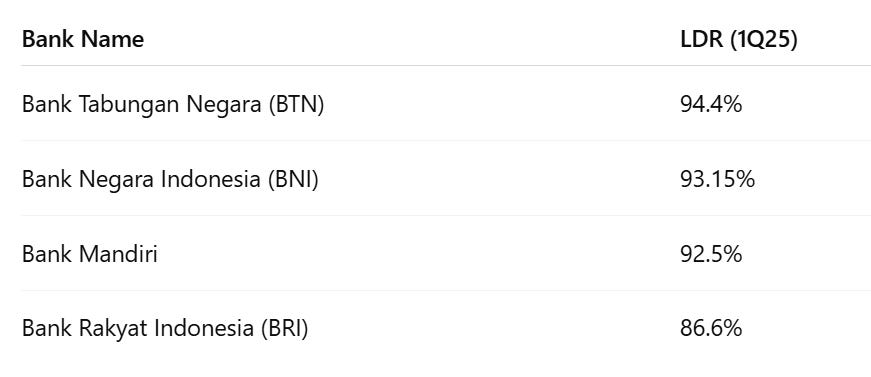
BTN, BNI and Bank Mandiri reported loan-to-deposit ratios above 90% as of March 2025, indicating tighter liquidity.
Indonesian state-owned banks have been doing their fair share of national service, such as upstreaming dividends, channeling loans for President Prabowo Subianto’s initiatives, and supporting their troubled peers.
For example, a big chunk of Indonesian sovereign fund Danantara’s roughly USD 400 million shareholder loan to flag airline Garuda Indonesia was funded by dividends from the state-owned banks. These lenders have also been called upon to back the president’s signature projects, including nation-wide housing and cooperatives schemes.
Out of the four main state-owned banks, three reported loan-to-deposit ratios (LDR) above 90% as of March 2025, indicating tighter liquidity: Bank Tabungan Negara (BTN) had the highest LDR at 94.4%, followed by Bank Negara Indonesia (BNI) at 93.15% and Bank Mandiri at 92.5%, according to their disclosures. Bank Rakyat Indonesia (BRI) had the lowest LDR at 86.6%.
Indonesia has an ambitious plan to build three million affordable homes, with an initial USD 8 billion financing scheme reportedly backed by Danantara and the state-owned banks. Last week, the president also launched the first batch of the so-called Red and White Cooperatives, which aim to disburse as much as USD 15 billion in state-bank loans directly to local communities, according to Bloomberg.
Finance Minister Sri Mulyani Indrawati announced on 28 July that Indonesia will tap its budget surplus – including funds placed at the Central Bank – to boost the liquidity of BRI, BNI, Mandiri and state-owned Islamic lender Bank Syariah Indonesia (BSI), which are financing the cooperatives. The 2025 state budget surplus currently stands at IDR 457.5 trillion (USD 28 billion), state news agency Antara reported.
Infrastructure Debt
Given the current president’s penchant for large-scale programs, there’s a risk of a growing funding gap that state-owned banks may have to find ways to bridge.
These lenders already have a sizeable exposure to SOEs in the infrastructure sector, which borrowed heavily to build airports, railways and toll roads under former President Joko Widodo.
Danantara will restructure the debt incurred to build the Jakarta-Bandung high speed rail, Bloomberg Technoz reported last week, citing Chief Operating Officer Dony Oskaria. Indonesian SOEs in the consortium include state-owned builder Wijaya Karya, rail operator Kereta Api Indonesia (KAI), and toll road company Jasa Marga.
The USD 7.3 billion project was significantly delayed, with Indonesia bearing the USD 1.2 billion cost overrun, according to an article by the Lowy Institute. To cover some of the ballooning costs, China Development Bank (CDB) reportedly gave KAI a nearly IDR 7 trillion (USD 426.8 million) loan.
Danantara also aims to consolidate seven Indonesian state-owned builders into just three companies in the second half of this year. The state-owned banks typically roll over loans to their peers, including the construction companies, but I wrote in April that a more novel way to kick the can down the road has emerged in recent times: Swapping non-performing loans with 20-year Islamic bonds or sukuk. (I’ve mapped out the transaction structure here).
BTN already pulled the trigger on the sukuk swap, but the other state-owned banks were taking a wait-and-see approach as the decision now lies with Danantara, according to friends familiar with the matter.
If the state-owned banks keep answering the call of duty, they may eventually call for help too.
📒 Quick Take: Indonesia’s SOE Supremo
30 September 2025
Indonesian sovereign fund Danantara controls the restructurings and consolidations of the country’s sprawling SOEs.
However, it may eventually run into a similar challenge faced by state-owned asset manager PPA to resolve the underlying bad debt.
Indonesian sovereign fund Danantara reigns supreme over the operations of the country’s state-owned enterprises (SOEs), with overarching control of their restructurings and consolidations.
On 26 September 2025, Indonesian lawmakers agreed to dissolve the SOE Ministry and replace it with a regulatory agency (BPBUMN). This agency will retain the government’s 1% “golden share” in the SOEs, while Danantara holds the remaining 99% and acts as the operator, the Jakarta Globe reported.
SOE Minister Erick Thohir – who was first appointed to the position by former President Joko Widodo in 2019 – was reassigned to the Youth and Sports Ministry. Danantara’s Chief Operating Officer who was previously Thohir’s deputy, Dony Oskaria, will be the acting head of the SOE Ministry during the transition period.
When the SOE law was revised in February 2025 to create the legal foundation for Danantara, the profits and losses incurred by the SOEs were decoupled from the state. Since then, the SOEs have directly upstreamed dividends to Danantara, which determines how to distribute these funds.
Oskaria said in June that the SOEs will no longer receive a state capital injection (penanaman modal negara) from the Finance Ministry because state-owned assets are now managed by Danantara. If the SOEs need support from the government, this will come from Danantara instead of the state budget.
Danantara is set to accelerate the restructurings of SOEs including flag airline Garuda Indonesia and steel maker Krakatau Steel, on top of consolidating state-owned builders and the subsidiaries of energy giant Pertamina, Oskaria told local media.
I wrote last week that a potential merger between Garuda and Pertamina’s aviation unit, Pelita Air, is likely driven by the need to pool plane components amid an industry-wide shortage. Despite the resistance from some politicians, Oskaria reportedly said on 29 September that the merger will go ahead.
The state-owned airline consolidation has been included in Danantara’s “working plan” this year, according to Oskaria. He sought to assure members of a parliamentary commission overseeing SOEs that the merger with Garuda should not drag down Pelita Air’s service quality.
PPA Precedent
In the previous administration, Indonesian state-owned asset manager Perusahaan Pengelola Aset (PPA) spearheaded the restructurings and the clean-up of distressed debt in the SOE sector. However, PPA became less active under President Prabowo Subianto, as Danantara has firmly taken over the role of turning around the SOEs.
Danantara’s goal to slim down the number of SOEs from as many as 1,050 to around 200 companies should help to reduce business overlaps and pool resources more effectively. But the fund may eventually run into a similar challenge faced by PPA to resolve the underlying bad debt.
PPA was supposed to take the non-performing loans (NPLs) off the state-owned banks while being funded by the same banks. This means that its operating model was effectively circular unless it could attract third-party investors or recover the soured loans.
In 2021, PPA tested the market for a potential offshore bond – out of which around IDR 2.3 trillion (USD 137.8 million) would be allocated for refinancing – but the asset manager had to shelve the issuance because investors questioned how it would actually make money.
Indonesia is not alone, as China is also trying to figure out how to clear its unpaid bills. I wrote on 12 September that getting the state-owned banks to absorb the NPLs in China’s property sector could create another problem down the road if there’s no market mechanism for bad debt to exit the system.
As the boss of Indonesia’s SOEs, one of the most challenging tasks in Danantara’s clean-up operation is deciding who should take the biggest hit, but this would likely take an extraordinary level of commitment.
💼 Brief Take: The SOE Circles
17 October 2025
China and Indonesia have one thing in common: the circularity of their state-linked entities.
Both countries need to break this cycle by getting third-party funding and unclogging their bad debt.

Beijing is ramping up support towards clearing public-sector arrears owed to businesses, but some localities may hesitate to take on new bank loans due to cost concerns, Caixin reported on 15 October 2025.
Eveline’s Take:
🛟 China and Indonesia have one thing in common: the circularity of their state-linked entities. China’s LGFVs are vehicles for local governments to raise off-balance-sheet debt, such as loans and bonds that are taken up by state-owned banks and other domestic investors. Indonesian SOEs are also interconnected via a web of criss-crossing relationships, including bank and trade debt.
🛟 I wrote on 12 September that China is moving to clear the unpaid bills that have stifled business recovery for years, but transferring the risk from local governments to the banking sector may create another problem down the road if there’s no market mechanism for bad debt to exit the system.
🛟 Arrears owed by local governments likely reached around CNY 4.5 trillion (USD 632 billion) this year, more than 3% of China’s GDP, Caixin reported, citing an estimate by China Chengxin International Credit Rating. China’s “Big Six” state-owned lenders and 12 joint-stock banks were tasked with helping to clear some of these arrears, such as by supporting local SOEs and LGFVs.
🛟 However, several bankers told Caixin that most of the arrears owed by the SOEs stemmed from projects that they took on behalf of local governments. Issuing new loans to these SOEs may amount to creating more off-the-books government debt, one of the bankers said.
🛟 In Indonesia, the SOEs have been practising “gotong royong” or burden-sharing for years. Flag airline Garuda Indonesia, for example, owed trade payables to its state-owned peers including energy giant Pertamina, ground service provider Gapura Angkasa and airport operator Angkasa Pura. It also reported long-term loans from state-owned lenders such as Bank Negara Indonesia (BNI), Bank Rakyat Indonesia (BRI) and Bank Mandiri.
🛟 The state-owned banks rolled over their loans to Garuda while Pertamina is converting the airline’s fuel debt into equity. Sovereign fund Danantara also injected capital to plug Garuda’s negative equity, which partly came from the dividends pooled from other SOEs. As I wrote yesterday, Indonesia is on an all-out mission to turn around the national carrier.
🛟 Another similarity between Indonesia and China is their need to break the circularity of their SOEs by getting third-party funding and unclogging their bad debt. While both countries seem to be trying to do something, their success depends on whether there are enough takers outside their SOE circles.