

📚 Acrostics Anatomy: Indonesia’s Policy Disconnect
The disconnect between President Prabowo Subianto’s ambition and the economic reality is becoming starker.

📒 Quick Take: Indonesia’s Growing Disconnect (6 May 2025)
📒 Quick Take: Indonesia’s Looming Storm (18 July 2025)
📒 Quick Take: Indonesian SOE Banks’ Call of Duty (30 July 2025)
📒 Quick Take: Indonesia’s Groundswell of Anger (2 September 2025)
🔎 Highlights: Sri Mulyani’s Translated Instagram Post (31 August 2025)
💼 Brief Take: Indonesia’s Tipping Point (9 September 2025)
🔎 Highlights: Tempo’s Podcast on Sri Mulyani’s Exit (13 September 2025)
📒 Quick Take: Indonesia’s Growing Disconnect
6 May 2025
The economy grew at the slowest pace in over three years and far below the president’s 8% target.
Indonesia cannot have its cake and eat it too.
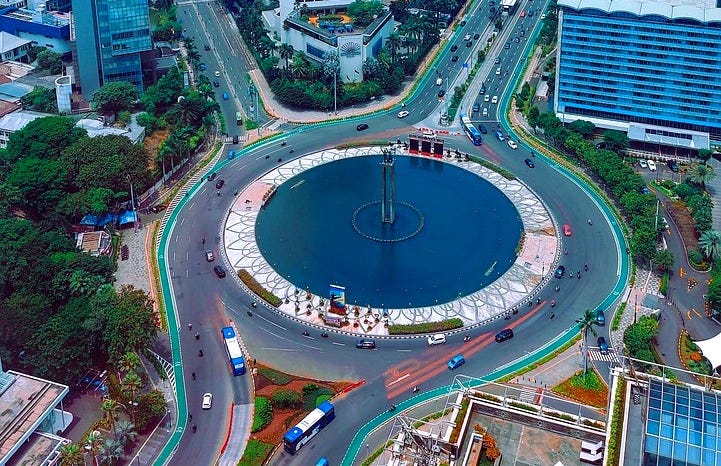
The disconnect between Indonesian President Prabowo Subianto’s ambition and the reality on the ground is becoming starker by the day.
I flagged that Indonesia’s economy was likely weaker than what the numbers previously stated because of these tell-tale signs:
Widespread layoffs in the labour-intensive manufacturing sectors such as textiles. Many of these jobs are not coming back because it’s cheaper to produce elsewhere.
Indonesians are dipping into their savings, as indicated by the loan-to-deposit (LDR) and current and savings account (CASA) ratios. This may translate into a higher cost of funds for local banks.
Mortgage defaults are climbing, which suggests that stress is building in the lower and middle-income classes.
Official data released yesterday showed that Indonesia’s economy grew 4.87% in the first quarter of 2025, the slowest pace in more than three years and far below the president’s 8% target.
Economists were counting on government spending to pick up the slack from lacklustre consumption, yet it contracted by 1.38% in 1Q25 due to “policy adjustments and sluggish disbursement”, according to a note from Bank Mandiri.
The president ordered massive spending cuts to fund his signature free school lunch program, which has been marred by food poisonings on top of costing a whopping USD 10 billion this year. Feeding children is a worthy cause, but the problem is it’s coming at the expense of other areas, such as infrastructure development and higher education funding.
I wrote that Indonesian state-owned builders Wijaya Karya and Waskita Karya are struggling to dig their way out of their debt pile as the state budget for construction has shrunk under the current administration. Flag airline Garuda Indonesia is also grappling with the costs to restore its grounded planes and service its debt while being constrained from increasing ticket prices.
There’s talk that Indonesian officials are working on raising funds to save Garuda via new sovereign fund Danantara, but potential investors will likely ask whether there’s going to be a state guarantee.
While state-owned enterprises such as Perusahaan Listrik Negara (PLN) and Pertamina have raised billions of dollars thanks to a so-called implicit state backing, I wrote that this “sovereign halo” would come under higher scrutiny from the market given the latest developments.
In short, Danantara has the potential to be a new engine for growth, but it’s also not a saviour who can rescue the troubled SOEs without breaking a sweat. Even if Garuda could pull off a fourth restructuring, the state-controlled carrier would still find it hard to make money if the government maintains the cap on domestic airfares. The president also asked Garuda to offer the cheapest rates possible for the Muslim pilgrimage to Saudi Arabia.
Indonesia cannot have its cake and eat it too – the question is whether the leaders can accept this and make a choice before it’s too late.
📒 Quick Take: Indonesia’s Looming Storm
18 July 2025
Indonesia is facing a gathering storm that will pick up speed as the impact of its trade deal with the US ripples through the economy.
The deal is a triple whammy of Indonesia.

Indonesia is facing a gathering storm that will pick up speed as the impact of its trade deal with the US ripples through the economy.
I flagged back in March that rainy days were in store as Indonesians were dipping into their savings amid mass layoffs in the manufacturing industry. I also wrote in May that the disconnect between President Prabowo Subianto’s ambition and the reality on the ground was widening as official data confirmed the economic slowdown.
Indonesia is now staring at a full-blown storm due to factors that were both within and beyond its control. It’s always going to be challenging to negotiate with US President Donald Trump and details of the trade deal have not been released, but there’s no denying that Indonesia is getting the shorter end of the stick.
The US lowered tariffs to 19% from its initial threat of slapping 32% on Indonesia, but the Southeast Asian country committed to USD 15 billion in American energy, USD 4.5 billion in agriculture and 50 Boeing jets in return. “This is an extraordinary struggle by our negotiating team led by the Coordinating Minister for Economic Affairs,” an Indonesian presidential spokesman said.
It’s basically a triple whammy for Indonesia, where shoes and textile exporters are smacked with higher tariffs, farmers will be hit by US imports such as corn and soybeans, while the finances of state-owned enterprises (SOEs) including flag airline Garuda Indonesia and energy company Pertamina could be strained even more.
The biggest blow will likely be sustained by millions of Indonesians who are out of work or at risk of losing their jobs. I warned in February that Indonesia was experiencing a wave of layoffs because of the job cuts in the manufacturing and startup sectors, but there doesn’t seem to be a new engine to fuel the economy.
Thousands of jobseekers flooded employment fairs in recent months, with people reportedly fainting while jostling with each other. Throngs of applicants also packed the streets in the Indonesian town of Cianjur this week, vying for a role that opened up at a retail store, according to a widely circulated video.
Public Interest
Indonesian sovereign fund Danantara Indonesia was established in February to be a new catalyst for growth through the consolidation of SOEs and increased leverage. (Click here for a compilation of my takes on Danantara’s genesis).
While Danantara has reportedly lined up USD 3 billion from foreign banks and is seeking to borrow more, the initial round was earmarked to finance the petrochemical project of Indonesian billionaire Prajogo Pangestu’s Chandra Asri as well as to co-invest with the wealth funds of Qatar and China. It’s unclear whether these investments would translate to the creation of a lot more jobs for Indonesians.
Last week, Finance Minister Sri Mulyani Indrawati took a rather extraordinary step of reminding Danantara on Instagram that its investments should be “rooted in the interest of the public.” She also told local media that her ministry is searching for alternative sources of income as the dividends from SOEs are now managed by Danantara instead of contributing to non-tax state revenue.
While Indonesian politicians were still hoping for the best out of their negotiations with the US, Indrawati “stood out as a lone voice of reason” and warned early on that the tariffs could shave 0.3 to 0.5 percentage points off Indonesia’s GDP, according to an article written by researchers at the Center of Economic and Law Studies.
I wrote throughout the year that the former World Bank managing director is a steady hand who earned respect from the international community by steering Indonesia through the 2008-2009 global financial crisis and the Covid-19 pandemic in 2020.
If Indonesia wants to get through the latest storm, the country’s political leaders may want to listen to her.

📒 Quick Take: Indonesian SOE Banks’ Call of Duty
30 July 2025
Indonesian state-owned banks have been upstreaming dividends, channelling loans for the president’s initiatives, and supporting their troubled peers.
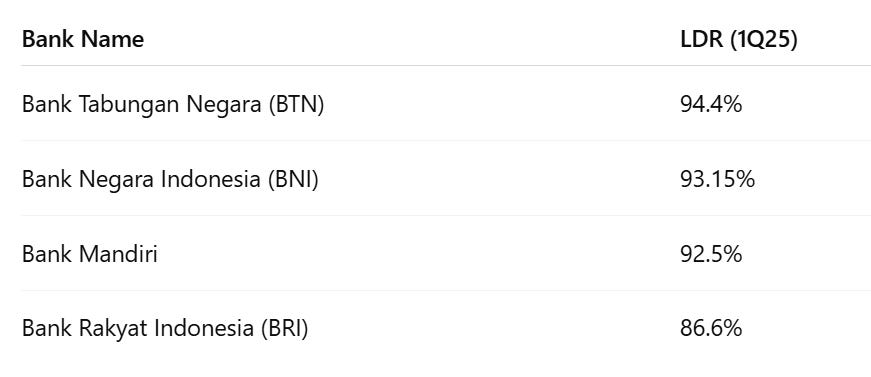
BTN, BNI and Bank Mandiri reported loan-to-deposit ratios above 90% as of March 2025, indicating tighter liquidity.
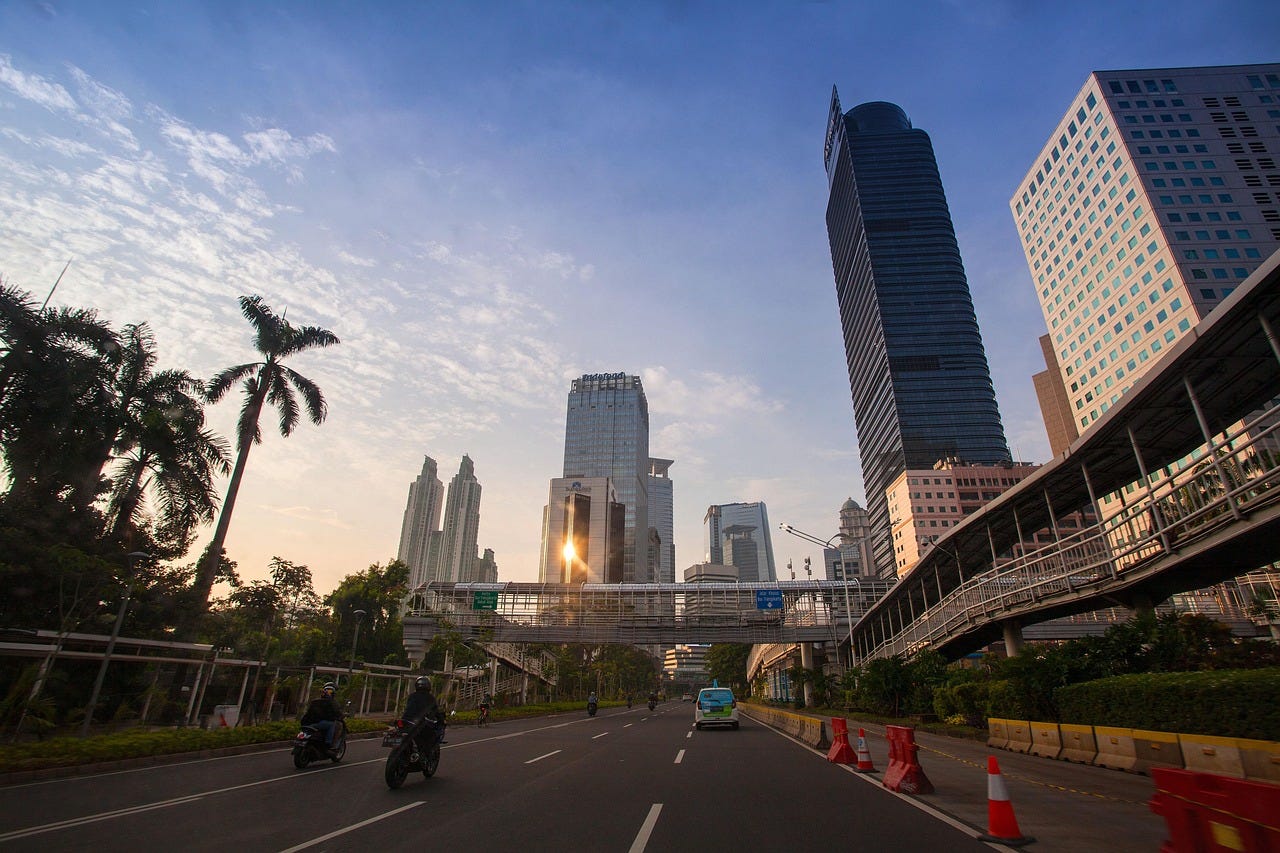
Indonesian state-owned banks have been doing their fair share of national service, such as upstreaming dividends, channelling loans for President Prabowo Subianto’s initiatives, and supporting their troubled peers.
For example, a big chunk of Indonesian sovereign fund Danantara’s roughly USD 400 million shareholder loan to flag airline Garuda Indonesia was funded by dividends from the state-owned banks. These lenders have also been called upon to back the president’s signature projects, including nation-wide housing and cooperatives schemes.
Out of the four main state-owned banks, three reported loan-to-deposit ratios (LDR) above 90% as of March 2025, indicating tighter liquidity: Bank Tabungan Negara (BTN) had the highest LDR at 94.4%, followed by Bank Negara Indonesia (BNI) at 93.15% and Bank Mandiri at 92.5%, according to their disclosures. Bank Rakyat Indonesia (BRI) had the lowest LDR at 86.6%.
Indonesia has an ambitious plan to build three million affordable homes, with an initial USD 8 billion financing scheme reportedly backed by Danantara and the state-owned banks. Last week, the president also launched the first batch of the so-called Red and White Cooperatives, which aim to disburse as much as USD 15 billion in state-bank loans directly to local communities, according to Bloomberg.
Finance Minister Sri Mulyani Indrawati announced on 28 July that Indonesia will tap its budget surplus – including funds placed at the Central Bank – to boost the liquidity of BRI, BNI, Mandiri and state-owned Islamic lender Bank Syariah Indonesia (BSI), which are financing the cooperatives. The 2025 state budget surplus currently stands at IDR 457.5 trillion (USD 28 billion), state news agency Antara reported.
Infrastructure Debt
Given the current president’s penchant for large-scale programs, there’s a risk of a growing funding gap that state-owned banks may have to find ways to bridge.
These lenders already have a sizeable exposure to SOEs in the infrastructure sector, which borrowed heavily to build airports, railways and toll roads under former President Joko Widodo.
Danantara will restructure the debt incurred to build the Jakarta-Bandung high speed rail, Bloomberg Technoz reported last week, citing Chief Operating Officer Dony Oskaria. Indonesian SOEs in the consortium include state-owned builder Wijaya Karya, rail operator Kereta Api Indonesia (KAI), and toll road company Jasa Marga.
The USD 7.3 billion project was significantly delayed, with Indonesia bearing the USD 1.2 billion cost overrun, according to an article by the Lowy Institute. To cover some of the ballooning costs, China Development Bank (CDB) reportedly gave KAI a nearly IDR 7 trillion (USD 426.8 million) loan.
Danantara also aims to consolidate seven Indonesian state-owned builders into just three companies in the second half of this year. The state-owned banks typically roll over loans to their peers, including the construction companies, but I wrote in April that a more novel way to kick the can down the road has emerged in recent times: Swapping non-performing loans with 20-year Islamic bonds or sukuk. (I’ve mapped out the transaction structure here).
BTN already pulled the trigger on the sukuk swap, but the other state-owned banks were taking a wait-and-see approach as the decision now lies with Danantara, according to friends familiar with the matter.
If the state-owned banks keep answering the call of duty, they may eventually call for help too.
📒 Quick Take: Indonesia’s Groundswell of Anger
2 September 2025
Indonesia’s Finance Minister Sri Mulyani Indrawati had her home looted during the protests that swept the country.
The public anger can partly be traced to a more aggressive tax collection at a time when households and businesses are under pressure.
However, the problem is bigger than one person as Indonesia’s traditional growth engines are sputtering.
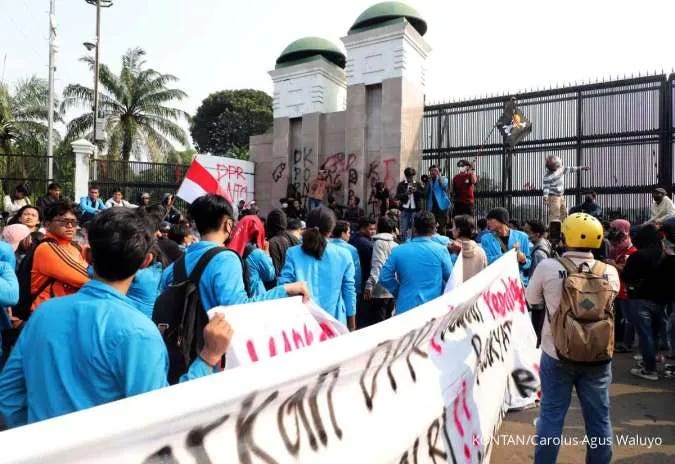
There’s nothing normal about a person’s home being looted, regardless of his or her position.
Yet, Indonesia’s Finance Minister Sri Mulyani Indrawati had her house ransacked twice during the protests that roiled the country over the weekend. The unrest stemmed from anger over bread-and-butter struggles and escalated into violence after a police armoured vehicle ran over a motorbike taxi driver.
In an Instagram post, Sri Mulyani wrote on Sunday (31 August 2025) that Indonesian laws are drafted with input from the government, the parliament and the public. There are channels for members of the public to challenge the laws, such as by submitting a request for a judicial review, she said.
“Our duty is to improve the quality of democracy in a civilized manner, not with anarchy, intimidation and repression,” according to the finance minister. Still, she acknowledged shortcomings, apologized, and promised to improve.
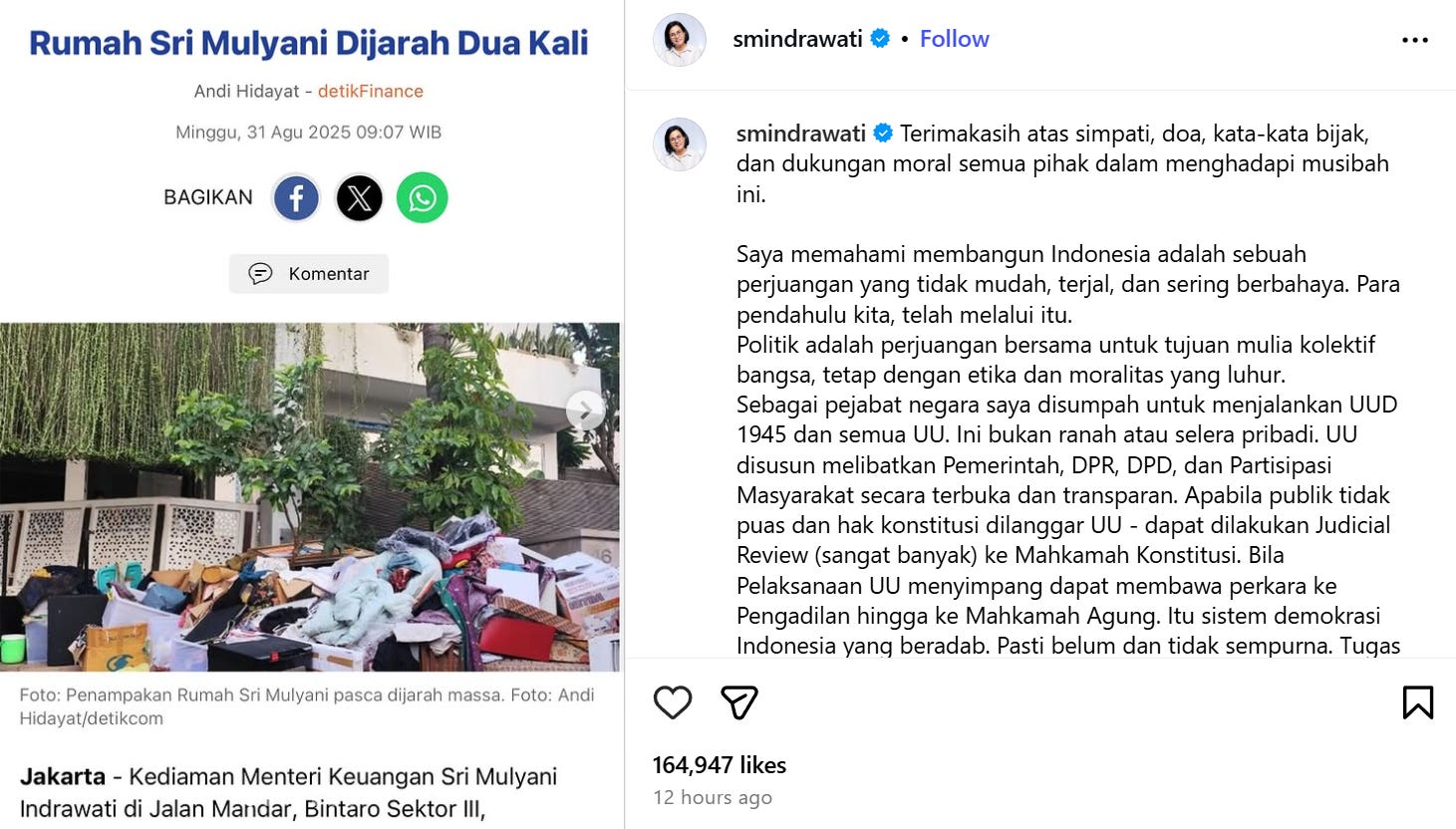
Within 24 hours, a note written by an anonymous author has been circulated on WhatsApp, alleging that the finance minister’s post contained “a narrative that is imbalanced and probably not siding with the people while looking at our problems right now.”
Urging members of the public to express their dissatisfaction by applying for a judicial review is a “formal and legalistic” route, as lawmakers should “feel clearly the pulse of the people’s livelihoods”, according to the note.
In short, the message is that lawmakers should have considered the public interest when drafting policies, such that a judicial review wouldn’t be necessary in the first place.
Tax Bills
The widespread discontent can partly be traced to a more aggressive tax collection at a time when households and businesses are already under economic pressure.
A Jakarta-based business owner described being relentlessly chased by the tax office over a transaction that was completed years ago, while a second friend said this is a common predicament in Indonesia. The government also planned to make e-commerce platforms collect taxes on the sales booked by sellers, Reuters reported in June.
The finance minister was left with a shortfall after her boss reversed a planned value-added tax hike at the start of the year. Furthermore, dividends from state-owned enterprises – which are projected to reach IDR 150 trillion (USD 9.1 billion) this year – are now upstreamed to sovereign fund Danantara instead of flowing to the state budget.
Two friends said that the fury at the finance minister may have been misdirected as some of the levies or fees were collected by local governments. After the fall of former President Suharto, Indonesia went through a major decentralization that gave more autonomy to provinces and districts across the sprawling archipelago.
While the tax crackdown may have played a part in stoking public resentment, the problem is bigger than one person. Indonesia’s traditional growth engines are sputtering, as the manufacturing sector is gradually being hollowed out while the prices of key commodities such as coal, nickel and palm oil have softened.
I’ve written since early 2025 that Indonesians were dipping into their savings amid mass layoffs, with unemployment rates, mortgage defaults and banking ratios all pointing to an economy that’s weaker than what official data suggested.
United Front
To defuse the tension, President Prabowo Subianto revoked the controversial lawmaker perks that sparked a backlash, while presenting a united front with other political leaders, CNA reported.
Coordinating Minister for Economic Affairs Airlangga Hartarto also dismissed rumours that the finance minister may resign after the looting experience.
Sri Mulyani herself shared photos of her attending a cabinet meeting led by the president on Sunday, Antara reported. Her presence was likely spotlighted by the state news agency because the former World Bank managing director is crucial to retain the confidence of foreign investors in Indonesia, which has long been vulnerable to capital outflows.
While the finance minister is highly regarded by the international community, the harder task for her right now is to unite the people in her home country to weather the economic headwinds.
“Let us safeguard and build Indonesia together, not by destroying, burning, looting, slandering, dividing, hating, being arrogant, and wounding and betraying the feelings of the public,” she wrote.
🔎 Highlights: Sri Mulyani’s Translated Instagram Post
31 August 2025
Indonesian Finance Minister Sri Mulyani Indrawati’s home was looted twice during the protests that roiled the country over the weekend.
This is my full translation of the Instagram post penned by the former World Bank managing director in the aftermath of the raids.
“Thank you for the sympathy, prayers, wise words, and moral support from everyone amid this tribulation.
I understand that building Indonesia is a struggle that is not easy, steep and often dangerous. Our predecessors went through that.
Politics is a common struggle for the noble purpose of the collective nation, with high ethics and morals.
As a state official, I took an oath to carry out the 1945 Constitution and all the law. This is not a personal domain or preferences. The drafting of the law involved the Government, House of Representatives (DPR), Regional Representative Council (DPD), and Public Participation in an open and transparent manner.
If the public are not satisfied and their constitutional rights are violated by the law, a Judicial Review (there are many) can be submitted to the Constitutional Court. If the execution of the law deviates, the case can be brought to the Court all the way to the Supreme Court. That is the democratic system in Indonesia that is civilized. Certainly not yet and not perfect. Our duty is to improve the quality of democracy in a civilized manner, not with anarchy, intimidation and repression.
The duty of the state must be carried out with trust, honesty, integrity, appropriateness and fitness, professionality, transparency, accountability, and for sure we are not allowed to be corrupt. This is an honour as well as a tremendously noble duty. A duty that is not easy and very complex, requiring wisdom – empathy, the sensitivity of listening to and understanding the voice of the people. Because this involves the fate of the Indonesian people and the future of the Indonesian nation.
Thank you to all of society including netizens, teachers, lecturers, students, mass media, small and medium-sized business owners, cooperatives, big businesses, and all stakeholders who continue to convey their feedback, criticism, sarcasm and even castigation, and also advice. As well as prayers and encouragement for us to improve ourselves. That is part of the process of building Indonesia.
Let us safeguard and build Indonesia together, not by destroying, burning, looting, slandering, dividing, hating, being arrogant, and wounding and betraying the feelings of the public.
We apologize, certainly there are still many shortcomings. God willing, we will continue improving.
May God bless and protect Indonesia.
Never tire of loving Indonesia.
Jakarta, 31 August 2025”
💼 Brief Take: Indonesia’s Tipping Point
9 September 2025
Sri Mulyani’s departure underscores the divergence between her international stature and domestic image.
The new finance minister, Purbaya Yudhi Sadewa, has to reassure international investors that he would exercise fiscal discipline.
Indonesian assets fell after Sri Mulyani Indrawati was removed as finance minister, adding to concerns about the nation’s long-term financial outlook, Bloomberg reported on 9 September 2025.
Eveline’s Take:
🔸 The departure of the former World Bank managing director underscores the divergence between her international stature and domestic image. The protests that culminated in the looting of Sri Mulyani’s home in late August were likely the tipping point.
🔸 Since early 2025, I’ve connected the savings rate, layoff numbers, mortgage defaults and banking ratios to infer that Indonesia’s economy was likely weaker than what official data suggested. The simmering public anger erupted at Sri Mulyani as she was seen to have spearheaded the more aggressive tax collection, even though I wrote last week that the problem is bigger than one person.
🔸 Rumours of Sri Mulyani’s resignation had circulated sporadically even before President Prabowo Subianto took office in October 2024, but these were officially denied. After her house raid sparked a resurgence of this speculation, Coordinating Minister for Economic Affairs Airlangga Hartarto said she was still active in government discussions. State news agency Antara also reported on 1 September that Sri Mulyani attended a cabinet meeting led by the president a day earlier.
🔸 Yet within a week, the president replaced Sri Mulyani with Purbaya Yudhi Sadewa, who held roles at state-owned brokerage Danareksa and most recently the Indonesia Deposit Insurance Corporation. When reporters asked State Secretariat Minister Prasetyo Hadi for the reason behind the reshuffle, he responded that Sri Mulyani “neither resigned nor was removed” and the president has the “prerogative right” to evaluate his cabinet and “make changes to the formation”.
🔸 What lies ahead now? The newly appointed finance minister has pledged to accelerate Indonesia’s economic growth to around 6-7% to ease public discontent, but Sadewa has to reassure international investors that he would exercise fiscal discipline. The most immediate test will likely be the “burden sharing” agreement between the government and the Central Bank, which is closely watched by the markets.
Eveline’s Notes
10 September 2025
Did she or did she not resign?
I scanned the media reports to make sense of the story behind the departure of Indonesian Finance Minister Sri Mulyani Indrawati.
The brilliant team at Tempo released a podcast on 6 September, which had detailed sourcing that Sri Mulyani received intel of looters heading to her house on 31 August. At the time, she asked the defence minister for reinforcement, but he only deployed 20 soldiers who were not enough to face the mass of at least hundreds, according to Tempo.
After the looting, Sri Mulyani reportedly told President Prabowo Subianto that she would like to resign, but he refused because of concerns about the market impact.
Reuters reported on 10 September that she only got one hour’s notice before she was sacked. Bloomberg wrote on the same day that the president fired her after she previously attempted to resign twice.
Putting together these pieces of information, it seems like the president’s camp decided to take control of the narrative and removed Sri Mulyani as it became clear to them that she was serious about leaving.
Kudos to the tireless Tempo reporters for getting the biggest piece of the puzzle.
🔎 Highlights: Tempo’s Podcast on Sri Mulyani’s Exit
13 September 2025
Indonesian investigative news agency Tempo released a podcast on 13 September 2025 that revealed the circumstances surrounding Sri Mulyani’s exit as finance minister. These are the highlights that I pulled from the podcast.
🔸 𝗧𝗵𝗲 𝗽𝗿𝗲𝘀𝗶𝗱𝗲𝗻𝘁’𝘀 𝘁𝗲𝗿𝗺𝘀
After her home was looted, Sri Mulyani travelled to President Prabowo Subianto’s country estate in Hambalang to submit her resignation. The president refused to accept her resignation at that time and told her that he would only do so under his own terms, according to Tempo. Sri Mulyani also brought a resignation letter to a cabinet meeting later that day, but did not tender it.
🔸 𝗛𝗮𝗻𝗱-𝘄𝗿𝗶𝘁𝘁𝗲𝗻 𝗻𝗼𝘁𝗲
On 8 September 2025, Sri Mulyani missed multiple calls from the cabinet secretary, Teddy Indra Wijaya, as she was chairing a meeting at the Finance Ministry, Tempo reported. The Presidential Palace then got hold of Sri Mulyani’s assistant, who relayed a hand-written note to the finance minister with the message that she was set to be replaced in a cabinet reshuffle. A few hours later, the reshuffle was officially announced.
🔸 𝗥𝗲𝗽𝗹𝗮𝗰𝗲𝗺𝗲𝗻𝘁 𝗰𝗮𝗻𝗱𝗶𝗱𝗮𝘁𝗲𝘀
The first choice to replace Sri Mulyani was Bank Indonesia Governor Perry Warjiyo, who was suggested by Soedradjad Djiwandono (a former Central Bank governor who is the father of Deputy Finance Minister Thomas Djiwandono), according to Tempo. But Perry declined, saying that his term at the Central Bank was extended until 2028 and leaving at this point could negatively affect the markets.
Purbaya Yudhi Sadewa’s name was then floated by Burhanuddin Abdullah, another former Central Bank governor who is in the president’s team of experts, Tempo reported. Over the years, Purbaya has also worked under Luhut Binsar Pandjaitan, the current chairman of the National Economic Council, in various capacities.
🔸 𝗧𝗶𝗰𝗸𝗶𝗻𝗴 𝘁𝗶𝗺𝗲𝗯𝗼𝗺𝗯
Purbaya assumed his position as the new finance minister during challenging times. As soon as he was appointed, Purbaya made some controversial statements that contributed to the market sell-off, Tempo reported.
An alliance of 300 economists also joined several think-tanks to voice concerns about the state of Indonesia’s economy, including the impact of populist policies and reduced funding for local governments, according to Tempo.
The drastic funding cuts are a “ticking timebomb” as the local governments could be forced to raise taxes, with direct consequences on the public, Tempo said.