

📚 Acrostics Anatomy: Indonesia’s Mission to Save Garuda
President Prabowo Subianto ordered sovereign fund Danantara to lead a campaign to turn around flag airline Garuda Indonesia.

📒🎞️ Quick Take: Danantara’s Lifeline for Garuda Indonesia (27 June 2025)
📒 Quick Take: The Garuducks Have Assembled (1 August 2025)
📒 Quick Take: Garuda’s Accounting Bugbear (7 August 2025)
🔎 Highlights from CNA’s Southeast Asian Airlines Documentary (5 September 2025)
💼 Brief Take: Garuda-Pelita Air Floated Merger (18 September 2025)
📸 Snapshot: Garuda Indonesia 1H25 Results (24 September 2025)
📒 Quick Take: Garuda’s Quest for Plane Parts (25 September 2025)
📒 Quick Take: Indonesia’s SOE Supremo (30 September 2025)
📒🎞️ Quick Take: Danantara’s Lifeline for Garuda Indonesia
27 June 2025
Indonesian sovereign fund Danantara is rescuing Garuda with an up to USD 1 billion financing package.
Why the flag airline needs another helping hand even after three restructurings.

Indonesian flag airline Garuda Indonesia is receiving a lifeline from sovereign fund Danantara.
On 24 June 2025, Danantara and Garuda officials held a press conference where they announced the rescue scheme. These are the key points:
Danantara will give a USD 405 million shareholder loan to meet Garuda’s maintenance, repair and overhaul needs. This is the initial phase of a total funding package of around USD 1 billion.
Nearly 73% of the shareholder loan – USD 294 million – is allocated for Garuda’s budget unit Citilink, while the remainder will be for the parent company.
The fund utilization will be overseen by an independent financial controller, while an aviation industry expert is set to provide technical input.
Garuda aims to increase its fleet to 120 aircraft over the next five years. The group operated 98 planes as of March 2025, according to its presentation.

Danantara officials emphasized that the money is not considered a state capital injection, but many people still question why Garuda needs another helping hand even after three restructurings, with the latest round just completed three years ago.
To answer that question, let’s take a look at the numbers.
Falling Passenger Yield
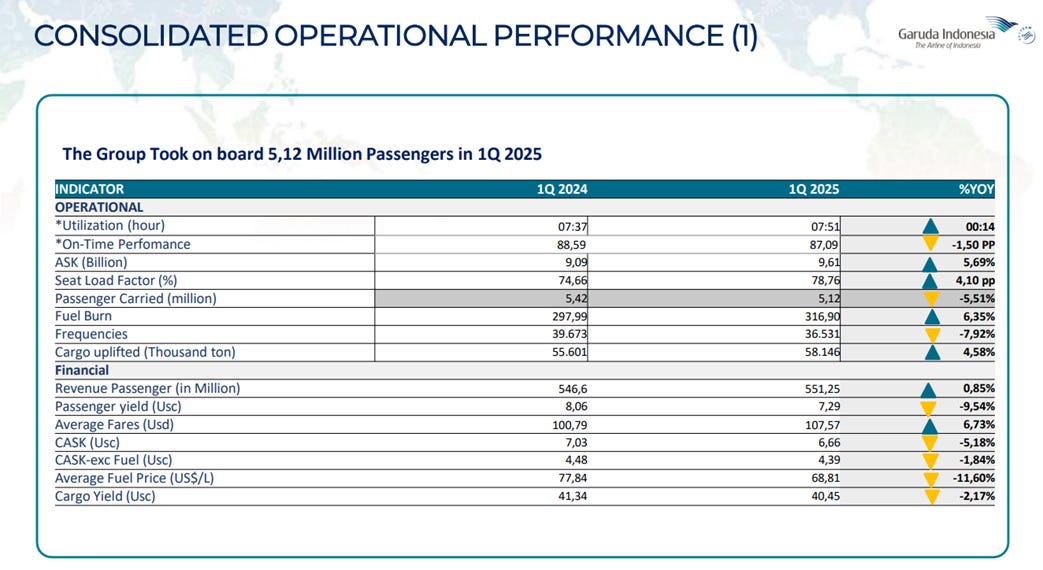
Passenger yield fell to 7.29 US cents in 1Q25 from 8.06 US cents a year earlier, indicating that Garuda earned lower average fares per distance flown.
Fuel burn increased 6.35% but the average fuel price dropped 11.6% to USD 68.81 per liter, which suggests that the airline managed to suppress the average price even though it consumed more fuel.
High Maintenance
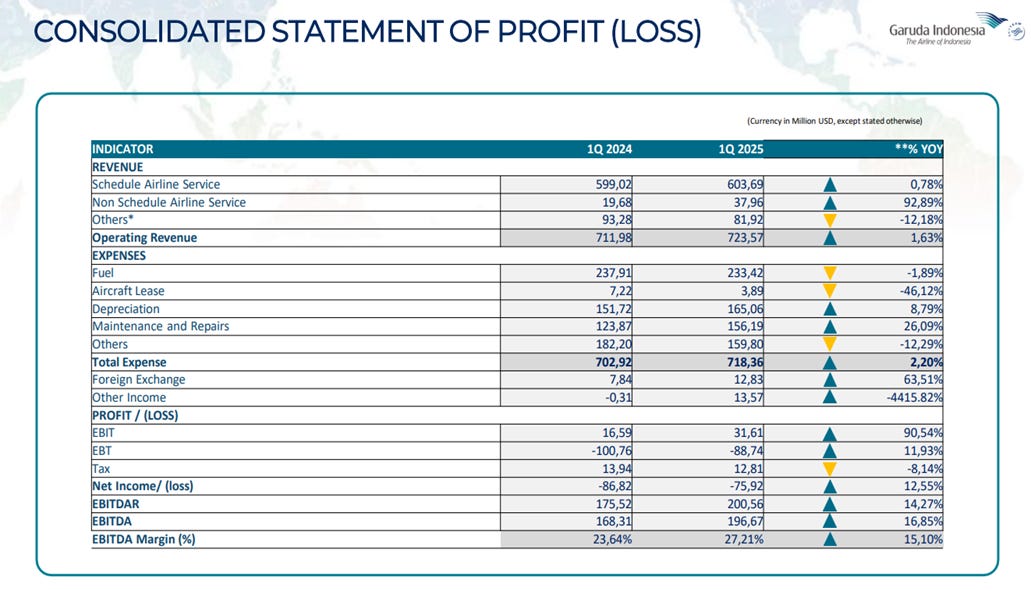
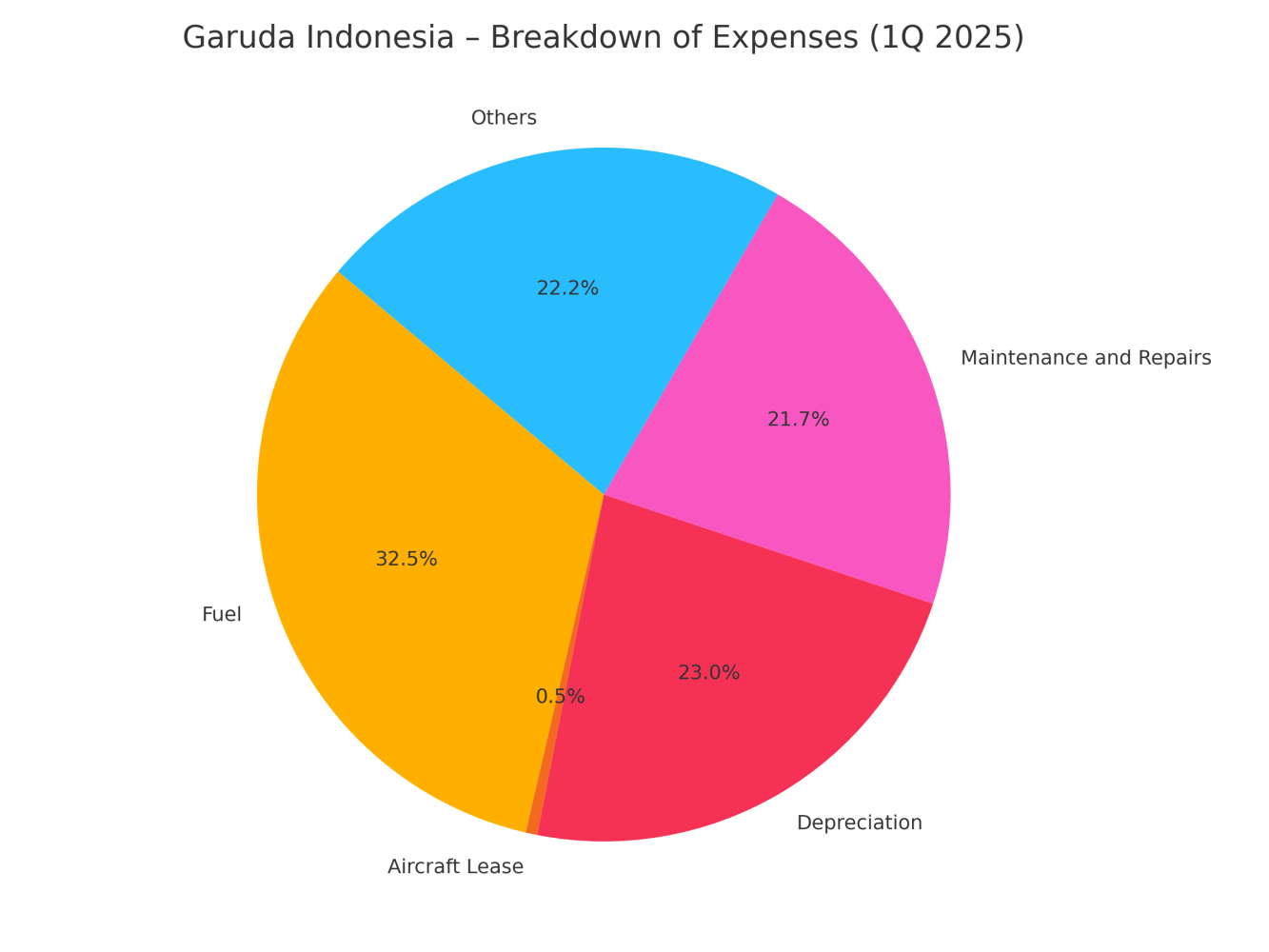
Operating revenue rose 1.63% to USD 723.57 million in 1Q25 from a year earlier, but this was eaten up by expenses. Depreciation, maintenance and repairs accounted for the lion’s share of total expenses apart from fuel costs.
Bigger Hole
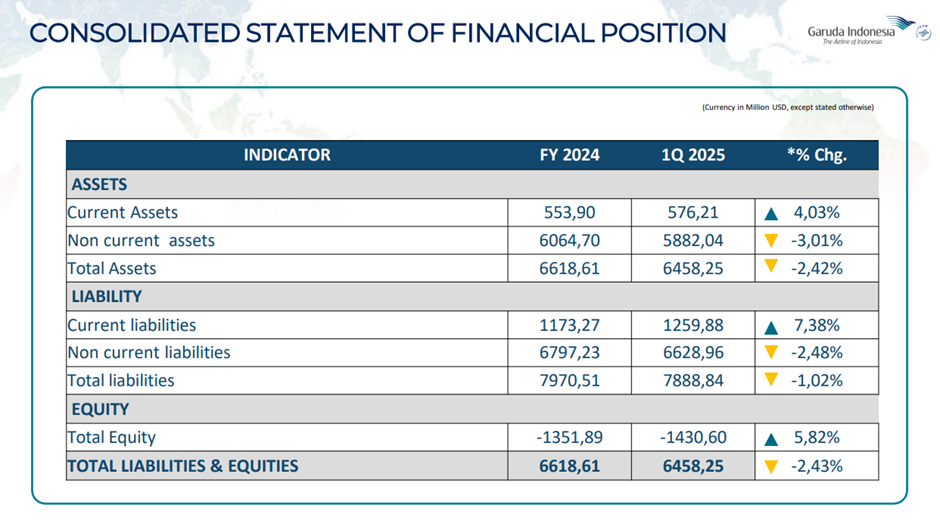
Garuda’s negative equity widened to USD 1.43 billion as of end-March 2025 from USD 1.35 billion as of end-2024. This is the airline’s bugbear, as attracting new investors or lenders would be tough when its liabilities exceed its assets by such a big margin.
Conclusion
Garuda’s operational performance was a mixed bag, though it was probably affected by the flag carrier’s national duty to fly less profitable routes.
Maintenance, repair and overhaul expenses gobbled up a big chunk of whatever money Garuda made, which is why Danantara’s shareholder loan would go towards fixing this. The priority is to get Garuda’s grounded planes to fly again and start contributing to the airline’s income.
Garuda’s negative equity is the albatross around its neck that keeps weighing it down, so Danantara’s overall funding package of up to USD 1 billion is likely aimed at helping to plug this gap. However, the other ingredient to attract third-party investment is corporate governance.
In Indonesia, the individuals executing it can be even more important than the plan, so the market is waiting to see who will be appointed to monitor Garuda.
📒 Quick Take: The Garuducks Have Assembled
1 August 2025
Garuda Indonesia’s state-owned peers such as energy company Pertamina are being asked to help the flag airline.
Third-party creditors are unlikely to be as lenient, so the carrier will have to rebuild its access to the credit markets.

Indonesia’s flag airline Garuda Indonesia is plotting its revival by stringing up multiple ducks on a tightrope.
There’s been a flurry of news surrounding the state-controlled carrier over the past few weeks, but the ripples can be traced to President Prabowo Subianto, who told local media that Garuda is a national symbol that was born in the throes of Indonesia’s fight for sovereignty.
The former army general has resolved to revitalize the airline that was founded in 1949, four years after Indonesia’s independence from the Dutch.
In short, Indonesia’s top commander has ordered a mission to save Garuda, so the entire battalion will have to fall in line. The rescue operation is being led by Indonesian sovereign fund Danantara, which has provided a USD 405 million shareholder loan to the airline mainly for plane maintenance and repairs.
Emergency Rescue
I wrote as early as 24 April that Indonesian officials were discussing a potential capital infusion for Garuda, but this may have to be executed via Danantara because of the unfavourable public optics of a direct state injection into the carrier.
I also flagged on 25 April that Garuda has to plug its negative equity – which widened to USD 1.4 billion as of end-March – without tripping up its local in-court restructuring (PKPU) agreement.
Danantara had to step in with the shareholder loan to avert an emergency, as Garuda’s budget unit Citilink was on the brink of a default and this would have triggered a group-wide contagion, according to a friend familiar with the matter. Citilink – which accounted for 14 of 15 grounded aircraft – was financially bleeding because its planes simply couldn’t fly.
Family Support
Danantara then called the cavalry to chip in.
Garuda will undergo a comprehensive restructuring that is set to include cash and non-cash corporate actions, Danantara’s Chief Operating Officer Dony Oskaria told local media last week. Indonesian state-owned energy company Pertamina will “go into Garuda” by converting the airline’s fuel debt into equity, Oskaria said.
Garuda reported USD 233.4 million in fuel expenses for the first quarter of 2025, accounting for nearly a third of its operating expenses, according to its latest results. Trade payables owed to Pertamina and its downstream energy unit Pertamina Patra Niaga stood at USD 319.1 million as of end-March.
The airline has criss-crossing relationships with other Indonesian SOEs such as airport operator Angkasa Pura Indonesia and ground service provider Gapura Angkasa, which will likely be asked to help their peer.
State-owned lenders Bank Negara Indonesia (BNI), Bank Rakyat Indonesia (BRI) and Bank Mandiri will also probably continue rolling over their loans.
Tightwire Talks
Third-party creditors are unlikely to be as lenient as family and friends, so Garuda will have to rebuild its access to the credit markets to refinance some of its existing debt.
This reminds me of the tightrope act pulled by Indian miner Vedanta Resources, which secured a crucial USD 1.25 billion private credit facility in December 2023 as a bridge to a more sustainable source of funding. I wrote that the group controlled by Indian billionaire Anil Agarwal played two cards – timing and assets – to its advantage.
Garuda has limited physical assets as most of its planes are leased, but it can leverage its sovereign backing to get creditors to play ball – which it has done in the past. The Indonesian flag airline got its PKPU deal recognized in Singapore and successfully asserted “foreign state immunity” to thwart Greylag Goose Leasing’s legal challenge in Australia.
Cashflow is King
The most important currency in the credit world is cashflow, so Garuda’s strategy is probably to get its planes back in the sky to earn some cash and improve its standing with potential lenders.
One of the options is to securitize future cashflow, which has a precedent as Garuda previously issued an investment product (KIK EBA) backed by ticket sales from the Muslim pilgrimage routes.
It’s also possible that someone else will borrow on Garuda’s behalf: Danantara CEO Rosan Roeslani met Finance Minister Sri Mulyani Indrawati this week to discuss financing options for its strategic projects, including a potential bond issuance.
However, even the right strategy can unravel with the wrong timing. Garuda has to manage this capricious ingredient to walk the entire rope towards recovery.

📒 Quick Take: Garuda Indonesia’s Accounting Bugbear
7 August 2025
Since 2020, Garuda had to bring aircraft leases onto its balance sheet under the local equivalent of the IFRS 16 reporting standard.
The Indonesian flag airline has been exploring the Ijarah structure to avoid having to capitalize the leases.

One of Garuda Indonesia’s bugbears is an accounting rule that forces the Indonesian flag carrier to bring aircraft leases onto its stretched balance sheet.
Since 1 January 2020, Indonesian companies have adopted PSAK 73, the local equivalent of the IFRS 16 reporting standard, which requires them to recognize assets and liabilities for all leases with a term of more than 12 months.
A lessee must recognize right-of-use assets representing its right to use the underlying leased assets, as well as lease liabilities representing its obligation to make lease payments, according to an accounting industry publication.
As a result of the accounting treatment, Garuda’s total lease liabilities ballooned to around USD 6 billion in 2020, according to local reports. Even though assets also increased under IFRS 16, some of them had to be impaired amid the pandemic, further expanding the asset-liabilities gap.
Fast forward to the present and Garuda’s negative equity has widened to USD 1.4 billion as of end-March 2025. I wrote last week that Indonesian sovereign fund Danantara and Garuda’s state-owned peers, including energy company Pertamina, are helping to pull this thorn out of the airline’s flesh.
A conversion of Garuda’s fuel debt into equity should strengthen the carrier’s balance sheet, though Pertamina is unlikely to be ecstatic about it. Pertamina already owns an airline called Pelita Air, but aviation lies outside its core oil and gas business.
Furthermore, a typical SOE would rather monetize its receivables and improve its cashflow, rather than holding a stake in a troubled peer.
Islamic Accounting
Garuda has been trying for some time to convert its existing leases into Shariah-compliant contracts (Ijarah) to ease the burden on its balance sheet, but the airline encountered resistance from most of its lessors, according to two friends familiar with the matter.
The lessors were confused by the complex arrangement suggested by Garuda, one of these friends said. To avoid capitalizing the leases as required by IFRS 16, the deal may have to be structured as an Ijarah contract, either as a service agreement or a transaction where control over the aircraft remains with the lessor, according to accounting industry publications.
Garuda may argue that it’s simply exploring the available structures that can help to repair its balance sheet weighed down by legacy leases. The Ijarah accounting is also nowhere as egregious as the airline’s move in 2018 to recognize nearly USD 240 million of revenue upfront from its 15-year in-flight connectivity deal with an unknown startup called Mahata Aero Teknologi.
Garuda is not alone in tapping Islamic finance. I wrote in April that at least three local banks, including state-owned lender Bank Tabungan Negara (BTN), had swapped their non-performing loans with Islamic bonds or sukuk with a long tenor.
However, it remains to be seen whether Garuda can implement the Ijarah structure for future aircraft purchases, especially if it’s seen as a method to get around an international reporting standard.
Accounting practices lie in a spectrum. Some companies might be able to stretch the books and get away with it, but overly aggressive gymnastics may draw the scrutiny of auditors and regulators. The hard part is knowing where to draw the line.
🔎 Highlights from CNA’s Southeast Asian Airlines Documentary
5 September 2025
CNA released a documentary on 5 September 2025 that examined why Southeast Asian airlines are struggling despite the travel boom. These are the highlights that I pulled from the documentary.
💸 𝗟𝗼𝘄 𝗺𝗮𝗿𝗴𝗶𝗻𝘀
🔸 Many Asian airlines – from low-cost carriers (LCCs) to full-service airlines – are running on thin profit margins.
🔸 “The competition is really brutal in our part of the world. There are so many LCCs here and it’s very hard to earn a dollar in every single seat that you fly,” Shukor Yusof, Founder of Endau Analytics, told CNA.
🔸 The net profit for Asia Pacific airlines was only 1.9% in 2024, “so it is a very low margin,” according to Subhas Menon, Director General of the Association of Asia Pacific Airlines (AAPA).
🛠️ 𝗦𝘂𝗽𝗽𝗹𝘆 𝗰𝗵𝗮𝗶𝗻 𝗯𝗼𝘁𝘁𝗹𝗲𝗻𝗲𝗰𝗸
🔸 Carriers in the region face a long wait time for replacement parts as the aircraft supply chain is experiencing a post-pandemic lag.
🔸 “Components are not readily available and if you send an engine for overhaul it takes a longer time for it to come back,” Izham Ismail, Group Managing Director at Malaysia Aviation Group, told CNA. “Issues of supply chain will not be resolved overnight. It takes 2-3 years from now.”
🔸 In Indonesia, CNA’s aviation sources said that 209 out of 583 commercial planes were grounded for maintenance as of July. Engines as well as slots for maintenance, repair and overhaul (MRO) are limited, Andi Fahrurrozi, CEO of Garuda Indonesia’s aircraft maintenance unit GMF AeroAsia, told CNA. “You have to wait for your slot and for materials.”
✈️ 𝗣𝗹𝗮𝗻𝗲 𝗯𝗮𝗰𝗸𝗹𝗼𝗴
🔸 Aside from parts, there’s also a huge backlog for new planes. The backlog in aircraft deliveries implies a waiting time of 14 years, CNA reported, citing the International Air Transport Association (IATA).
🔸 AAPA’s Menon told CNA there was already a 15-20% backlog in 2024 and he expects another 25% this year. “But more than that, it’s the cost that is going up.”
🔸 Older planes cost more to maintain and use up higher fuel. They also reduce the efficiency of fleet utilization because airlines could be forced to deploy larger planes than needed to fly some routes, according to CNA.
🪖 𝗖𝗼𝗻𝗳𝗹𝗶𝗰𝘁𝘀 𝗮𝗻𝗱 𝘁𝗮𝗿𝗶𝗳𝗳𝘀
🔸 Conflicts around the globe also add to the cost pressure for airlines, as a rerouting of planes could require more fuel and longer flying hours.
🔸 Middle East tensions may also push up the prices of fuel, which is typically the biggest cost item for airlines.
🔸 Furthermore, the tariffs imposed by the US hit at the core of the aircraft supply chain, according to AAPA’s Menon.
💼 Brief Take: Garuda-Pelita Air Floated Merger
18 September 2025
The potential merger would fit the pattern of SOE consolidation and optimize assets such as aircraft parts.
However, it may face resistance from labour unions and politicians.
Indonesian sovereign fund Danantara is reviewing a potential merger between flag carrier Garuda Indonesia and Pelita Air, the aviation unit of state-owned energy giant Pertamina, Jakarta Globe reported on 17 September 2025.
Eveline’s Take:
✈️ If it goes ahead, the merger between Pelita Air and Garuda should fit the trend of consolidation among Indonesia’s state-owned enterprises (SOEs). Danantara reportedly aims to reduce the number of SOEs to 200 “competitive” companies from as many as 1,050 (including subsidiaries and grand-subsidiaries).
✈️ Pertamina CEO Simon Aloysius Mantiri said that the company plans to focus on oil and gas as well as renewable energy, so it may spin off non-core businesses under Danantara’s coordination. A potential merger between Pelita Air and Garuda would be aimed at “optimizing existing assets”, such as flight duration and aircraft parts, Danantara CEO Rosan Roeslani told local media.
✈️ I wrote on 24 April that Garuda – along with its budget unit Citilink – was forced to ground some of its planes due to a lack of components. Carriers in the region face a long queue for maintenance slots and parts as the aircraft supply chain is experiencing a post-pandemic lag, according to a CNA documentary on 5 September. In Indonesia, 209 out of 583 commercial planes were grounded as of July, CNA reported.
✈️ However, the floated merger between Garuda and Pelita Air may face resistance from labour unions due to the potential layoffs. A member of parliament also criticized the merger plan, saying that Pelita Air has shown a positive performance and shouldn’t be dragged down by the financially troubled Garuda.
✈️ Garuda’s state-owned peers have been chipping in to support the flag airline as directed by President Prabowo Subianto. I wrote that Danantara’s USD 405 million shareholder loan to Garuda was partly pooled from dividends contributed by state-owned banks, while the airline’s fuel debt owed to Pertamina could be converted into equity.
✈️ The Indonesian government is helping to plug Garuda’s negative equity via Danantara, but I flagged on 1 August that the state support is likely intended as a runway for the airline to rebuild access to third-party investors or lenders.
📸 Snapshot: Garuda Indonesia 1H25 Results
24 September 2025
Indonesian flag airline Garuda Indonesia has released its results for the six months ended 30 June 2025 (1H25). These are some of the highlights.
🛫 𝗪𝗶𝗱𝗲𝗿 𝗻𝗲𝗴𝗮𝘁𝗶𝘃𝗲 𝗲𝗾𝘂𝗶𝘁𝘆: Garuda’s negative equity expanded to USD 1.5 billion as of end-June, from USD 1.35 billion as of end-2024. Current liabilities rose to USD 1.32 billion from USD 1.17 billion, partly due to an increase in lease and contract liabilities. In total, liabilities stood at USD 8 billion as of end-June, exceeding assets worth USD 6.5 billion.
🛫 𝗛𝗶𝗴𝗵𝗲𝗿 𝗳𝗶𝗻𝗮𝗻𝗰𝗲 𝗰𝗼𝘀𝘁𝘀: Total revenue fell to USD 1.55 billion in 1H25, from USD 1.62 billion a year earlier, due to a drop in scheduled airline services. Garuda managed to keep a lid on operating expenses, which amounted to USD 1.5 billion. However, it reported higher finance costs, with the biggest chunk coming from estimated liabilities for aircraft return and maintenance costs. Overall, net loss widened to USD 143.7 million from USD 101.7 million a year earlier.
🛫 𝗟𝗼𝘄𝗲𝗿 𝗽𝗮𝘆𝗺𝗲𝗻𝘁𝘀 𝘁𝗼 𝘀𝘂𝗽𝗽𝗹𝗶𝗲𝗿𝘀: Net cash provided by operating activities increased to USD 303.3 million in 1H25, from USD 235.1 million a year earlier, as Garuda paid less cash to suppliers and employees. However, net cash used in investing activities widened to USD 181.3 million from USD 159.2 million due to higher payments for aircraft maintenance assets. In total, cash and equivalents fell to USD 211.3 million as of end-June from USD 229.1 million a year earlier.
📒 Quick Take: Garuda’s Quest for Plane Parts
25 September 2025
The main driver for a potential merger between Garuda and Pertamina’s airline unit. Pelita Air, is likely to pool precious plane components.
Garuda’s targeted recovery hinges on the availability of hardware and funding from third-party investors.
Garuda Indonesia’s latest results indicate that the Indonesian flag airline was squeezed from all sides by aircraft leases and maintenance.
On the balance sheet side, Garuda’s negative equity expanded to USD 1.5 billion as of end-June, from USD 1.4 billion as of end-March and USD 1.35 billion as of end-December. In total, liabilities stood at USD 8 billion as of end-June, exceeding assets worth USD 6.5 billion.
Garuda’s current liabilities rose to USD 1.32 billion as of end-June from USD 1.17 billion as of end-December. This was partly due to an increase in lease liabilities to USD 300.35 million from USD 260.2 million over the same period.
On the income side, Garuda reported an increase in finance costs to USD 251.5 million in the first half of 2025 from USD 246.5 million a year earlier. Out of these finance costs, estimated liabilities for aircraft return and maintenance costs accounted for the biggest chunk at USD 101.8 million, followed by lease liabilities at USD 85.1 million.
And on the cashflow side, net cash used in investing activities widened to USD 181.3 million from USD 159.2 million, on the back of higher payments for aircraft maintenance assets. To balance this, Garuda paid less cash to suppliers and employees, generating USD 303.3 million in net operating cash inflow.
Grounded Planes
I wrote as early as 24 April that Garuda had to ground some of its planes due to a shortage of components. In May, Garuda disclosed that it had 15 grounded planes, out of which 14 were under its budget unit Citilink Indonesia.
Garuda’s commercial director, Reza Aulia Hakim, told a parliamentary commission overseeing state-owned enterprises on 22 September that the airline had 18-20 grounded planes. This suggests that Garuda had to ground an additional three to five planes over the last few months.
However, the shareholder loan from sovereign fund Danantara should help Garuda to reactivate these planes and deploy them on profitable routes, Hakim said, urging members of the parliamentary commission to give the airline more time to recover.
Danantara Lifeline
I flagged on 24 April that Indonesian officials were discussing a potential capital infusion for Garuda, but this may have to be executed via Danantara to avoid the optics of a direct state injection. I also wrote that Garuda must plug its negative equity without tripping up its local in-court restructuring (PKPU) agreement.
On 24 June, Danantara signed an agreement to provide a IDR 6.65 trillion (USD 405 million) shareholder loan for Garuda. The two-year loan carries an annual interest rate of 9.5% and can be converted into equity, according to Garuda’s 1H25 results.
Additional capital will be allocated for aircraft maintenance, but the figure was not specified in the results. Garuda also said that it plans to implement a series of initiatives to “strengthen its capital structure and improve its equity position, through both cash and non-cash corporate actions.”
Gotong Royong
I wrote on 1 August that Indonesian state-owned energy company Pertamina had to contribute to Garuda’s rescue operation by converting the airline’s fuel debt into equity. As of end-June, Garuda reported USD 329.1 million of trade payables owed to Pertamina and its downstream energy unit Pertamina Patra Niaga.
Danantara CEO Rosan Roeslani also told local media on 17 September that the fund was reviewing a potential merger between Garuda and Pertamina’s airline unit, Pelita Air, to optimize assets including aircraft parts. I noted that the floated merger would fit the pattern of SOE consolidation, but may face resistance from labour unions and politicians.
The main driver is likely to pool precious components, given that the aircraft supply chain is still lagging behind the post-pandemic travel boom. Garuda is also facing stiff competition for both planes and parts from regional airlines, including Malaysia’s flag carrier Malaysia Airlines.
Indonesian SOEs seem to be adhering to the “gotong royong” or burden-sharing principle to support their peers who need a helping hand. However, Garuda’s targeted recovery will also depend on the availability of hardware and funding from third-party investors.
📒 Quick Take: Indonesia’s SOE Supremo
30 September 2025
Indonesian sovereign fund Danantara controls the restructurings and consolidations of the country’s sprawling SOEs.
However, it may eventually run into a similar challenge faced by state-owned asset manager PPA to resolve the underlying bad debt.
Indonesian sovereign fund Danantara reigns supreme over the operations of the country’s state-owned enterprises (SOEs), with overarching control of their restructurings and consolidations.
On 26 September 2025, Indonesian lawmakers agreed to dissolve the SOE Ministry and replace it with a regulatory agency (BPBUMN). This agency will retain the government’s 1% “golden share” in the SOEs, while Danantara holds the remaining 99% and acts as the operator, the Jakarta Globe reported.
SOE Minister Erick Thohir – who was first appointed to the position by former President Joko Widodo in 2019 – was reassigned to the Youth and Sports Ministry. Danantara’s Chief Operating Officer who was previously Thohir’s deputy, Dony Oskaria, will be the acting head of the SOE Ministry during the transition period.
When the SOE law was revised in February 2025 to create the legal foundation for Danantara, the profits and losses incurred by the SOEs were decoupled from the state. Since then, the SOEs have directly upstreamed dividends to Danantara, which determines how to distribute these funds.
Oskaria said in June that the SOEs will no longer receive a state capital injection (penanaman modal negara) from the Finance Ministry because state-owned assets are now managed by Danantara. If the SOEs need support from the government, this will come from Danantara instead of the state budget.
Danantara is set to accelerate the restructurings of SOEs including flag airline Garuda Indonesia and steel maker Krakatau Steel, on top of consolidating state-owned builders and the subsidiaries of energy giant Pertamina, Oskaria told local media.
I wrote last week that a potential merger between Garuda and Pertamina’s aviation unit, Pelita Air, is likely driven by the need to pool plane components amid an industry-wide shortage. Despite the resistance from some politicians, Oskaria reportedly said on 29 September that the merger will go ahead.
The state-owned airline consolidation has been included in Danantara’s “working plan” this year, according to Oskaria. He sought to assure members of a parliamentary commission overseeing SOEs that the merger with Garuda should not drag down Pelita Air’s service quality.
PPA Precedent
In the previous administration, Indonesian state-owned asset manager Perusahaan Pengelola Aset (PPA) spearheaded the restructurings and the clean-up of distressed debt in the SOE sector. However, PPA became less active under President Prabowo Subianto, as Danantara has firmly taken over the role of turning around the SOEs.
Danantara’s goal to slim down the number of SOEs from as many as 1,050 to around 200 companies should help to reduce business overlaps and pool resources more effectively. But the fund may eventually run into a similar challenge faced by PPA to resolve the underlying bad debt.
PPA was supposed to take the non-performing loans (NPLs) off the state-owned banks while being funded by the same banks. This means that its operating model was effectively circular unless it could attract third-party investors or recover the soured loans.
In 2021, PPA tested the market for a potential offshore bond – out of which around IDR 2.3 trillion (USD 137.8 million) would be allocated for refinancing – but the asset manager had to shelve the issuance because investors questioned how it would actually make money.
Indonesia is not alone, as China is also trying to figure out how to clear its unpaid bills. I wrote on 12 September that getting the state-owned banks to absorb the NPLs in China’s property sector could create another problem down the road if there’s no market mechanism for bad debt to exit the system.
As the boss of Indonesia’s SOEs, one of the most challenging tasks in Danantara’s clean-up operation is deciding who should take the biggest hit, but this would likely take an extraordinary level of commitment.