

📚 Acrostics Anatomy: Indonesia’s Infrastructure Timebomb
Indonesia’s infrastructure push under its former president has saddled state-owned builders with mounting debt.

📒 Quick Take: The Price of Indonesia’s Whoosh (14 April 2025)
📒 Quick Take: Indonesia’s SOE Restructuring Redux (15 April 2025)
💼 Brief Take: Indonesia’s Whoosh Whammy (11 October 2025)
📒 Quick Take: Asian Sovereigns’ Tug of War (6 November 2025)
💼 Brief Take: Wijaya Karya’s Re-Restructuring (12 November 2025)
🔮 Indonesian SOEs 2026 Outlook: Wijaya Karya (25 November 2025)
📒 Quick Take: The Price of Indonesia’s Whoosh
14 April 2025
Former Indonesian President Joko Widodo’s infrastructure push has tangible results, but it also saddled state-owned builders with debt.
Wijaya Karya and Waskita Karya may have to go for another restructuring as the current president, Prabowo Subianto, ordered steep budget cuts.
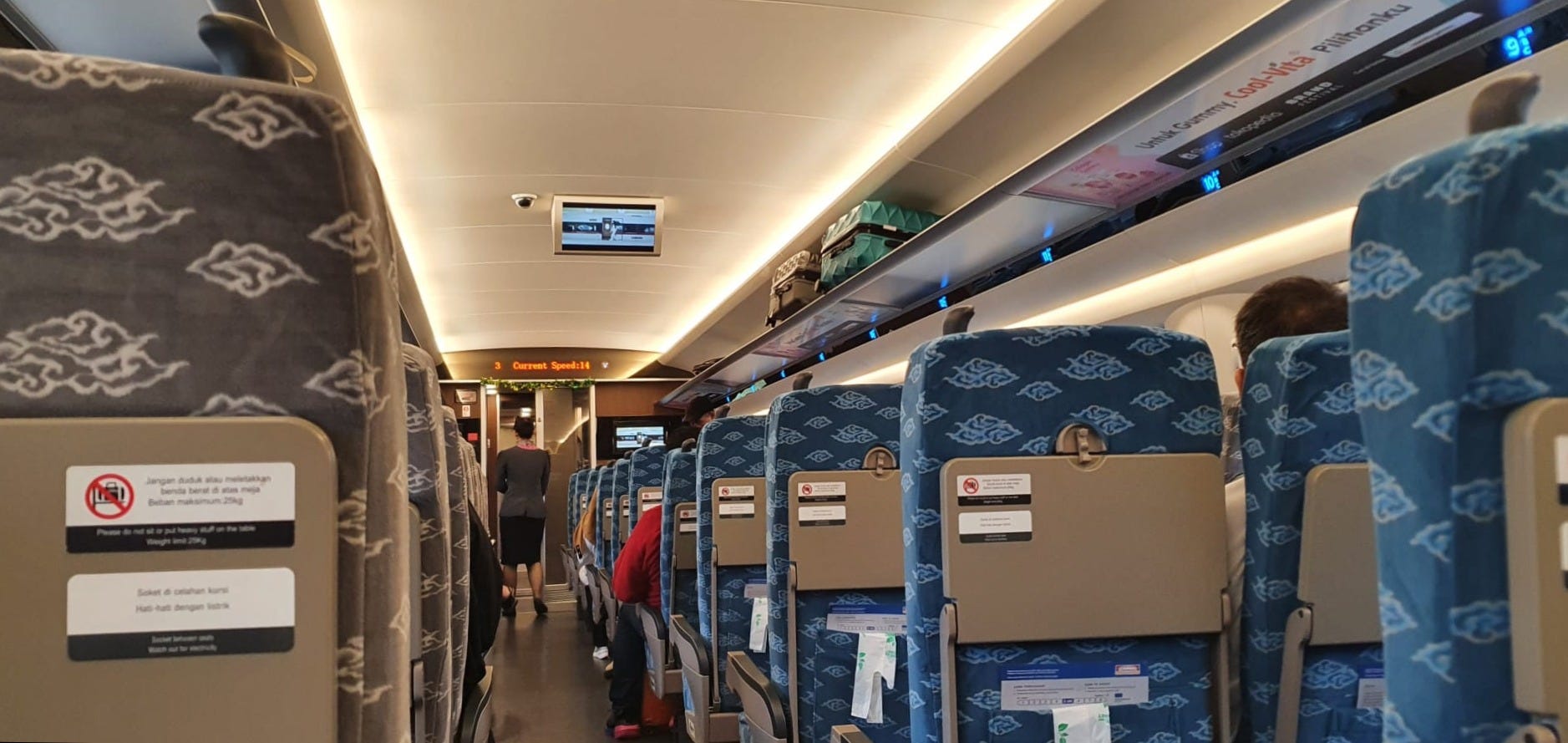
Over the weekend, I ‘whooshed’ from the Indonesian capital of Jakarta to the city of Bandung on the high-speed rail. The Jakarta-Bandung train branded as Whoosh was clean and well-equipped – the seats even came with sockets to charge our phones.
As a kid growing up in Bandung, it used to take my family up to seven hours during peak traffic to drive by car to Jakarta, but that travel time has now been slashed to roughly 40 minutes with the arrival of the Chinese-funded rail. This is one of the tangible results of former President Joko Widodo’s infrastructure push that cannot be denied.
Nevertheless, that achievement comes at a price as the USD 7.3 billion project was significantly delayed, with Indonesia bearing the USD 1.2 billion cost overrun, according to an article published by the Lowy Institute.
A consortium consisting of Indonesian state-owned enterprises (SOEs) and their Chinese counterparts may take 40 years to break even – twice as long as initial estimates – if the relocation of the capital to Borneo went ahead, Reuters reported, citing an executive at the joint venture.
In short, the project has saddled Indonesian SOEs with debt and it’s uncertain if they can make enough money to repay this mounting debt within our lifetime.
Wijaya Karya, one of the SOEs that built the Jakarta-Bandung rail, reported total liabilities of IDR 51.7 trillion (USD 3.1 billion) as of end-2024, out of which IDR 19 trillion was due in the short term, according to its annual report. Cash and equivalents stood at IDR 3.4 trillion.
Wijaya Karya’s revenue fell 14.6% to IDR 19.2 trillion in 2024 mainly due to a drop in contribution from its infrastructure and building segment, while the cost of revenue amounted to IDR 17.7 trillion. Total net loss narrowed to IDR 2.5 trillion from a year earlier thanks to IDR 4.49 trillion of “gains” from its loan restructuring.
In January 2024, Wijaya Karya’s banks agreed to roll over IDR 20.58 trillion of loans until as late as 2031, Bloomberg reported. Barely a year later, the company was unable to repay IDR 1 trillion of local bonds that matured on 18 February 2025, citing a liquidity crunch arising from cuts in the state infrastructure budget.
Wijaya Karya’s peer, Waskita Karya, also projected a bigger net loss of nearly IDR 4 trillion this year, Reuters reported, citing its president director’s remarks at a parliamentary hearing.
Work from the central government usually comprised 65% of Waskita’s total contracts, but that share is expected to shrink to 55% after the current president, Prabowo Subianto, embarked on an aggressive cost-cutting drive.
Waskita signed a restructuring agreement with 21 banks in September 2024 to extend IDR 26.3 trillion of loans until 2032, Bloomberg reported. I wrote back then that these rollovers fit the SOE debt restructuring pattern of kicking the can down the road, but the underlying fissures remained. Now, the reckoning is coming earlier than expected due to the president’s deep budget cuts to fund his free school lunch program.
As the cracks risk blowing out in the open, state-owned builders like Wijaya Karya and Waskita may have to go for another round of restructuring.
📒 Quick Take: Indonesia’s SOE Restructuring Redux
15 April 2025
If Indonesian state-owned builders restructure again, the banks have the options of taking a haircut or swapping their loans with Islamic bonds.
Despite the available tools, state-owned banks may not take an immediate decision as they figure out the modus operandi of new sovereign fund Danantara.
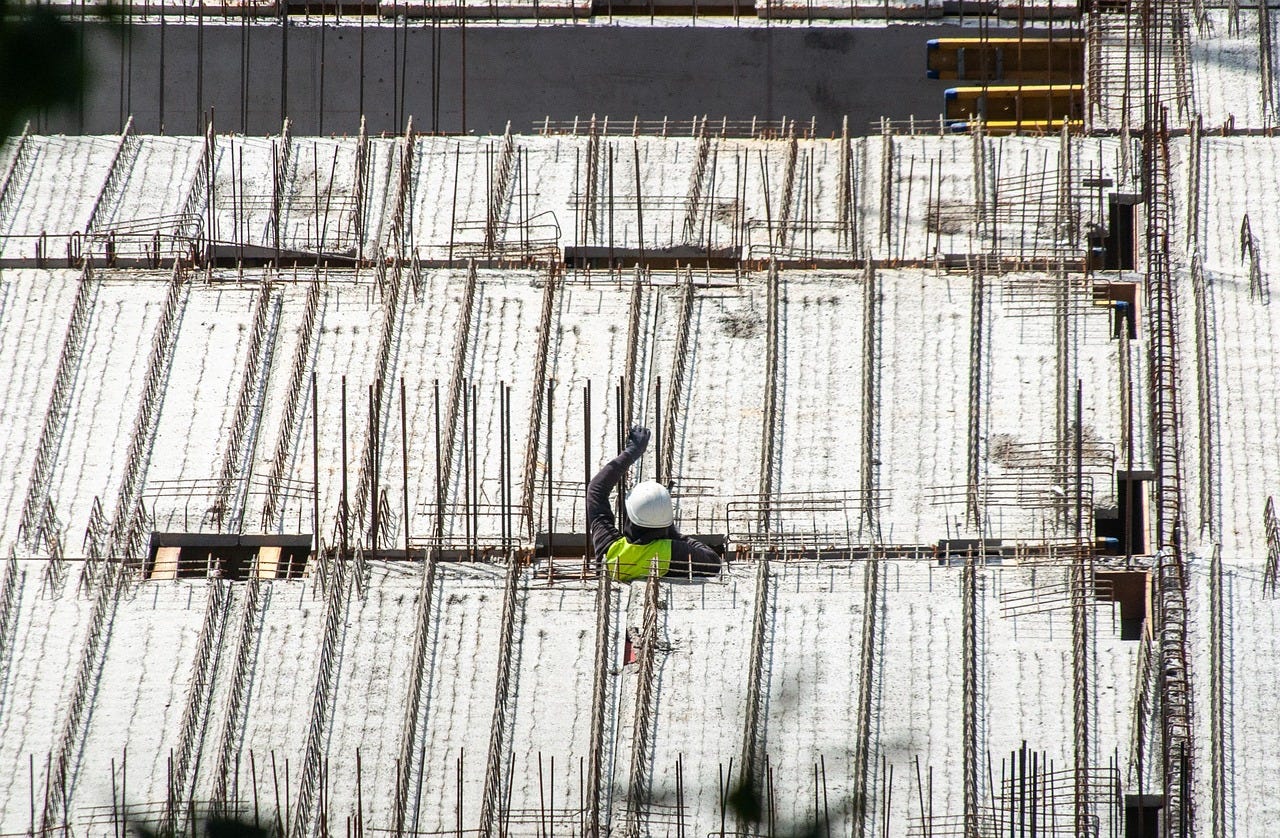
Indonesian state-owned builders’ renewed malaise may force the banks to finally pull the trigger and deal with their troubled loans.
I wrote yesterday that two of the state-owned construction firms, Wijaya Karya and Waskita Karya, may head for another round of debt restructuring as President Prabowo Subianto has slashed the infrastructure budget.
In short, these builders were betting that they could get a slice of the government contracts, but they found out that the entire cake was being redistributed to feed the president’s free school lunch program.
State-owned banks already did their national service by agreeing to roll over their loans to Wijaya Karya and Waskita last year. These restructuring deals were designed to ease the burden of the construction SOEs while they wait for cashflow to recover, but now the budget cuts have torpedoed their plans.
Wijaya Karya couldn’t even repay IDR 1 trillion (USD 59.5 million) of local bonds due 18 February 2025 after stretching its loan repayments as long as 2031. If these loan extensions aren’t working, what are the options left in the event of a restructuring redux?
The banks have at least two ways to manage their soured loans: 1) Take a haircut, and 2) Exchange their non-performing loans (NPLs) with Islamic bonds or sukuk.
The first option would be a test of Indonesia’s revised SOE law. I wrote two months ago that on paper, the decoupling of SOE and state losses should remove the threat of criminal prosecution hanging over the heads of state-owned bankers if they accept a haircut (check out Indonesia’s SOE Circuit). In practice, few want to be the “guinea pig” partly due to fears that they could still be brought down by potentially conflicting laws or regulations.
The second option of swapping NPLs with 20-year sukuk is a more novel version of kicking the can down the road that was pioneered by Bank Muamalat Indonesia in 2021 (I’ve mapped out the transaction structure here). The Muamalat deal – which involved state-owned asset manager Perusahaan Pengelola Aset (PPA) – even won two international awards for its creativity.
Another private lender, Bank KB Bukopin, announced last month that it had exchanged a portfolio of NPLs and written-off loans for “productive assets” in the form of sukuk issued by TBS Energi Utama. However, the only state-owned bank that had gone ahead with the sukuk swap was Bank Tabungan Negara (BTN), according to friends familiar with the matter.
Despite the available tools, state-owned banks may not take an immediate decision because of the new player in the room: Indonesian sovereign fund Danantara, which is supposed to eventually oversee all SOEs. It’s still early days for Danantara, so the SOEs may avoid risky moves until the fund’s modus operandi becomes clearer.
If the initial restructurings essentially bought the SOEs a bit of time, hopefully the next round will be a more effective medicine that can treat the root cause.

💼 Brief Take: Indonesia’s Whoosh Whammy
11 October 2025
The typical Indonesian SOE workaround of rolling over loans or converting debt into equity is unlikely to fly with the Chinese.
Danantara has to cough up some hard cash, but there’s a risk of a crowding out effect as some SOEs have their own financing needs.
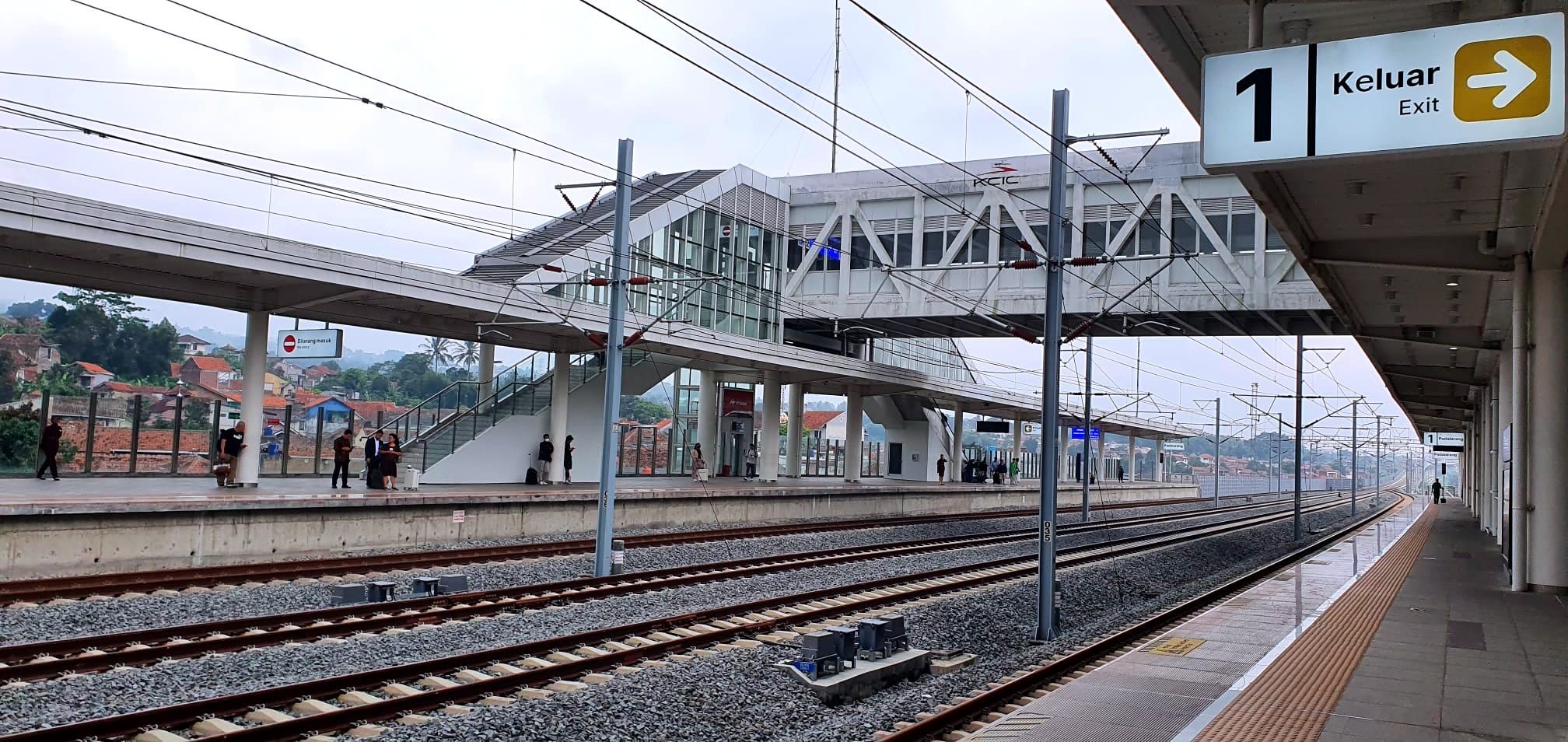
Indonesia is weighing two options to resolve the outstanding debt from its Jakarta-Bandung high-speed rail project with China: increasing equity in the operating company or handing over the infrastructure to the government, the Jakarta Globe reported, citing sovereign fund Danantara’s Chief Operating Officer Dony Oskaria on 10 October 2025.
Eveline’s Take:
🚂 The high-speed rail, known as Whoosh, is a financial timebomb that has to be defused. Finance Minister Purbaya Yudhi Sadewa told reporters that Whoosh is the responsibility of Danantara, which collects billions of dollars in dividends from state-owned enterprises (SOEs). Sadewa estimated Danantara to receive around IDR 80 trillion (USD 4.8 billion) in annual dividends.
🚂 I flagged in April that state-owned builders such as Wijaya Karya and Waskita Karya were heading towards another round of debt restructuring due to the infrastructure budget cuts. I also wrote last week that the Finance Ministry is unlikely to bail out troubled SOEs given that their dividends now flow to Danantara instead of the state budget.
🚂 Unless President Prabowo Subianto intervenes, Danantara will have to come up with its own solution to keep Whoosh running. Whoosh is operated by Kereta Cepat Indonesia China (KCIC), a joint venture between Indonesian SOEs including Wijaya Karya and their Chinese partners.
🚂 Danantara already has its hands full trying to stem the bleeding of flag airline Garuda Indonesia and steel maker Krakatau Steel. The typical Indonesian SOE workaround of rolling over loans or converting debt into equity is also unlikely to fly with the Chinese. In short, Danantara has to cough up some hard cash.
🚂 Danantara moved to raise an up to USD 10 billion unsecured loan in June, though I noted that the banks were likely to put in place some protections that mimic security. The fund also said last week that Indonesian tycoons had fully subscribed to its IDR 50 trillion (USD 3 billion) low-yield “patriot bonds”. However, Danantara may have to eventually go back to the market.
🚂 This raises the risk of a crowding out effect, as some SOEs under Danantara also have their own financing needs. State-owned energy giant Pertamina mandated MUFG to raise a USD 2.5 billion one-year loan for working capital, Bloomberg reported in September.
🚂 Banks have their internal risk allocations and some of them may lend to Danantara because they want to get other business streams from the fund. However, the lack of a sovereign guarantee could be a sticking point with offshore bondholders.
📒 Quick Take: Asian Sovereigns’ Tug of War
6 November 2025
India is reportedly considering a USD 12 billion bailout for its state-run power distributors.
Indonesia’s Finance Ministry is speeding up payments to PLN and Pertamina, while having to provide fiscal support for a debt-laden rail project.
China is trying to gradually defuse its LGFV risk, but local governments are intertwined with the property sector.

State-linked entities across India, Indonesia and China are caught between performing their national duty and reining in leverage.
This tug-of-war has long been a feature in the sovereign space, but now the stakes are higher because of the growing pile of debt to cover the costs of building infrastructure and subsidizing public services. Some of these state-linked entities loaded up on debt to bridge the funding gap as they were barred from raising prices.
Despite three federal bailouts worth billions of dollars over two decades, India’s state-run power distributors had accumulated INR 7.08 trillion (USD 80.6 billion) in losses and INR 7.42 trillion (USD 84.4 billion) in outstanding debt as of March 2024, according to Reuters.
India is considering a bailout of more than INR 1 trillion (USD 12 billion) for these companies, Reuters reported, citing three government officials and a document outlining the plan prepared by the Ministry of Power. To receive the funds, the states will be required to privatize their electric utilities and transfer managerial control, or keep control but list them on a stock exchange.
In Indonesia, state-owned electricity distributor Perusahaan Listrik Negara (PLN) was also mandated to keep tariffs affordable. PLN is supposed to receive “compensation income” from the government as reimbursement, but delayed payments would risk straining its cashflow.
The new Finance Minister, Purbaya Yudhi Sadewa, announced last week that he would speed up the compensation payment to PLN and state-owned energy giant Pertamina. While this should bring some relief to the SOEs, the Finance Ministry has to juggle competing demands even as Indonesia’s economic growth slowed to 5.04% in the third quarter.
Back in April, I flagged that the construction of the Jakarta-Bandung high-speed rail – known as Whoosh – carried a roughly USD 7 billion price tag that may keep ballooning. I also noted last month that Sadewa had insisted that Whoosh was the responsibility of Indonesian sovereign fund Danantara, not his ministry.
However, President Prabowo Subianto told reporters this week that the joint venture operating Whoosh, Kereta Cepat Indonesia China (KCIC), will receive support from the state coffers after all. Given that the boss has weighed in, the finance minister will likely have to cough up the fiscal support.
And in China, I wrote last month that local government financing vehicles (LGFVs) were tasked to raise funding for key projects, but many of them went out of control and ended up creating a debt mountain. I also noted that China seems to be weeding out the weaker LGFVs, akin to gradually releasing steam from a pressure cooker.
The officials are probably keen to avoid the property implosion triggered by the implementation of the “three red lines” policy five years ago. However, many local governments are intertwined with the property sector, as they relied on land sales for income while the developers were a significant source of employment.
Chinese real estate is also not out of the woods yet, as even China Vanke – which was previously seen as one of the stronger developers because of its state backing – has been spiralling downwards. Vanke’s bonds plunged this week after its state-owned shareholder, Shenzhen Metro Group, requested collateral or pledges for previously unsecured loans totalling CNY 20.4 billion (USD 2.9 billion).
If there’s any consolation for these Asian state-linked entities, it’s that they’re not alone in their struggle to make money.
💼 Brief Take: Wijaya Karya’s Re-Restructuring
12 November 2025
Indonesian state-owned builder Wijaya Karya is set to restructure its debt again in 2026 amid a decline in revenue.
If state-owned steel maker Krakatau Steel’s recent restructuring serves as an indicator, there’s a possibility that some of Wijaya Karya’s lenders may also get a haircut.
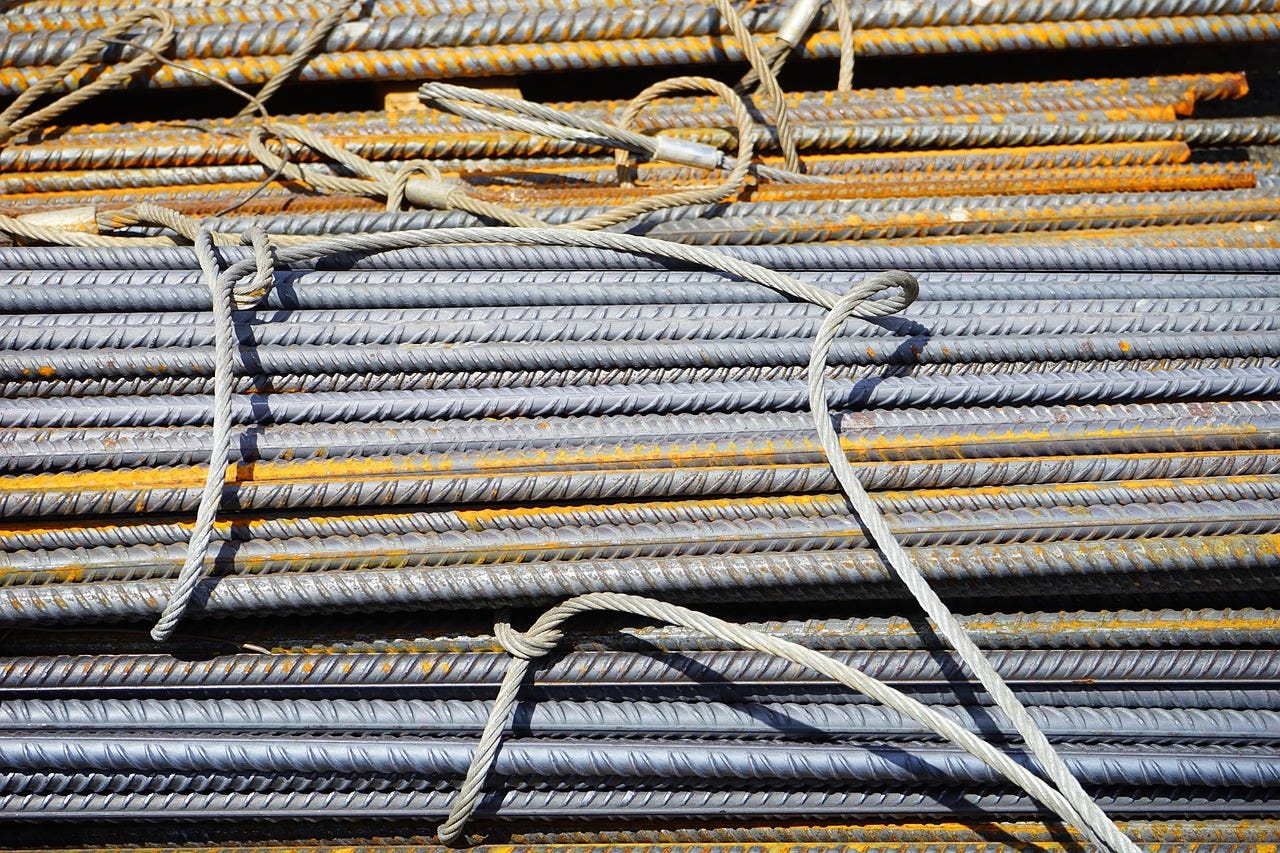
Indonesian state-owned builder Wijaya Karya is set to restructure its debt again in 2026 because it could not cover its obligations amid a decline in revenue, Kontan reported on 12 November 2025.
Eveline’s Take:
🧱 Seven months ago, I flagged that Wijaya Karya and its peer, Waskita Karya, may have to go for another restructuring due to Indonesia’s infrastructure budget cuts. “These builders were betting that they could get a slice of the government contracts, but they found out that the entire cake was being redistributed to feed the president’s free school lunch program,” I wrote in April.
🧱 This was confirmed by Wijaya Karya’s latest results. Revenue fell 27.5% to IDR 9.1 trillion (USD 543 million) for the nine months ended 30 September from a year earlier, dragged down by its infrastructure and building segment. Other income also plunged to IDR 1 trillion from IDR 5.25 trillion, mainly due to the absence of gains from its loan restructuring in 2024. As a result, Wijaya Karya swung to an operating loss of IDR 216 billion for 9M25.
🧱 Net operating cash outflow widened to IDR 1 trillion from IDR 218.9 billion, partly due to lower cash received from customers (though its payment to directors and employees increased to IDR 1.16 trillion). Financing activities used up IDR 3.1 trillion of net cash, versus an inflow of IDR 3.9 trillion a year earlier, mainly due to the absence of “receipt from paid in capital” and long-term bank loans.
🧱 The builder reported IDR 2.3 trillion in net cash provided by investing activities, but this was insufficient to stem the plunge in its cash and equivalents to IDR 1.5 trillion as of end-September, from IDR 5.6 trillion a year earlier. In short, cash plummeted to less than a third of the year-ago level.
🧱 Wijaya Karya plans to reduce its interest-bearing debt, which hit around IDR 29 trillion (USD 1.7 billion) as of end-September, President Director Agung Budi Waskito told a briefing on 12 November. This consisted of IDR 19 trillion of bank loans and IDR 10 trillion of bonds.
🧱 Wijaya Karya may pursue another master restructuring agreement (MRA) with the banks, alongside a restructuring of its notes, according to Finance Director Sumadi. The builder will coordinate its second restructuring with sovereign fund Danantara and sell some non-core assets, including its 85%-owned Serang-Panimban toll road.
🧱 It’s worth noting that state-owned steel maker Krakatau Steel recently got 80% “principal relief” from four private banks, implying a steep haircut for these lenders. If Krakatau Steel’s restructuring – which was overseen by Danantara – serves as an indicator, there’s a possibility that some of Wijaya Karya’s lenders may face a similar treatment.
🔮 Indonesian SOEs 2026 Outlook: Wijaya Karya
25 November 2025
Wijaya Karya was hit by a double whammy of infrastructure budget cuts and the snowballing debt incurred to build the Jakarta-Bandung high-speed rail.
Indonesian state-owned builders including Wijaya Karya are also preparing for a merger in the second half of 2026.

In Indonesia, there’s a phrase that says “sudah jatuh tertimpa tangga”, referring to a situation where a person fell off the ladder and then got squashed by the same ladder.
This analogy seems apt for Indonesian state-owned builder Wijaya Karya, which was hit by a double whammy of infrastructure budget cuts and the snowballing debt incurred to build the Jakarta-Bandung high-speed rail known as Whoosh.
Seven months ago, I flagged that Wijaya Karya was headed towards a second round of debt restructuring as President Prabowo Subianto abandoned his predecessor’s infrastructure drive.
The extent of Indonesia’s construction slowdown was laid bare in Wijaya Karya’s latest earnings presentation.
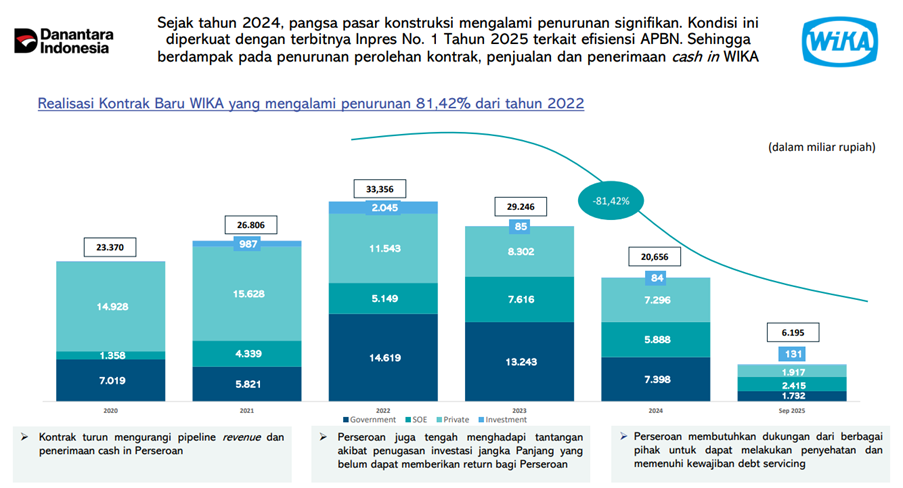
Wijaya Karya’s new realized contracts crashed 81.42% to IDR 6.2 trillion (USD 372 million) as of September 2025 from IDR 33.4 trillion in 2022. The government contributed only IDR 1.7 trillion of the total amount, a fraction of its lion’s share of IDR 14.6 trillion three years ago.
In short, Wijaya Karya used to rely on a stream of contracts from the government, but this has dried up drastically. “The company needs support from various parties to carry out a revitalization and to fulfill its debt servicing obligations,” according to its presentation.
Wijaya Karya plans to reduce its interest-bearing debt that hit around IDR 29 trillion (USD 1.7 billion) as of end-September, President Director Agung Budi Waskito told a briefing on 12 November. This consisted of IDR 19 trillion of bank loans and IDR 10 trillion of bonds.
In January 2024, Wijaya Karya’s banks reportedly agreed to roll over IDR 20.58 trillion of loans until as late as 2031. Barely a year later, the company was unable to repay IDR 1 trillion of local bonds that matured on 18 February 2025.
One of the problems is that Wijaya Karya only tackled the loans in its earlier restructuring without addressing the bonds, according to two friends familiar with the matter. The instruction to leave out the bonds went down the chain of command, as restructuring the public notes could have attracted unwanted attention at the time, one of these friends said.
Breaking Point
Even with the bond cracks, Wijaya Karya held its breath until it reached breaking point.
Net operating cash outflow widened to IDR 1 trillion (USD 60 million) in the nine months ended 30 September from IDR 218.9 billion a year earlier, while cash and equivalents plummeted to IDR 1.5 trillion from IDR 5.6 trillion, according to my analysis of its results.
Wijaya Karya is also a part of the Indonesia-China consortium that was beset with cost over-runs arising from the delayed construction of Whoosh. This escalated into a dispute, which is being processed at the Singapore International Arbitration Centre (SIAC), according to the company.
I noted last month that the new finance minister, Purbaya Yudhi Sadewa, insisted that Whoosh was the responsibility of Danantara, as dividends from state-owned enterprises now flow to the sovereign fund. However, President Prabowo Subianto has decided that the joint venture operating Whoosh, Kereta Cepat Indonesia China (KCIC), will receive state support after all.
The consortium is in advanced talks to restructure around IDR 85 trillion (USD 5.1 billion) of debt owed to China Development Bank (CDB), the Straits Times reported on 5 November. Based on the discussions so far, the Indonesian government will cover Whoosh’s infrastructure while Danantara is set to handle the operations.
In the meantime, Indonesian state-owned builders including Wijaya Karya are preparing for a merger in the second half of 2026. Wijaya Karya is hoping that the consolidation will improve its finances as it aims to pull off the “three pillars” of debt restructuring, asset sale, and tenders with more sustainable terms.