

📚 Acrostics Anatomy: Garuda Indonesia’s Clean Up Operation
The Indonesian flag carrier moves to reshuffle its management and clean up its balance sheet.

📒 Quick Take: Garuda’s Equity Shot (8 October 2025)
💼 Brief Take: Garuda’s Change of Guards (16 October 2025)
💼 Brief Take: The SOE Circles (17 October 2025)
💼 Brief Take: Garuda’s Spring Cleaning (22 October 2025)
📸 Snapshot: Garuda Indonesia 9M25 Results (4 November 2025)
📒 Quick Take: Asian Flag Airlines’ Cash Plight (11 November 2025)
🔮 Indonesian SOEs 2026 Outlook: Garuda Indonesia (21 November 2025)
📒 Quick Take: Garuda’s Equity Shot
8 October 2025
Indonesian sovereign fund Danantara is injecting USD 1.4 billion in cash and converting its USD 405 million shareholder loan into equity.
The officials likely recognized that Garuda needs a meaningful injection instead of a dripfeed before its hole gets even bigger.
Indonesian flag airline Garuda Indonesia is receiving an equity shot from sovereign fund Danantara to get its planes back in the sky.
Close to midnight on 6 October 2025, Garuda announced that it will conduct a USD 1.8 billion private placement, consisting of a USD 1.44 billion cash injection from Danantara and a conversion of the fund’s USD 405 million shareholder loan into equity.
While this is not at the scale of Singapore’s SGD 19 billion (USD 13 billion) bazooka to lift its national carrier, Singapore Airlines, out of the pandemic five years ago, the Indonesian officials likely recognized that Garuda needs a meaningful injection instead of a dripfeed before its hole gets even bigger.
Garuda’s latest results showed that its negative equity had widened to USD 1.5 billion as of end-June, from USD 1.4 billion as of end-March and USD 1.35 billion as of end-December. I wrote on 25 September that Garuda was squeezed from all sides – balance sheet, income and cashflow – by aircraft leases and maintenance.
Let’s unpack Danantara’s support package for Garuda.
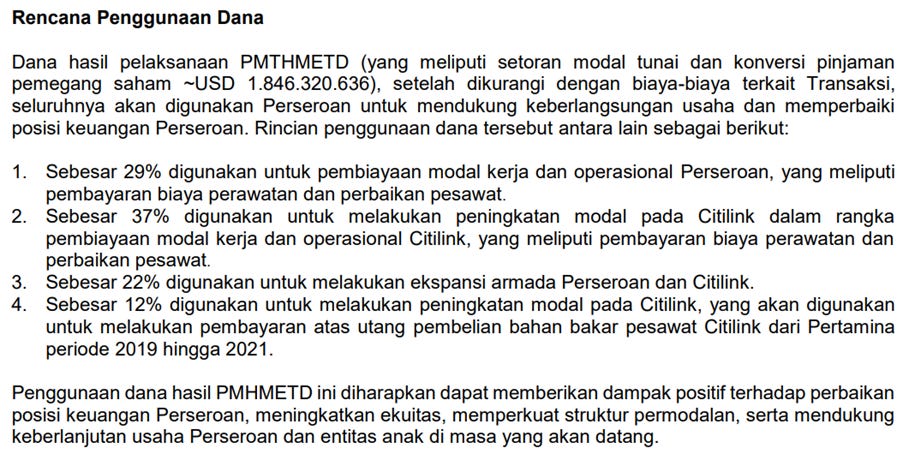
This is the allocation of Danantara’s funds:
29% will be for Garuda’s working capital and operations, covering the costs of plane maintenance and repairs.
37% will be for the working capital and operations of Garuda’s budget unit Citilink, covering the costs of plane maintenance and repairs.
22% will be to expand the fleet of Garuda and Citilink.
12% will be used to pay Citilink’s fuel debt to state-owned energy company Pertamina for the 2019-2021 period.
These funds are intended to improve Garuda’s financial position, equity, capital structure, as well as the business continuity of the company and its subsidiaries, according to its stock exchange filing.
Can Garuda soar this time?
As I wrote on 1 August, plugging the airline’s negative equity must come hand in hand with reopening access to third-party lenders or investors. That would be the next step for Garuda, but at least Indonesia is building the bridge to bring it over the cliff.
💼 Brief Take: Garuda’s Change of Guards
16 October 2025
Garuda’s board revamp is likely aimed at getting its rank and file in line, while stabilizing its finances and operations.
The appointment of two foreigners despite the opposition from local politicians showed that Indonesia is on an all-out mission to turn around Garuda.
Indonesian flag airline Garuda Indonesia has reshuffled its management at an extraordinary shareholders’ meeting on Wednesday (15 October 2025), the Jakarta Globe reported.
These are some of the key appointments:
🔸 CEO: Glenny H. Kairupan
🔸 Deputy CEO: Thomas Sugiarto Oentoro
🔸 Director of Finance & Risk Management: Balagopal Kunduvara
🔸 Director of Transformation: Neil Raymond Mills
Eveline’s Take:
🛫 Garuda’s board revamp is likely aimed at getting its rank and file in line, while stabilizing its finances and operations. Less than a year since Wamildan Tsani Panjaitan was poached from Garuda’s domestic rival, Lion Air, he has been replaced by Glenny Kairupan, a former military academy classmate of President Prabowo Subianto.
🛫 Garuda probably hoped that Panjaitan, who was a military pilot himself, could instill the agility of the privately owned Lion Air into the state-controlled carrier. Yet, a group of Garuda pilots staged a mutiny in May 2025 to protest Panjaitan’s move to hire staff from Lion Air at allegedly inflated salaries.
🛫 Under Panjaitan’s stewardship, Garuda’s negative equity also steadily widened from USD 1.35 billion as of end-December to USD 1.4 billion as of end-March and USD 1.5 billion as of end-June. To be fair, Panjaitan inherited expensive leases from past Garuda managements that continued bogging down the airline, but both the optics and reality didn’t look good.
🛫 As I noted back in April, Garuda faced a chicken-and-egg problem: the carrier must fly its planes to earn money, but it must put in money to get its grounded planes back in the sky. The stakes are also higher now, as Garuda went through a local in-court restructuring (PKPU) in 2022 and risks being bankrupted by a creditor if it breaches this PKPU agreement.
🛫 Indonesia’s SOE supremo Danantara has stepped in with a capital injection to break the chicken-and-egg cycle, but the next step would be to renegotiate or refinance Garuda’s leases and rebuild the confidence of third-party investors. This is where the latest appointments fit in.
🛫 Garuda’s new deputy CEO, Thomas Oentoro, is the chief risk officer of Indonesian sovereign wealth fund Indonesia Investment Authority (INA). The new CFO, Balagopal Kunduvara, previously served as the divisional vice president for financial services at Singapore’s flag carrier, Singapore Airlines, while transformation director Neil Mills was pitched as a restructuring expert in the aviation industry.
🛫 The appointment of two foreigners despite the opposition from local politicians showed that Indonesia is on an all-out mission to turn around Garuda. However, the battalion will have to quickly deliver or risk being shipped out.

💼 Brief Take: The SOE Circles
17 October 2025
China and Indonesia have one thing in common: the circularity of their state-linked entities.
Both countries need to break this cycle by getting third-party funding and unclogging their bad debt.

Beijing is ramping up support towards clearing public-sector arrears owed to businesses, but some localities may hesitate to take on new bank loans due to cost concerns, Caixin reported on 15 October 2025.
Eveline’s Take:
🛟 China and Indonesia have one thing in common: the circularity of their state-linked entities. China’s LGFVs are vehicles for local governments to raise off-balance-sheet debt, such as loans and bonds that are taken up by state-owned banks and other domestic investors. Indonesian SOEs are also interconnected via a web of criss-crossing relationships, including bank and trade debt.
🛟 I wrote on 12 September that China is moving to clear the unpaid bills that have stifled business recovery for years, but transferring the risk from local governments to the banking sector may create another problem down the road if there’s no market mechanism for bad debt to exit the system.
🛟 Arrears owed by local governments likely reached around CNY 4.5 trillion (USD 632 billion) this year, more than 3% of China’s GDP, Caixin reported, citing an estimate by China Chengxin International Credit Rating. China’s “Big Six” state-owned lenders and 12 joint-stock banks were tasked with helping to clear some of these arrears, such as by supporting local SOEs and LGFVs.
🛟 However, several bankers told Caixin that most of the arrears owed by the SOEs stemmed from projects that they took on behalf of local governments. Issuing new loans to these SOEs may amount to creating more off-the-books government debt, one of the bankers said.
🛟 In Indonesia, the SOEs have been practising “gotong royong” or burden-sharing for years. Flag airline Garuda Indonesia, for example, owed trade payables to its state-owned peers including energy giant Pertamina, ground service provider Gapura Angkasa and airport operator Angkasa Pura. It also reported long-term loans from state-owned lenders such as Bank Negara Indonesia (BNI), Bank Rakyat Indonesia (BRI) and Bank Mandiri.
🛟 The state-owned banks rolled over their loans to Garuda while Pertamina is converting the airline’s fuel debt into equity. Sovereign fund Danantara also injected capital to plug Garuda’s negative equity, which partly came from the dividends pooled from other SOEs. As I wrote yesterday, Indonesia is on an all-out mission to turn around the national carrier.
🛟 Another similarity between Indonesia and China is their need to break the circularity of their SOEs by getting third-party funding and unclogging their bad debt. While both countries seem to be trying to do something, their success depends on whether there are enough takers outside their SOE circles.
💼 Brief Take: Garuda’s Spring Cleaning
22 October 2025
The Indonesian flag airline will likely take a hit by writing off aircraft assets that constitute more than 50% of its total net worth.
However, this might be necessary to clean up its balance sheet and attract outside capital.

Indonesian flag airline Garuda Indonesia plans to seek approval for the transfer and write-off of aircraft assets at an extraordinary general meeting of shareholders on 12 November 2025, according to Garuda’s stock exchange filing today.
Eveline’s Take:
🪣 Garuda is biting the bullet to clean up its balance sheet. The carrier will likely take a hit by writing off aircraft assets that constitute more than 50% of its total net worth, but this might be necessary to unload its heavy baggage.
🪣 I wrote last week that Indonesian sovereign fund Danantara is injecting a total of USD 1.85 billion towards plugging Garuda’s negative equity, but the airline will still have to renegotiate or refinance its leases and attract outside capital.
🪣 Before Garuda can even invite prospective investors into its house, it will have to remove the elephant in the room. I noted last month that Garuda has been squeezed from all sides – balance sheet, income and cashflow – by aircraft leases and maintenance. In short, Garuda has been unable to fly effectively because it’s weighed down by legacy leases.
🪣 Garuda’s total liabilities stood at USD 8 billion versus assets worth USD 6.5 billion as of end-June, resulting in a negative equity of USD 1.5 billion. Writing off aircraft assets may actually have the temporary effect of widening Garuda’s negative equity (although it might be partially offset by Danantara’s debt-to-equity conversion).
🪣 Nevertheless, this is the financial equivalent of lancing the boil. While it may get messy immediately, the aim is to heal the wound overtime rather than let it fester and infect the body even more. In other words, Garuda is probably trading short-term pain for long-term gain.
🪣 The airline is laying the groundwork to repair its balance sheet. The next step will likely be to tackle its liabilities and get badly needed cash from third-party investors.
📸 Snapshot: Garuda Indonesia 9M25 Results
4 November 2025
Indonesian flag airline Garuda Indonesia has released its results for the nine months ended 30 September 2025. These are some of the highlights.
🪽 𝗡𝗲𝗴𝗮𝘁𝗶𝘃𝗲 𝗲𝗾𝘂𝗶𝘁𝘆 𝘀𝗹𝗶𝗴𝗵𝘁𝗹𝘆 𝘄𝗶𝗱𝗲𝗻𝘀: Overall revenue fell nearly 7% to USD 2.39 billion from a year earlier, dragged down by a decline in scheduled passenger services. The carrier reduced its operating expenses to USD 2.29 billion from USD 2.38 billion, but pre-tax losses still widened to USD 211.7 million from USD 148.1 million due to the weaker topline. Total liabilities stood at USD 8.3 billion as of end-September, exceeding assets worth USD 6.75 billion. The resulting negative equity of USD 1.54 billion slightly expanded from a gap of USD 1.5 billion as of end-June.
🪽 𝗟𝗼𝗮𝗻 𝗽𝗿𝗼𝗰𝗲𝗲𝗱𝘀 𝗽𝗿𝗼𝗽 𝘂𝗽 𝗰𝗮𝘀𝗵: Net cash inflow from operations shrank to USD 367.1 million in 9M25 from USD 382.7 million a year earlier partly due to a jump in finance costs. Net cash used in investing activities widened to USD 535.4 million from USD 268 million mainly on payments for aircraft maintenance assets. However, financing activities generated a net cash inflow of USD 199.8 million, compared with an outflow of USD 194.9 million a year earlier, as Garuda booked USD 420.9 million of long-term loan proceeds. In total, cash and equivalents increased to USD 243.1 million as of end-September from USD 211.2 million.
🪽 𝗖𝗹𝗲𝗮𝗻𝗶𝗻𝗴 𝘂𝗽 𝘁𝗵𝗲 𝗯𝗮𝗹𝗮𝗻𝗰𝗲 𝘀𝗵𝗲𝗲𝘁: On 6 October 2025, Garuda announced that it will conduct a USD 1.85 billion private placement, consisting of a USD 1.44 billion cash injection from Danantara and a conversion of the sovereign fund’s USD 405 million shareholder loan into equity. The airline also plans to seek shareholders’ approval on 12 November 2025 to write off aircraft assets that constitute more than 50% of its total net worth. I noted last month that while Garuda will likely take a hit from the substantial write-off, the move is the financial equivalent of lancing the boil and might be necessary to attract outside capital.
📒 Quick Take: Asian Flag Airlines’ Cash Plight
11 November 2025
Garuda Indonesia’s private placement to sovereign fund Danantara was downsized to USD 1.4 billion.
Sri Lanka aims to restructure its national airline’s defaulted offshore bond by year-end.
Pakistan plans to complete the privatization of its flag carrier before the end of this year.
From Jakarta to Colombo, Asian flag carriers are fighting a common battle for cash.
Barely a month since Garuda Indonesia announced a USD 1.8 billion private placement to sovereign fund Danantara, the Indonesian airline updated the local bourse that the amount has been reduced to USD 1.4 billion. Garuda also said that the use of proceeds will no longer include a planned fleet expansion.
In the latest breakdown, Garuda allocated IDR 3.73 trillion (USD 223.4 million at today’s exchange rate) to pay the fuel debt owed by its budget unit Citilink. Garuda didn’t detail the reason for these changes, but state-owned energy giant Pertamina likely pushed to get a bigger share of the cash as Citilink’s fuel debt had piled up over the years.
At a group level, Garuda owed USD 324.5 million of trade payables to Pertamina and its downstream subsidiary Pertamina Patra Niaga as of end-September.
As I noted last month, Indonesian state-owned enterprises (SOEs) have been performing their family duty and supporting each other, such as by rolling over trade debt. Most SOE bosses typically tell the public that they will follow instructions from the top, but they may also privately lobby their shareholder as they seek to preserve their own liquidity.
In Garuda’s case, the smaller capital injection won’t fully cover the airline’s negative equity, which widened to USD 1.54 billion as of end-September. The change of plan in favor of paying more debt to Pertamina also means that Garuda may not be able to ramp up its fleet as fast as previously expected.
SriLankan Airlines (SLA) is in a worse shape than Garuda as it reported a negative cash position of LKR 17.6 billion (USD 57.8 million) as of end-March.
SriLankan President Anura Kumara Dissanayake said that SLA’s government-guaranteed offshore notes – which had ballooned to around USD 210 million due to outstanding coupons – are expected to be restructured by year-end, according to local media.
As I noted two months ago, SLA’s bondholders have limited bargaining power because the most favored creditor (MFC) clause in Sri Lanka’s restructuring gave the nation a justification not to give special treatment to any group of creditors. Nevertheless, the bondholders were not taking it lying down as they hoped to extract some concessions from the government.
The bigger picture is that Sri Lanka is assessing what it should do with its flag carrier. In his budget speech, President Dissanayake noted that Sri Lanka’s earlier attempt to sell SLA did not generate enough interest from buyers.
The government has given SLA’s management “some time” to implement their turnaround plan, but if this fails, “we will not hesitate to look at the airline in a different way,” Dissanayake reportedly said.
Elsewhere in South Asia, Pakistan plans to privatize 24 SOEs and merge 39 ministries as part of a major restructuring, local media reported last week. Finance Minister Muhammad Aurangzeb said his government aims to complete the privatization of Pakistan International Airlines (PIA) before the end of this year.
The sale of PIA is a key condition under Pakistan’s USD 7 billion bailout from the International Monetary Fund (IMF), CNA reported. Over the past decade, the state-run carrier racked up USD 2.5 billion of losses, with nearly a third of its 30 aircraft grounded due to age, according to CNA.
Some flag airlines have been kept airborne despite consistently losing money, but more countries are recalculating the costs of flying their national symbols.
🔮 Indonesian SOEs 2026 Outlook: Garuda Indonesia
21 November 2025
Garuda seems to be slicing and dicing its equity in return for family support, but this may limit the room for the flag airline to obtain equity financing from third parties.
For now, the focus is optimizing Garuda’s operations, such as reactivating its grounded planes and evaluating its code-sharing partnerships.

Throughout the year, I’ve plotted Indonesian flag carrier Garuda Indonesia’s flight trajectory by connecting the financial, legal, operational and political dots.
On 24 April, I flagged that Indonesian officials were discussing a potential capital infusion for Garuda, but this may have to be executed via sovereign fund Danantara to avoid a direct state injection. I also reported that the airline was forced to ground some planes due to a shortage of components.
I pointed out on 25 April that Garuda must plug its negative equity without tripping up its local in-court restructuring (PKPU) deal. This is because under Indonesian law, a borrower can be filed into bankruptcy by its creditor if it breaches their PKPU agreement.
On 24 June, Danantara announced that it would give a USD 405 million shareholder loan to Garuda after President Prabowo Subianto ordered a mission to save the national symbol. I also wrote that Danantara would rope in Garuda’s state-owned peers, including energy giant Pertamina, to take part in the airline’s rescue operation by converting debt into equity.
However, I noted that the state support must be paired with rebuilding access to third-party lenders or investors. I also unpacked Garuda’s results for the first half of 2025, which showed that the carrier was squeezed from all sides by aircraft leases and maintenance, widening its negative equity to USD 1.5 billion as of end-June.
Plugging the Gap
On 6 October, Garuda said it would conduct a USD 1.85 billion private placement, consisting of a USD 1.44 billion cash injection from Danantara and a conversion of the fund’s USD 405 million shareholder loan into equity. Garuda also reshuffled its management and decided to write off aircraft assets to clean up its balance sheet.
Barely a month later, however, the airline said in response to a stock exchange query that the injection from Danantara would be cut by USD 400 million and that it will drop a planned fleet expansion. Danantara’s Chief Operating Officer Dony Oskaria told reporters that the fund ultimately allocated USD 1.4 billion because Garuda “only needed that amount”.
The shift in the use of proceeds in favour of paying fuel debt owed by Garuda’s budget unit Citilink to Pertamina means that the airline may not be able to ramp up its fleet as fast as it wanted. I noted that while Indonesian SOEs are expected to support their troubled siblings, they may also seek to preserve their own liquidity or request a more equitable deal.
Apart from Pertamina, Garuda owed trade payables to other SOEs including airport operator Angkasa Pura and ground service provider Gapura Angkasa. Angkasa Pura is reportedly set to get a 64.33% stake in Garuda’s maintenance unit Garuda Maintenance Facility Aero Asia after an asset injection.
Garuda seems to be slicing and dicing its equity in return for the family support, but this may limit the room for the airline to obtain equity financing from third parties. While returning to positive equity is the first step towards attracting potential investors, Garuda may bleed again if it continues being weighed down by costly leases without improving its cashflow.
Renegotiating these legacy leases would have been a logical move, but I flagged seven months ago that Garuda is likely hamstrung by its own PKPU agreement. For now, the focus is optimizing Garuda’s operations, particularly reactivating its grounded planes by 2026, according to Danantara Managing Director Febriany Eddy.
Danantara is also pushing Garuda to renegotiate its global code-sharing agreements that are seen to favour its partners, Eddy reportedly said. The airline “should be smart” about entering alliances that would allow it to fly more international routes, she added.