

🔮 Indonesian SOEs 2026 Outlook
As 2025 draws to a close, Acrostics Asia has pulled a series of outlooks for key Indonesian state-owned enterprises in the year ahead.

Danantara (20 November 2025)
Garuda Indonesia (21 November 2025)
Krakatau Steel (23 November 2025)
Wijaya Karya (25 November 2025)
Danantara
20 November 2025
Danantara is syndicating a USD 1 billion-equivalent loan, far below the USD 10 billion credit line that it was reported to have clinched four months ago.
The sovereign fund will likely have to construct a refinancing path to the international markets as the facility will mature in three years.

Four months ago, I wrote that even though several media reported that Danantara had clinched a USD 10 billion credit line, “the reality is no banks would underwrite such a huge unsecured loan right off the bat.”
In short, the USD 10 billion wasn’t in the bag yet and the fund will have to broaden its base of lenders to reach that target.
IFR reported on 18 November that Danantara had launched a USD 1 billion-equivalent debut loan into general syndication, with commitments due by 19 December. DBS, HSBC, Standard Chartered and UOB (Natixis withdrew) are the mandated lead arrangers and bookrunners of the transaction, which can be upsized to a maximum of USD 10 billion.
It’s possible that Danantara needs less from the banks at this point after raising USD 3 billion from a sale of low-yield “patriot bonds” to local tycoons. While Danantara can also tap SOE dividends to service its debt, the USD 1 billion facility will mature in three years and the fund will likely have to construct a refinancing path to the international markets.
The advantage for Danantara is that Asia’s bond tide has returned as institutional investors are hungry for more supply. However, I noted in July that pitching an Indonesian credit to offshore bondholders is a different ball game now and some of them may push harder for a guarantee or other forms of protection.
Negative Pledge
I flagged in June that some SOE lenders were restricted from taking collateral because of a negative pledge in previous financing from the World Bank.
In these cases, banks can put in place quasi-security protections, such as tying the loan drawdown to certain projects or installing an offshore cash account management agreement (CAMA). However, bondholders may not have the latitude for a similar structural workaround.
Another factor to watch is the risk of a crowding out effect, as individual SOEs under Danantara have their own financing needs and potential investors may have to decide how to allocate their capital. As I wrote last month, it’s common knowledge that all SOEs are equal but some are more equal than others.
Energy giant Pertamina and electricity distributor Perusahaan Listrik Negara (PLN) are usually perceived to sit at the top of the pecking order, as fuel shortages or blackouts risk triggering a public backlash. But for the rest of the SOEs, investors will have to gauge whether they are aligned with the Indonesian president’s priorities.
Finally, I noted in September that while Danantara reigns supreme over the restructurings and consolidations of the country’s sprawling SOEs, the fund may eventually run into a similar challenge faced by state-owned asset manager Perusahaan Pengelola Aset (PPA) to resolve the underlying bad debt.
Garuda Indonesia
21 November 2025
Garuda seems to be slicing and dicing its equity in return for family support, but this may limit the room for the flag airline to obtain equity financing from third parties.
For now, the focus is optimizing Garuda’s operations, such as reactivating its grounded planes and evaluating its code-sharing partnerships.
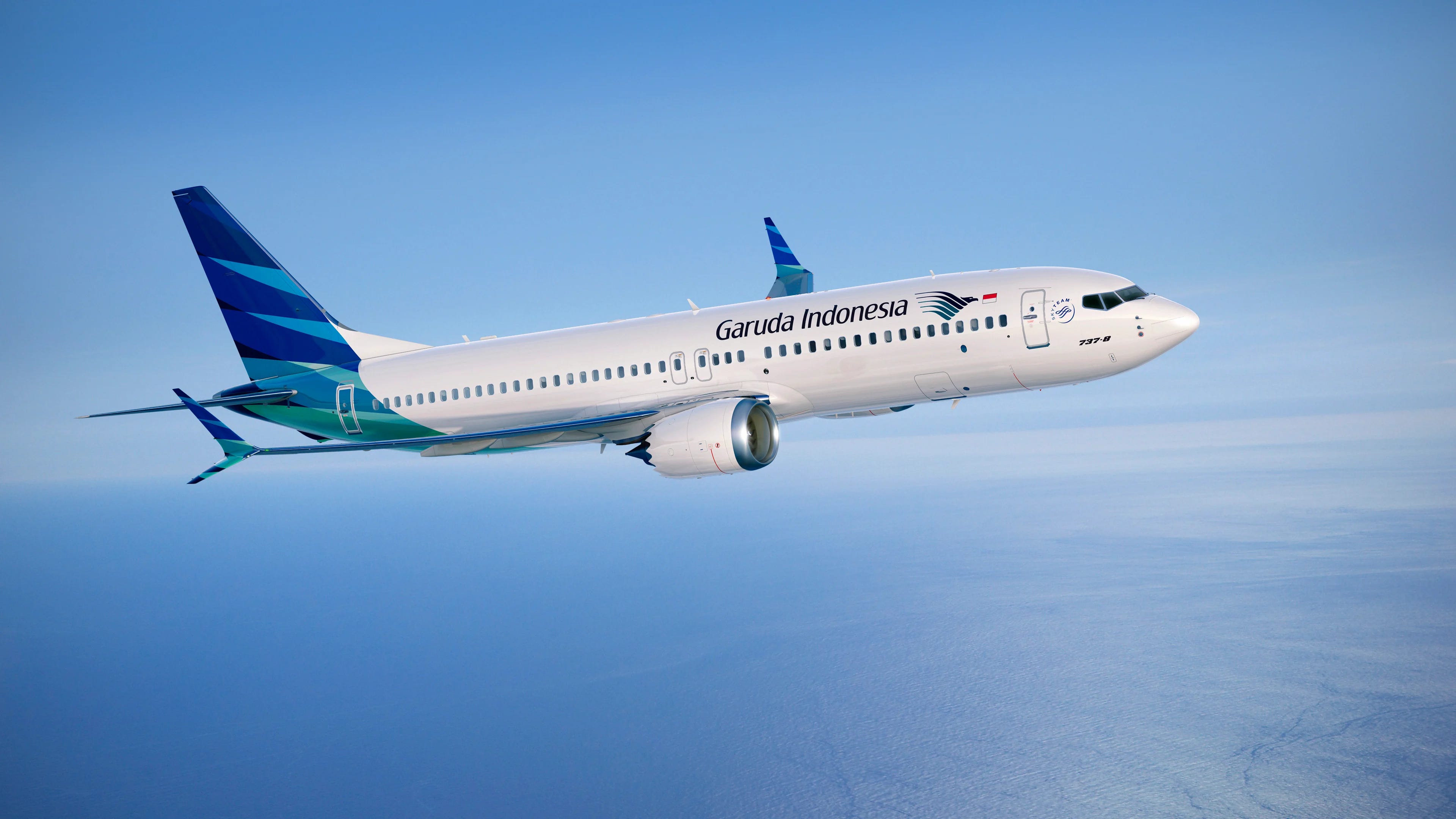
Throughout the year, I’ve plotted Indonesian flag carrier Garuda Indonesia’s flight trajectory by connecting the financial, legal, operational and political dots.
On 24 April, I flagged that Indonesian officials were discussing a potential capital infusion for Garuda, but this may have to be executed via sovereign fund Danantara to avoid a direct state injection. I also reported that the airline was forced to ground some planes due to a shortage of components.
I pointed out on 25 April that Garuda must plug its negative equity without tripping up its local in-court restructuring (PKPU) deal. This is because under Indonesian law, a borrower can be filed into bankruptcy by its creditor if it breaches their PKPU agreement.
On 24 June, Danantara announced that it would give a USD 405 million shareholder loan to Garuda after President Prabowo Subianto ordered a mission to save the national symbol. I also wrote that Danantara would rope in Garuda’s state-owned peers, including energy giant Pertamina, to take part in the airline’s rescue operation by converting debt into equity.
However, I noted that the state support must be paired with rebuilding access to third-party lenders or investors. I also unpacked Garuda’s results for the first half of 2025, which showed that the carrier was squeezed from all sides by aircraft leases and maintenance, widening its negative equity to USD 1.5 billion as of end-June.
Plugging the Gap
On 6 October, Garuda said it would conduct a USD 1.8 billion private placement, consisting of a USD 1.44 billion cash injection from Danantara and a conversion of the fund’s USD 405 million shareholder loan into equity. Garuda also reshuffled its management and decided to write off aircraft assets to clean up its balance sheet.
Barely a month later, however, the airline said in response to a stock exchange query that the injection from Danantara would be cut by USD 400 million and that it will drop a planned fleet expansion. Danantara’s Chief Operating Officer Dony Oskaria told reporters that the fund ultimately allocated USD 1.4 billion because Garuda “only needed that amount”.
The shift in the use of proceeds in favour of paying fuel debt owed by Garuda’s budget unit Citilink to Pertamina means that the airline may not be able to ramp up its fleet as fast as it wanted. I noted that while Indonesian SOEs are expected to support their troubled siblings, they may also seek to preserve their own liquidity or request a more equitable deal.
Apart from Pertamina, Garuda owed trade payables to other SOEs including airport operator Angkasa Pura and ground service provider Gapura Angkasa. Angkasa Pura is reportedly set to get a 64.33% stake in Garuda’s maintenance unit Garuda Maintenance Facility Aero Asia after an asset injection.
Garuda seems to be slicing and dicing its equity in return for the family support, but this may limit the room for the airline to obtain equity financing from third parties. While returning to positive equity is the first step towards attracting potential investors, Garuda may bleed again if it continues being weighed down by costly leases without improving its cashflow.
Renegotiating these legacy leases would have been a logical move, but I flagged seven months ago that Garuda is likely hamstrung by its own PKPU agreement. For now, the focus is optimizing Garuda’s operations, particularly reactivating its grounded planes by 2026, according to Danantara Managing Director Febriany Eddy.
Danantara is also pushing Garuda to renegotiate its global code-sharing agreements that are seen to favour its partners, Eddy reportedly said. The airline “should be smart” about entering alliances that would allow it to fly more international routes, she added.

Krakatau Steel
23 November 2025
On top of USD 500 million working capital, the company also plans to request up to USD 500 million from sovereign fund Danantara to support its restructuring.
The issue is that Danantara cannot print money to keep Krakatau and other ailing SOEs on perpetual life support.
Indonesian state-owned steel maker Krakatau Steel has parallels with the debt-laden textile companies that cling to a shrinking lifeline.
I wrote in early October that these manufacturers are heavily reliant on working capital to cover their cash conversion gap, which basically refers to the delay between collecting cash from customers and having to pay suppliers.
Working capital is like the blood that transports oxygen throughout the body, without which the system risks shutting down.
I noted that Krakatau’s net operating cash outflow widened sharply to USD 32.8 million in the first half of 2025 from USD 2.3 million a year earlier, mainly on higher payments to suppliers. Cash and equivalents fell to USD 63.6 million as of end-June, while short-term liabilities stood at USD 2.3 billion, of which USD 1.4 billion were current maturities of long-term loans.
To secure raw materials, Krakatau obtained third-party financing that carried higher rates than banking facilities and imposed restrictions on the company. In short, Krakatau had to borrow at exorbitant rates to finance normal operations, forcing it to appeal to its shareholder, Indonesian sovereign fund Danantara, for USD 500 million in working capital.
“They cannot borrow money like other companies anymore, not even for working capital,” Danantara Managing Director Febriany Eddy told reporters on 14 November, adding that the fund is finalizing the amount of working capital for Krakatau. She also noted that Krakatau’s poorly executed investment in a blast furnace had saddled it with “tremendous debt”.
Deep Haircut
In addition to the working capital, Krakatau also plans to ask for up to USD 500 million “in other forms” from Danantara to support its restructuring agreement with a group of banks.
Krakatau obtained written approval from four private banks on 30 September for a restructuring deal that will include an 80% “principal relief” for the company.
On the surface, the four private banks should receive around 20 cents on the dollar, representing a steep haircut that departed from the typical SOE restructuring method of rolling loans over 10-20 years. (Click here for Acrostics Anatomy on Indonesia’s SOE Circuit).
Why would the banks agree to such terms?
The additional USD 500 million that Krakatau would request from Danantara to back its restructuring may include a debt-to-equity conversion, upfront cash component or discounted debt buyback. In short, the banks may choose to take something in the near term, rather than wait 20 years for the dim prospects of getting back their full principal.
The issue is that Danantara cannot print money to keep Krakatau and other ailing SOEs on perpetual life support. I wrote earlier this week that the fund has launched a USD 1 billion-equivalent three-year loan into syndication, far below the USD 10 billion credit line that it was reported to have clinched four months ago. (Click here for my Danantara takes).
I also flagged the risk of a crowding out effect, as some lenders may prefer exposure to individual SOEs rather than the holding entity. If Danantara were in the market at the same time as Pertamina, for example, potential investors may pick the state-owned energy company because of its perceived strategic importance and longer track record in the international debt markets.
Nevertheless, investors have different portfolio allocations and some may want to build a relationship with Danantara given that the fund will likely be a repeat borrower.
Wijaya Karya
25 November 2025
Wijaya Karya was hit by a double whammy of infrastructure budget cuts and the snowballing debt incurred to build the Jakarta-Bandung high-speed rail.
Indonesian state-owned builders including Wijaya Karya are also preparing for a merger in the second half of 2026.
In Indonesia, there’s a phrase that says “sudah jatuh tertimpa tangga”, referring to a situation where a person fell off the ladder and then got squashed by the same ladder.
This analogy seems apt for Indonesian state-owned builder Wijaya Karya, which was hit by a double whammy of infrastructure budget cuts and the snowballing debt incurred to build the Jakarta-Bandung high-speed rail known as Whoosh.
Seven months ago, I flagged that Wijaya Karya was headed towards a second round of debt restructuring as President Prabowo Subianto abandoned his predecessor’s infrastructure drive. (Click here for a compilation of my takes on Indonesian state-owned builders).
The extent of Indonesia’s construction slowdown was laid bare in Wijaya Karya’s latest earnings presentation.
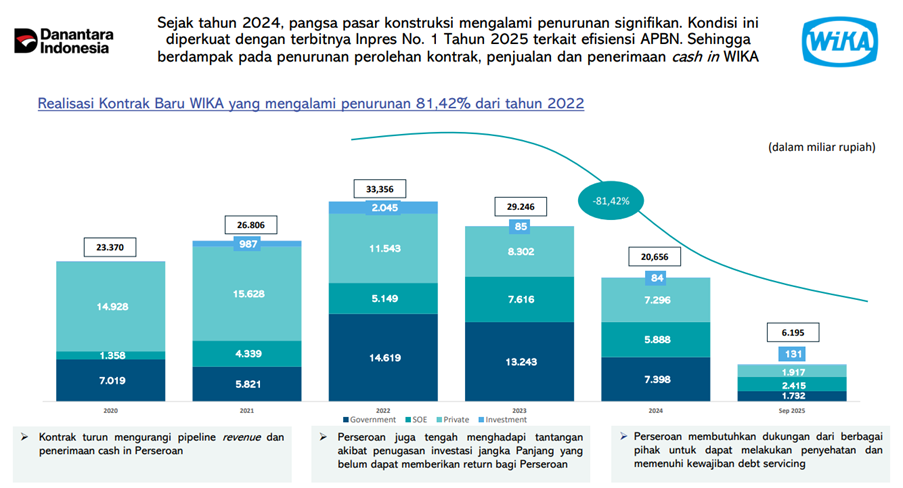
Wijaya Karya’s new realized contracts crashed 81.42% to IDR 6.2 trillion (USD 372 million) as of September 2025 from IDR 33.4 trillion in 2022. The government contributed only IDR 1.7 trillion of the total amount, a fraction of its lion’s share of IDR 14.6 trillion three years ago.
In short, Wijaya Karya used to rely on a stream of contracts from the government, but this has dried up drastically. “The company needs support from various parties to carry out a revitalization and to fulfill its debt servicing obligations,” according to its presentation.
Wijaya Karya plans to reduce its interest-bearing debt that hit around IDR 29 trillion (USD 1.7 billion) as of end-September, President Director Agung Budi Waskito told a briefing on 12 November. This consisted of IDR 19 trillion of bank loans and IDR 10 trillion of bonds.
In January 2024, Wijaya Karya’s banks reportedly agreed to roll over IDR 20.58 trillion of loans until as late as 2031. Barely a year later, the company was unable to repay IDR 1 trillion of local bonds that matured on 18 February 2025.
One of the problems is that Wijaya Karya only tackled the loans in its earlier restructuring without addressing the bonds, according to two friends familiar with the matter. The instruction to leave out the bonds went down the chain of command, as restructuring the public notes could have attracted unwanted attention at the time, one of these friends said.
Breaking Point
Even with the bond cracks, Wijaya Karya held its breath until it reached breaking point.
Net operating cash outflow widened to IDR 1 trillion (USD 60 million) in the nine months ended 30 September from IDR 218.9 billion a year earlier, while cash and equivalents plummeted to IDR 1.5 trillion from IDR 5.6 trillion, according to my analysis of its results.
Wijaya Karya is also a part of the Indonesia-China consortium that was beset with cost over-runs arising from the delayed construction of Whoosh. This escalated into a dispute, which is being processed at the Singapore International Arbitration Centre (SIAC), according to the company. (Click here for a compilation of my takes on Whoosh).
I noted last month that the new finance minister, Purbaya Yudhi Sadewa, insisted that Whoosh was the responsibility of Danantara, as dividends from state-owned enterprises now flow to the sovereign fund. However, President Prabowo Subianto has decided that the joint venture operating Whoosh, Kereta Cepat Indonesia China (KCIC), will receive state support after all.
The consortium is in advanced talks to restructure around IDR 85 trillion (USD 5.1 billion) of debt owed to China Development Bank (CDB), the Straits Times reported on 5 November. Based on the discussions so far, the Indonesian government will cover Whoosh’s infrastructure while Danantara is set to handle the operations.
In the meantime, Indonesian state-owned builders including Wijaya Karya are preparing for a merger in the second half of 2026. Wijaya Karya is hoping that the consolidation will improve its finances as it aims to pull off the “three pillars” of debt restructuring, asset sale, and tenders with more sustainable terms.