

📑 3 India Headlines #1
The most important headlines that international readers should pay attention to – and why they matter.


Asia is a diverse region, with different news consumption habits across the markets.
Based on feedback from friends, India stands out because the country is not constrained by a lack of information, but by an abundance of it.
I am therefore shortlisting the most important headlines that international readers should pay attention to – and why they matter.
This is the first India edition of Acrostics Asia’s 3 Headlines.
🔸 Sharp Decline in IBC Recoveries in 2025-26: ICRA
Recoveries against admitted claims under India’s Insolvency and Bankruptcy Code (IBC) halved to 23% in 2025-26 from 46% in 2024-25, according to local rating agency ICRA. The average resolution time worsened to 744 days as on 31 March 2026, from 713 days a year earlier, significantly exceeding the deadline set by the IBC.
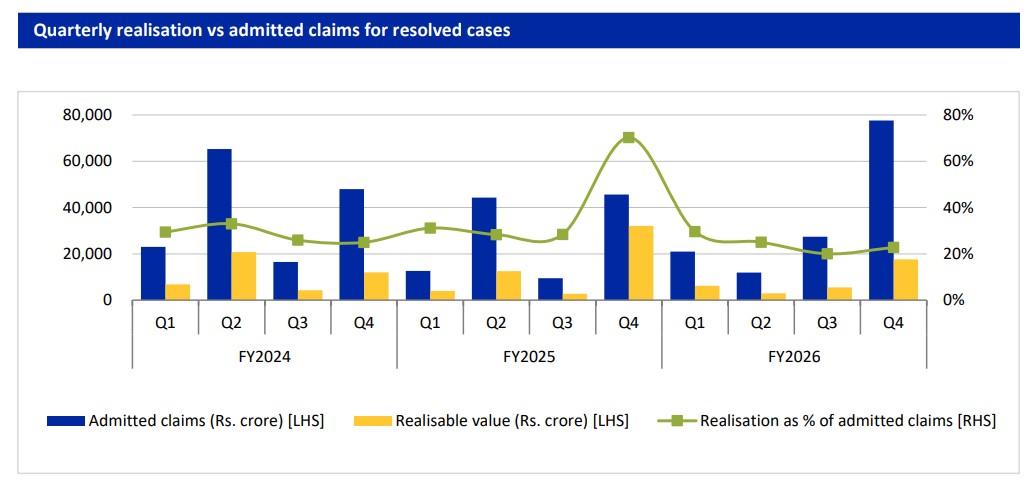
“The IBC, which completed 10 years in May 2026, continues to be plagued by long resolution timeframes, high haircuts for lenders and a sizeable share of liquidation cases,” Manushree Saggar, Senior Vice President and Group Head, Structured Finance Ratings, said in ICRA’s press release on 27 May.
For more reading:
IBC@10: Discipline of Letting Go by M.S. Sahoo and Raghav Pandey
🔸 India’s SP Group to Complete Dual-Tranche Debt Sale by Mid-June: Reuters
India’s Shapoorji Pallonji Group (SP Group) should complete its large fundraising plan by mid-June, ahead of a month-end deadline to refinance nearly USD 2.5 billion of debt, Reuters reported on 1 June, citing two sources familiar with the matter.
Eveline: The USD 1.5 billion-equivalent rupee tranche is reportedly set to yield 18.95% and its investors are mostly existing ones rolling over their exposure. I wrote on 8 May that some creditors that have built a sizeable exposure to SP Group wouldn’t want the conglomerate to default before they are at least partially repaid, so they may do their part to lengthen the bridge towards the potential monetization of its Tata Sons stake.
For more reading:
🔸 PwC Finds Accounting Lapses in IndusInd Treasury Operations: Economic Times
A PwC review of IndusInd Bank’s treasury operations found that manual accounting entries were used to offset trading losses, creating a receivable pool of more than INR 22 billion (USD 231.7 million) and overstating the bank’s profit and assets by INR 18.18 billion (USD 191.5 million), The Economic Times reported on 4 June.
Eveline: The glaring question is how did this go on for so long? Internally, the Indian bank lacks a direct link between its asset liability management desk, which manages balance sheet risks, and the trading desk, which executes market transactions, according to ET. PwC reportedly found that the treasury back office posted manual entries to offset losses incurred by the trading desk.
Acrostics Asia is an independent credit intelligence provider that connects the dots across Asian sovereigns, private credit and restructurings.